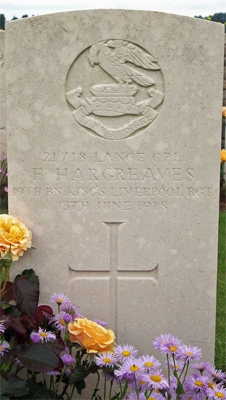
We have this soldier’s date of birth as 02nd April 1896, from German POW records. However, his birth was not registered until the June quarter of 1897, suggesting he was actually born on 02nd April 1897 and lied about his age when he enlisted in order to serve overseas. A baptism has not been found; his mother was Roman Catholic, and Fred later stated his religion as C of E.
Frederick, known as Fred, was the younger son of William Robert Hargreaves and his wife Teresa (née Carroll). His father, born in Liverpool, and his mother in County Dublin, married in 1889 and had five children. Fred had older siblings Elizabeth, born in 1889, William 1891, and Kathleen Isabella 1893, and a younger sister (Sarah) Josephine, born in 1902.
In 1901 the family is living at 109 Boaler Street. His father is a 35 year old whitesmith who was born in Liverpool, his mother is 33 years of age and was born in Ireland. They have four children declared in the household; Elizabeth aged 11, Wiilaim aged 9, Kathleen aged 7 and Frederick aged 4.
By 1911 they have moved to 46 Phoebe Ann Street, Everton. His father, 47, is still employed as a whitesmith, his mother is 45. William, 19, is a barber, Kathleen, 17, works in a tobacco factory, Frederick is 14 (the census was taken on 2nd April, his birthday). Fred is an apprentice blind maker, and Josephine, 8, is at school. His widowed grandmother, Elizabeth Carroll, 70, from Dublin, lives with them, as well as Isabell Jones, 29, widowed, listed as aunt, and her daughter, Mary, 7.
Fred enlisted in Liverpool on 11th November 1914 as Private 21718, joining the 19th (Pals) Battalion of The King’s Liverpool Regiment, giving his age as 19 years and 7 months. Even if he had been born in 1896, this would have made him 18 and a half years old. Taking his official birth registration as his true age, Fred would have been 17 and a half on enlistment. He gives his occupation as upholsterer. He was described as being 5’ 6” tall, weighing 118 lbs, with a sallow complexion, blue eyes, and brown hair. He stated his religion as Church of England and his mother as next of kin, at 49 Mansell Road.
He was initially billeted in the hutted accommodation at Lord Derby’s estate at Knowsley Hall. On 30th April 1915 the 19th Battalion alongside the other three Pals battalions left Liverpool via Prescot Station for further training at Belton Park, Grantham. Whilst at Belton Park, on 24th August 1915 he was confined to barracks for 4 days for leaving the rifle range without permission. The battalion moved to Larkhill Camp on Salisbury Plain for final infantry training in September. At Larkhill he was “remanded for C.O.”, confined to barracks for 10 days for overstaying pass 68 hours, and forfeited 4 days’ pay.
Fred shipped to France with his battalion from Folkestone, disembarking at Boulogne on 07th November 1915.
On the first day of the Battle of the Somme, 01st July 1916, during the attack at Montauban, Fred suffered a neck wound and was admitted to 96th Field Ambulance, to 5th then 45th Casualty Clearing Station, and admitted to 2nd General Hospital at Le Havre on the 5th, then posted to 24th Infantry Base Depot at Etaples on the 8th. He was posted to the 20th Bn K.L.R. on 15th July but a few days later reposted to the 19th.
He was granted his Good Conduct Badge on 25th November 1916
07/02/1917 Attended Lewis Gun school
19/02/1917 Rejoined unit
Granted leave to UK, rejoined unit 28/8/1917
07/11/1917 Appointed unpaid L/Cpl
He served in ‘B’ Company, 7th Platoon as Lewis Gunner
The German Spring Offensive, “Operation Michael”, began on 21st March 1918 on the 5th Army front. The three Pals battalions of the 89th Brigade are in Corps reserve. At 5 a.m. they receive orders to man battle stations. The 19th moves forward to prepare to counter attack at Roupy the next day. On the 22nd at Roupy the battalion suffers heavy casualties and is pushed back to Stanley Redoubt, and the few survivors eventually retire to Ham.
Fred was initially declared Missing between 22nd - 30th March 1918.
His name was published in the list of Missing in the Weekly Casualty List on 4th June 1918.
His mother, at 49 Mansell Road, contacted the International Red Cross but was notified in a reply dated 15th April 1918 that they held no information on Fred.
We can imagine his mother’s relief when she learned her son was alive. In the Liverpool Echo “Missing” column on 24th June 1918:
“Mrs. Hargreaves, 49 Mansell Road, Liverpool, has received news that her son, Lance-Corporal Fred Hargreaves, K.L.R., missing since March 21, is a prisoner in Germany, and well.”
According to the German POW records held by the International Red Cross, Fred was captured at St. Quentin on 22nd March 1918. German records list him at Stendhal camp, where he died of heart failure at 2 p.m. in War Hospital 21.B at Stendhal. However, prisoners were often listed officially at a POW camp but in many cases never set foot in Germany. Stendhal is 450 miles from the front.
He was buried by the Germans in Grave no.462, Bohain Station Military Cemetery. This cemetery is 20 miles northeast of St. Quentin. His burial place makes it very clear he died while being used as slave labour for the German army behind the lines, and died of malnutrition, exhaustion, and mistreatment, resulting in heart failure.
Richard Van Emden, in his book,“Prisoners of the Kaiser” writes:
"The use of prisoners at the front became vital to the German war effort so that all available forces could be directed to, and maintained at, the front during the campaign. This over-riding aim ensured that the number of British prisoners employed at the front rose dramatically after the Spring offensive of 1918. Not only were thousands of prisoners captured in the first weeks of the offensive kept in France but other prisoners, already living in camps in Germany, were transferred back to the Western Front.”
His family was notified of his death on 24th October 1918. The pension cards, giving cause of death as “cardiac weakness” and “disease”, show that his mother was awarded a pension, amount not specified.
After the war, his grave was identified by a cross (“& paper found in bottle”). His body was removed and reinterred in nearby Premont British Cemetery, where he now rests.
Premont village was captured by the 30th American Division on the 8th October 1918. Premont British Cemetery was made and used by four Casualty Clearing Stations (the 20th, 50th, 55th and 61st), which came to Bohain in October 1918, and it was closed in the following December. Some years later 165 graves were added to it from the following sites:-
BOHAIN STATION MILITARY CEMETERY, which was on the West side of the cross-road immediately West of Bohain railway station. It was made by the German forces, but one plot of 47 graves was added by the 11th Essex and other British units in October 1918. It contained in all 806 German graves, 155 British, 14 Russian, 12 French, one Italian and one Romanian.
SEBONCOURT COMMUNAL CEMETERY, which contained the graves of six soldiers from the United Kingdom buried by German forces in January, March and April 1918.
Four from a site near Honnechy.
This cemetery contains the graves of 536 Commonwealth casualties of the First World War, eight of which are unidentified. There are also 36 German casualties buried here, two of which are unidentified.
The cemetery was designed by Charles Holden.
Fred earned his three medals, which his mother signed for in 1919 and 1921. She received a War Gratuity of £21. Fred’s Army effects were shared between his mother, sisters Josephine, Mrs. Kathleen Thomas, Mrs. Elizabeth Burrows, and brother William (serving in the Army).
His mother died 1931 aged 64.
Sadly, Fred has not been found on any memorial.
We currently have no further information on Frederick Hargreaves. If you have or know someone who may be able to add to the history of this soldier, please contact us.