
1885 - 1916

CPL David Wallace Crawford
1887 - 1916

Lce-Corpl John Joseph Nickle
1894 - 1916

Pte 17911 Morton Neill
1897 - 1916

Lieut Edward Stanley Ashcroft
1883 - 1918

Pte 22120 Charles Henry Housden
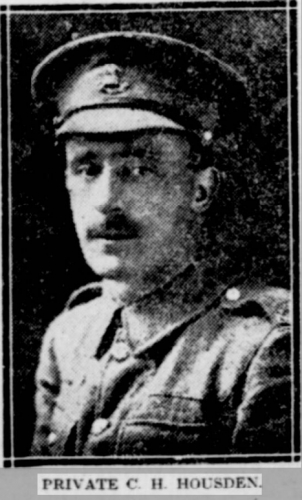
- Age: 34
- From: Liverpool
- Regiment: The King's (Liverpool Regiment) 20th Btn
- K.I.A Tuesday 7th March 1916
- Commemorated at: Cerisy-gailly Mil Cem
Panel Ref: II.D.27
Charles Henry Housden was born in 1881 in Liverpool, the second son of William Jones Housden, a printer/stationer born in Great Chesterford, Saffron Walden, and his wife, Alice (née Kirby) born in Liverpool. They married on the 23rd December 1876 at St Titus' Church, Portland Street. William was a stationer of 239 Burlington Street, father James a tailor and draper, whilst Alice gave the same address, father Thomas a licensed victualler.
He lived in 1891 at 61 Queens Road, Everton, the family were sufficiently well-off to have a servant. His father, William, is aged 38, a stationer, his mother, Alice, is aged 35, children Thomas aged 13, William J. 11, and Charles H. 10. Also present are William’s sisters, Elizabeth 44 and Esther 40.
In 1901, still at 61 Queens Road, his father, William, is aged 48, a printer and stationer, his mother, Alice, is aged 46, Charles worked as a ‘shorthand clerk’ while his elder brother, Thomas, was a ‘telegraphist’.
By 1911 the family have moved to 4 Ellel Grove, Rocky Lane, Liverpool. His father, William, is aged 58, a stationer, his mother, Alice, is aged 56. They advised that they have been married for married 34 years and have had 3 children. There are two children declared in the household; Thomas is a 32 year old Post Office sorting clerk & telegraphist, Charles is a 30 year old clerk with Liverpool Corporation. Also present is William’s sister Esther aged 60.
Prior to the outbreak of the war Charles had been employed by Liverpool Corporation Tramways Committee.
On 11th November 1914, Charles enlisted at Liverpool, joining the 20th Battalion as Private 22120, giving his age as 33 years 6 months - quite old for a volunteer - and his occupation as clerk. He was described as being five feet six inches tall, weighed 130lbs, 35" chest, fresh complexion, hazel eyes and light brown hair. He stated his religion as Wesleyan and his next of kin was his father William Jones Housden, of 4 Ellel Grove.
Formed in November 1914 the 20th Battalion were originally billeted at Tournament Hall, Knotty Ash before on 29th January 1915 they moved to the hutted accommodation purposely built at Lord Derby’s estate at Knowsley Hall. On 30th April 1915 the 20th Battalion alongside the other three Pals battalions left Liverpool via Prescot Station for further training at Belton Park, Grantham. They remained here until September 1915 when they reached Larkhill Camp on Salisbury Plain.
He arrived in France on the 07th November 1915.
He was a Mason and was a member of the King's Lodge No.3101. He was initiated on 25th May 1915 and passed on 24th September 1915.
His service was acknowledged in the Liverpool Weekly Courier on Saturday 12 February 1916:
BATTLE STORIES. WITH THE PALS. 4th BATTALION IN HEAVY BOMBARDMENT.
Writing from the front to his brother, and commenting on the reports just to hand of meetings held by the opposers of the Military Service Bill, Private Charles H. Housden, of the 20th Liverpools (4th Pals), says:— It is rather pathetic, writing from the trench at 1 a.m. now, to find people at home opposing the military bill. They ought to hold their meetings here in the trench or its vicinity. They would soon find out whether the bill was necessary. Having plenty to eat, getting sleep, living in comparative luxury, they have the effrontery to handicap these who are making great sacrifices out here. After all, voluntaryism, as a principle, has gone by the board during the war. Referring to events nearer to himself, Private Housden says:— We have been in the trenches double the usual time on this occasion owing to heavy bombardment of the village close to where we quarter, upsetting relief arrangements. It is stated that this was one of the biggest bombardments of the war. No great damage, though. That day I was on the most advanced post we had, about 40 yards from the Germans! The shells all passed over into the village. I am on “listening” post to-night throughout the night.
Charles Henry was killed in action by a German shell which also killed his comrade John Francis Bowler on 07th March 1916, he was aged 34.
He was originally buried at Maricourt Military Cemetery which was at the South-East corner of the village, 10 kilometers south-west of Albert. It was begun by French troops in December 1914, and was known by the name Ferme Caudron. It was taken over by British troops in August, 1915, and used until July 1916. It contained the graves of 887 French, 260 U.K, and 6 German soldiers.
After the war, when graves were concentrated, the burials from this cemetery and other small cemeteries were reinterred in Cerisy-Gailly Military Cemetery, where John now rests, his headstone bears the epitaph:
"LORD LEAD US UPWARD TO HIS GOAL THE PURE THE TRUE THE BEST"
Gailly was the site of the 39th and 13th Casualty Clearing Stations during the early part of 1917, and of the 41st Stationary Hospital from May 1917 to March 1918. The villages were then captured by the Germans, but were retaken by the Australian Corps in August 1918. Cerisy-Gailly Military Cemetery (originally called the New French Military Cemetery) was begun in February 1917 and used by medical units until March 1918. After the recapture of the village it was used by Australian units. The cemetery was increased after the Armistice when graves were brought in from the battlefields of the Somme. The cemetery now contains 745 Commonwealth burials and commemorations of the First World War. 114 of the burials are unidentified and special memorials commemorate five casualties buried at Maricourt and Ste. Helene whose graves could not be found.
The cemetery was designed by Sir Edwin Lutyens.
A newspaper report gives information on the death of Private Bowler and Charles Henry Housden.
The Rev M. Linton Smith, hon. canon of Liverpool, and senior chaplain of the 30th Division, B.E.F., has written to Mr. Bowler, 95 Hughes Street, Liverpool, concerning the death of his son, Private John Francis Bowler, of the 4th "Pals" who was killed by the same shell that killed his comrade, Private Housden. The rev. gentleman writing under date March 9, says that the Germans shelled heavily for some time on the Tuesday evening previous, a section of the trenches.The first shell caught some of the men as they were outside their dugout cleaning their rifles. "Your son and another were killed instantaneously, and seven others were wounded none of them, I am thankful to say, seriously. Your son can have suffered no pain, he was dead before his company commander, Major Watson, who was only a few yards away, could get to the spot, and in your consolation you have at least that slight consolation." The chaplain proceeds : "He and his comrade, Private Housden were laid to rest in the little cemetery behind the trenches, of which I send you a small photograph, yesterday afternoon. It was a bright fine day, and a number of his friends gathered round for the service to show their respect. The graves are close to the two crosses prominent in the photograph, which also mark the graves of men of the 20th battalion and similar crosses will be erected in a day or two for your son and his fellow. The cemetery is well looked after, and at the close of the war will become the property of the British Government".
Further reports on his death were reported:
"ONE OF THE "PALS"
Private Charles Henry Housden, of the 20th Liverpool (4th City Battalion), who has been killed instantaneously by a German shell. He was in the employ of the Liverpool Corporation Tramways Committee up to the time of his enlistment in November, 1914. He was the son of Mr. and Mrs. W.J.Housden, 4, Ellel Grove, Liverpool, to whom much sympathy is extended in their bereavement.
Charles’s death was also reported in the Liverpool Echo dated 13th March 1916:
MORE “PALS” KILLED
Information has been received in Liverpool that two of the “Pals” have been killed at the front. One of the victims was Private Charles Housden son of Mr & Mrs Housden of Ellel Grove, Rocky Lane. The shell that killed him killed another “Pal” and wounded about a dozen more. Housden was in the tramway service while doing civil duties before the war.
His death was also reported in the Liverpool Weekly Courier on Saturday 18 March 1916:
"ONE OF THE “PALS.”
News has been received in Liverpool that the Germans have been shelling the Liverpool Pals,” and one missile exploded killing two men and wounding 12. One of the killed is Private Charles Henry Housden, son of Mr and Mrs W. J. Housden of 4 Ellel Grove, who was in the employee of the Liverpool Corporation Tramways Committee. The news was received of Private Housden’s death by his parents was the Rev. Linton Smith, senior chaplain with the 20th Liverpools (4th City Battalion). He was instantaneously killed by a shell on Tuesday week and was laid to rest in the little cemetery behind the village, a number of his comrades gathering around to pay their respects. Private Housden enlisted in November 1914 and went to the front last November. Throughout the campaign he has proved himself a good soldier. Possessed a magnificent physique for an indoor worker, he was always “at home” out of doors, and besides being an excellent tennis player, he was a good swimmer and footballer. He travelled extensively and was a prolific walker, and in addition to climbing the Swiss and Italian Alps, he made an extensive tour over the Austrian Tyrol on foot. When the war broke out he was at Namur and had to struggle to get away from Ostend. He held a teacher's diploma in the Incorporated Photographic Society, and was an associate of the Incorporated Society of Shorthand Teachers. He spoke French fluently and possessed numerous certificates in that language. He was a member of the King’s Lodge of Freemasons, number 3101, of which body his eldest brother is at present Master. He was 33 years of age and his father, who is highly respected, has been employed in the “Liverpool Courier” stationery department for 38 years. The parents of Private C. H. Housden have received tributes to their late son both from the major of the company and the lieutenant of the Platoon in which he served. Major Watson, company commander, writes:- “He had been in my company from the start, and by this quiet manner and steady work set an example to everyone. I understand that his last act was to share a parcel just received from his friends. Lieutenant Small, of the same platoon, in his letter says:- “I recognized him as one of the most reliable men. He was admired by his mates, trusted by his officers, and died the best death a soldier can die.”
His death was also reported in the Liverpool Weekly Courier on Saturday 08 April 1916:
BOMBING ATTACK REPULSED.
A LIVERPOOL PAL'S EXPERIENCE
Writing from “Somewhere in France” to a friend, a well known Liverpool “Pal” states :— “I can quite understand the position of things at home, and the grouping system must cause a good deal of trouble, although some of the reports in the papers are really frivolous and amusing. To be quite candid I do not think there will be any necessity for this gathering in. The news from all districts is very satisfactory. We have had a rough time in this district, and, considering the isolated position we have had to hold, I suppose we must consider the battalion very fortunate we have not had more casualties. My company have occupied the trenches at the head of a salient with an advanced post running out to within 40 yards of the enemy, and the first night had to repel a bombing attack, which was successfully repulsed with only six casualties, one fatal “This experience seemed to stimulate the company, and although we have had the place blown in several times it is still as good as ever and fulfilling the purpose it was out for. This was the place where C. Housden was killed just before evening stand to.” After describing the work the men have to do when at “rest” the writer proceeds:— “Still on the whole it is a healthy life. The food is good, not always sufficient, but considering the conditions of transport it is wonderful how it is done.”
His Service File shows that his effects were to be sent to Thomas Kirby Housden, his brother, via Messrs Richardson Marsh & Co, solicitors, of 9 Cook Street, Liverpool.
On 13th March, his father sent a telegram to the Army Records Office at Preston stating that it had been reported by a Chaplain that their son had been killed “on Tuesday last - wire immediately if confirmed as no word from War Office”.
Although his effects were received, Thomas wrote again in 1920 showing some impatience at the fact that the family had not yet received the scroll and memorial plaque and was reassured that there was a backlog and it would be sent as soon as ready.
Personal items returned included:- disc, 4 letters, cigarette lighter, comb, 2 photos. Charles earned his three medals.
His brother Thomas received Charles’ Army Pay of £6 13s 1d (plus 7s 3d later) and £5 War Gratuity. A Pension of 4/- pw was awarded to his mother Alice.
Probate was granted to his brother Thomas Kirby Housden 1916:
HOUSDEN Charles Henry of 4 Ellel Grove Liverpool private 20th Battalion King’s Liverpool regiment died 7 March 1916 in France Probate Liverpool 10 April to Thomas Kirby Housden telegraphist. Effects £283 5s 10d.
He was remembered by his family in the Liverpool Weekly Courier on Saturday 13 March 1920:
HOUSDEN- In sad and loving memory of Charles Henry Housden, Private, K.L.R., dearly-beloved youngest son of Mr. and Mrs. W. J. Housden, 4, Ellel-grove, and late Liverpool Corporation (Tramways Department), killed in action on Tuesday, , March 7, 1916, and laid to rest in the British Cemetery, Maricourt, France. We know the travail of his soul, We thank Thee for his rest; Lord, lead us upward to his goal - The pure, the true, the best ! - Father, mother, and brothers.
On the 1921 Census at 4 Ellel Grove his father is now shown as William Jones Housden aged 68, Alice is aged 66, and son Thomas K. aged 43.
His father, died aged 74, on the Wirral in 1927.
Probate to his brother Thomas Kirby Housden £283.5.10d
Charles is also commemorated on the following Memorials:
Hall of Remembrance, Liverpool Town Hall, Panel 55 Left
Liverpool Masonic Hall.Page 126 of the Masonic Roll of Honour Book 1914-1918.
His mother died on 06th December 1936, aged 81.
Her death was reported in the Liverpool Daily Post on Tuesday 08 December 1936:
HOUSDEN— December 6, suddenly at the Post Office, Hightown, ALICE, dearly-loved wife of late William J. Housden, devoted mother of Tom, and loving grandmother of Olive. Interment at Anfield Cemetery, to-day (Tuesday) at 2 p.m. (Friends please accept this—the only— intimation.)
We currently have no further information on Charles Henry Housden. If you have or know someone who may be able to add to the history of this soldier, please contact us.
Killed On This Day.
(110 Years this day)Monday 1st May 1916.
L/Sgt 15959 Neville Brookes Fogg
32 years old
(109 Years this day)
Tuesday 1st May 1917.
Pte 33195 George Allen
30 years old
(109 Years this day)
Tuesday 1st May 1917.
L/Cpl 17823 Harry Cuthbert Fletcher
27 years old
(108 Years this day)
Wednesday 1st May 1918.
Pte 300188 Albert Charles Bausor
31 years old
(108 Years this day)
Wednesday 1st May 1918.
Pte 64776 Gerald Blank
20 years old
(108 Years this day)
Wednesday 1st May 1918.
Sgt 57831 Leonard Conolly
25 years old
(108 Years this day)
Wednesday 1st May 1918.
L/Cpl 94253 Ernest Firth
22 years old
(108 Years this day)
Wednesday 1st May 1918.
Pte 49533 Henry Rigby
32 years old
(108 Years this day)
Wednesday 1st May 1918.
Pte 17721 Charles Henry Squirrell
26 years old
(107 Years this day)
Thursday 1st May 1919.
Pte 91536 John Alfred Croft Kelly
26 years old