
1885 - 1916

CPL David Wallace Crawford
1887 - 1916

Lce-Corpl John Joseph Nickle
1894 - 1916

Pte 17911 Morton Neill
1897 - 1916

Lieut Edward Stanley Ashcroft
1883 - 1918

L/Cpl 17630 Harold Johnston
- Age: 24
- From: Liverpool
- Regiment: The King's (Liverpool Regiment) 19th Btn
- K.I.A Sunday 30th July 1916
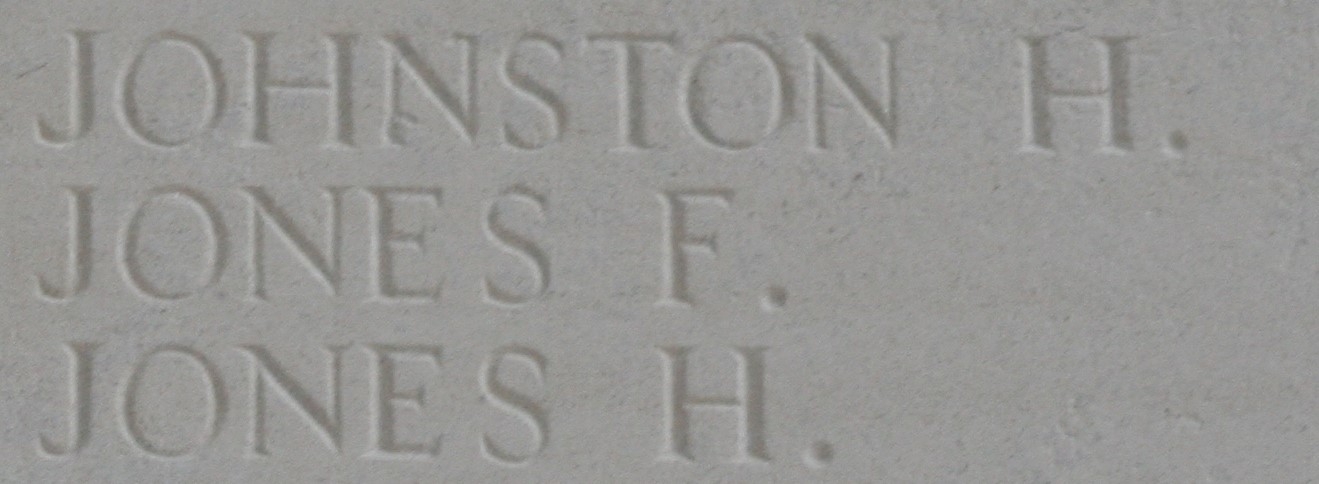
- Commemorated at: Thiepval Memorial
Panel Ref: P&F1D8B &8 C.
Harold Johnston was born in Liverpool on the 09th December 1891, the son of William Henry Johnston and his wife Margaret Ann (nee Eccleston) who married in December 1882 in Liverpool. Harold was the fifth of six children; he had older siblings John Henry, Florence, William Eccleston (who died at age 1), Margaret Alice, and a younger sister Beatrice.
Before Harold’s birth, on the 1891 census, the family lived at 19 Barry Street, Kirkdale. His father was listed as a general labourer, 33, born in Liverpool.
Harold’s father William died aged only 43, just before the 1901 census was taken and was buried the day after the census date. The census form lists Margaret as aged 41 and a widow living at 2 Peter Road, Walton, Liverpool with her children John who was 17 and a telegraph operator, Florence aged 15, Margaret 11, Harold 9 and 6 year old Beatrice.
Harold’s sister Florence married in 1909.
The family are living at 11 Breeze Hill by the time of the 1911 Census. Widowed Margaret, now aged 50, is an agent for a clothing club, is with four of her five children: John, 27, who was working as a telegraphist, Margaret, 21, who was a typist and shorthand clerk, Harold, 19, who was a clerk for a West African merchant and Beatrice, 16. Also present is her unmarried sister Alice Eccleston aged 63, who is a retired school cook.
Harold enlisted on the 11th September 1914 at Liverpool, joining the 19th Battalion of The King’s Liverpool Regiment as Private 17630. He gave his age as 22 years and 270 days and his occupation as a clerk. He was five feet seven and three quarter inches tall, weighed 123 lbs, 35" chest with a fresh complexion, grey eyes and light brown hair. He stated his religion as Wesleyan. His description page notes under distinctive marks: yellow stain on right ankle. He gave as next of kin his mother at 63 Stuart Road, Walton.
Formed on 7th September 1914 the 19th Battalion trained locally at Sefton Park and remained living at home or in rented accommodation until November 1914. They then moved to the hutted accommodation at Lord Derby’s estate at Knowsley Hall. On 30th April 1915 the 19th Battalion alongside the other three Pals battalions left Liverpool via Prescot Station for further training at Belton Park, Grantham.
30.8.15: Appointed unpaid Lance-Corporal.
7.11.15: Embarked for France from Folkestone with his battalion.
25.4.16: Sick to 55 Field Ambulance and admitted not yet diagnosed.
3.5.16: Discharged back to unit.
13.7.16: Appointed paid Lance Corporal.
Harold was killed in action on the 30th July 1916, aged 24, at the village of Guillemont, France, during the Somme Offensive.
19th Battalion Diary 30th July 1916
MALTZ HORN FARM
BATTLE begun. ZERO hour 4:45 am. The Battalion reached its objective, but suffered heavy losses, and had to evacuate its position owing to no reinforcements.
Everard Wyrall gives details of the attack in his book The History of The King’s Regiment;
"The 2nd Attack on Guillemont- 29th July 1916 the 89th Brigade the 20th King's were to attack on the right and the 19th on the left. During the evening of the 29th the night was dark and foggy when the Battalions moved off and the 19th with Lt Col G Rollo commanding, when passing the South east of the Briqueterie they were heavily shelled first with H E and then with a new kind of asphyxiating Gas shell which had curious results, at first it had no nasty effect but about 8 hrs later men began to fall sick with violent headaches and pains in the stomach. All ranks had to wear gas masks which in the darkness and mist made the going terribly difficult. It was indeed wonderful that they were able to reach their Assembly point at all. But they did and by 2.45 a.m. on the 30th July 1916 the Btn was assembled having suffered about 30 Casualties on the way up ready for the Zero hour at 4.45 a.m.
It is known that the two left Companies of the 19th under Capt. Dodd and Capt. Nicholson advanced in touch with the 2nd Royal Scots Fusiliers on their left although they suffered many casualties from Machine gun Fire did not encounter many Germans and reached their final objective about the time allocated, beginning at once to dig in south of the orchard on the South east corner of Guillemont.
On the left of the 19th the Scots Fusiliers most gallantly forced their way through Guillemont to the eastern side of the village but were soon overwhelmed by the enemy and few returned.
At 8 a.m. finding that the village was not held the two left Companies of the 19th received no word from the rear or either flank believed themselves to be totally isolated so were forced to fall back and dig in, their position being untenable.
At midday the effective fighting strength of the 19th Btn was just 7 Officers and 43 other ranks"
When darkness fell on the battlefield the 30th Division held a line from the railway on the eastern side of Trones Wood , southwards and including Arrow Head Copse, to east of Maltz Horn Farm. On this line the division was relieved by the 55th Division during the early hours of the 31st July.
Casualties in the 19th Battalion were 11 Officers and 435 Other Ranks
The events of 30th July 1916 were regarded at the time as Liverpool’s blackest day. There follows an extract from The History of the 89th Brigade written by Brigadier General Ferdinand Stanley which gives an indication of the events of the day.
Guillemont
Well the hour to advance came, and of all bad luck in the world it was a thick fog; so thick that you couldn’t see more than about ten yards. It was next to impossible to delay the attack – it was much too big an operation- so forward they had to go. It will give some idea when I say that on one flank we had to go 1,750 yards over big rolling country. Everyone knows what it is like to cross enclosed country which you know really well in a fog and how easy it is to lose your way. Therefore, imagine these rolling hills, with no landmarks and absolutely unknown to anyone. Is it surprising that people lost their way and lost touch with those next to them? As a matter of fact, it was wonderful the way in which many men found their way right to the place we wanted to get to. But as a connected attack it was impossible.
The fog was intense it was practically impossible to keep direction and parties got split up. Owing to the heavy shelling all the Bosches had left their main trenches and were lying out in the open with snipers and machine guns in shell holes, so of course our fellows were the most easy prey.
It is so awfully sad now going about and finding so many splendid fellows gone.
Harold was initially declared Missing, his name appearing in the list of K.L.R. casualties on 18th September 1916.
Missing.
King’s(Liverpool Regiment) - Johnston, 17639, L.-Cpl. H.;
His death was later presumed, for official purposes, as having occurred on that date.
Harold's body was not recovered or was subsequently lost as he has no known grave and is commemorated on the Thiepval Memorial to the Missing of the Somme.
The Thiepval Memorial, the Memorial to the Missing of the Somme, bears the names of more than 72,000 officers and men of the United Kingdom and South African forces who died in the Somme sector before 20 March 1918 and have no known grave. Over 90% of those commemorated died between July and November 1916.
On 01st August 1932 the Prince of Wales and the President of France inaugurated the Thiepval Memorial in Picardy. The inscription reads: “Here are recorded the names of officers and men of the British Armies who fell on the Somme battlefields between July 1915 and March 1918 but to whom the fortune of war denied the known and honoured burial given to their comrades in death.”
He earned his three medals.
His Army pay and a War Gratuity of £8-10s went to his mother, who was awarded a pension of 7/- a week from May 1917, increased to 10/-, and reverted to 8/5d in 1921.
In the Liverpool Echo, on 30th July 1917 under the heading Lost At The Battle of Guillemont, a friend paid tribute to Harold:
“In affectionate memory of Lance-Corporal Harold Johnston (19th King’s), missing (presumed killed in action) July 30, 1916. (Sadly missed by his Friend Eddie.)”
On the second anniversary of his death in 1918, In Memoriam notices were placed in the local newspaper:
“Johnston - In loving memory of Harold, killed in action July 30, 1916, aged 24 years. (“Till we meet.”) - Fondly remembered by Mother and Sisters, 63 Stuart Road.”
“In fond remembrance of Lance-Corporal H. Johnston (Harold), killed in action July 30, 1916. (“To memory ever dear.”) - Kitty.”
His brother John, a Post Office telegraphist, enlisted in December 1915 under the Derby scheme in the Royal Engineers. Married with three children, John was called up in August 1916 and served in the Signals section as a telegraphist. He embarked for East Africa in May 1917, was hospitalised with multiple bouts of malaria, including in Dar Es Salaam and Nairobi, and in February 1919 embarked for England for demobilisation.
Later in 1919 his mother was living at 63 Stuart Road with Margaret, 29, and Beatrice, 25. Married sister Florence Burns, 33, lived in Bank Street, Glazebrook, near Warrington, and John, 35, was in Haggerston Road, Walton.
His service medals were sent to his mother in October 1922.
Harold is commemorated on the following Memorials;
Liverpool’s Hall of Remembrance, Panel 66.
County Road Methodist Church in Walton, which was formerly a Wesleyan Church, a faith which Harold declared on his enlistment.
On the 1939 Register at 63 Stuart Road his mother Margaret, dob 27th April 1859, is living with daughter Margaret Alice. She died, aged 82, in 1942.
We currently have no further information on Harold Johnston. If you have or know someone who may be able to add to the history of this soldier, please contact us.
Killed On This Day.
(110 Years this day)Monday 1st May 1916.
L/Sgt 15959 Neville Brookes Fogg
32 years old
(109 Years this day)
Tuesday 1st May 1917.
Pte 33195 George Allen
30 years old
(109 Years this day)
Tuesday 1st May 1917.
L/Cpl 17823 Harry Cuthbert Fletcher
27 years old
(108 Years this day)
Wednesday 1st May 1918.
Pte 300188 Albert Charles Bausor
31 years old
(108 Years this day)
Wednesday 1st May 1918.
Pte 64776 Gerald Blank
20 years old
(108 Years this day)
Wednesday 1st May 1918.
Sgt 57831 Leonard Conolly
25 years old
(108 Years this day)
Wednesday 1st May 1918.
L/Cpl 94253 Ernest Firth
22 years old
(108 Years this day)
Wednesday 1st May 1918.
Pte 49533 Henry Rigby
32 years old
(108 Years this day)
Wednesday 1st May 1918.
Pte 17721 Charles Henry Squirrell
26 years old
(107 Years this day)
Thursday 1st May 1919.
Pte 91536 John Alfred Croft Kelly
26 years old