
1885 - 1916

CPL David Wallace Crawford
1887 - 1916

Lce-Corpl John Joseph Nickle
1894 - 1916

Pte 17911 Morton Neill
1897 - 1916

Lieut Edward Stanley Ashcroft
1883 - 1918

Pte 51746 William Duncan Johnston
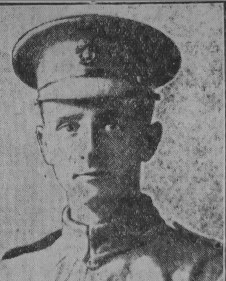
- Age: 20
- From: Liverpool
- Regiment: The King's (Liverpool Regiment) 20th Btn
- K.I.A Monday 9th April 1917
- Commemorated at: Henin Crucifix Cem
Panel Ref: A.40
William Duncan Johnston was born in 1896 in Liverpool and was baptised 30th September 1896 at St Augustine's Church, Everton, father’s address 513 West Derby Road. He was the son of Robert James Johnston and his wife Henrietta (nee Wilson) who were married on the 27th November 1887 at St James' Church, West Derby. Robert was a 33 year old commercial traveller of 7 Thurnham Street, father James, whilst Henrietta was aged 24 of 119 Townsend Lane.
The 1901 Census shows William aged 4 living at 10 Shiel Road, Liverpool with his parents and 6 siblings. His father is 46 years of age, a wholesale cabinet maker and born in Liverpool whilst his mother is 37 years old and born in Valparaiso, Chile but advises that she is a British subject. His siblings, all born in Liverpool are listed as; Constance aged 11, Agnes M. aged 10, Blanche aged 9, Robert L. aged 5, Dorothy aged 3 and new born Eric. Also present is Constance Wilson the sister of Henrietta and also born in Valparaiso.
His father died on the 09th November 1902 and was buried at Anfield Cemetery on the 12th.
Probate 1902:-
JOHNSTON Robert James of 74 Shiel Road, Liverpool commercial traveller died 9 November 1902 Administration (with Will) Liverpool 8 December to Henrietta Johnston widow. Effects £1303 18s 6d.
On the 1911 Census William Duncan is aged 14 and is a pupil at a Commercial Travellers School in Pinner, Middlesex. His widowed mother, aged 47, is now a manageress of a dye shop lives with her children at 31 St John's Road, Wallasey. William's siblings Constance Ethel 27, Agnes Mary 20, Blanche 19, Robert Leslie 15, and Dorothy 12, are all at home, as is Henrietta's sister Constance Sophia Wilson, aged 50, who is listed as a manageress in a dye shop like her sister. Henrietta had reported that she had 10 children of whom 3 had sadly died.
Mother died aged 50 on the 22nd April 1914
William enlisted in Liverpool as Rifleman 5166 joining the 6th Battalion of The King's Liverpool Regiment (Liverpool Rifles). He embarked from Folkestone-Boulogne on 29th July 1916 and reached the 24th Infantry Base Depot on 30th July. He then proceeded to the 17th Battalion K.L.R. on 04th August and was posted from 05th September 1916 to the 20th Battalion K.L.R. as Private No 51746.
He was killed in action on the 09th April 1917, aged 21, during the Battle of Arras.
17th, 19th & 20th Battalion at the Battle of Arras 09th April 1917
Everard Wyrall records the events of the day in Volume 2 of his History of the King's Regiment (Liverpool).
The 89th Brigade formed up for the attack with the 19th King's on the right and the 20th King’s on the left. The 17th King’s supplied the “mopping up" parties and he 2nd Bedfords were in close support.
It was just after 3pm when the advance began “According to scheduled time the waves advanced in good style and with determination; everyone was cheerful and in the best of spirits”
That advance is described by others as magnificent. From the OP’s the observing officers saw a wonderful sight – long lines of men advancing steadily up a long and gradual slope towards the enemy’ front line. Then suddenly they disappeared. The observers quite pardonably, imagined that the German front line had fallen into the hands of the assaulting troops and that the latter were on the way to the enemy’s support line. Alas something very different had happened. When the advancing troops had reached the summit of the long slope up which they advanced the ground suddenly dipped before the German front line , and when the observing officers thought they were already in the Bosche lines they had not, as a matter of fact, even reached the wire. What the observers took to be the front line was really the support line; the front line could not be seen - it lay just behind the crest of that slight rise in the ground.
The attacking waves of the 19th King’s got within 100 yards of the German wire but were then held up. They were faced by three belts of entanglements, practically untouched by our artillery, and nothing could be done but to dig in or else take shelter in the many shell- shell-with which “No Man’s Land" was pitted. By this time the battalion’s losses were very heavy, and when darkness fell “A" and “B" Companies (about 140 in all) lay in shell-holes, two or three hundred yards north east of St. Martin, but just south of the Cojeul River, and “C" and “D" Companies (140 all ranks) were along the river bank, but on the northern side about 150 yards north east of St. Martin.
The first waves of the 20th King’ advanced at 3.7pm. At 4pm Lieut Beaumont, commanding “A" Company, reported that he had had some forty casualties in passing through the enemy’s barrage. The next message, timed 4.40pm, stated that the position of the battalion at that period was on a crest in front of the enemy’s wire and about 100 yards from it. On the right the 21st Division was observed to have penetrated the enemy’s front line, but in the left the right Battalion of the 21st Brigade (the Wilts) was on the St. Martin- Neuville Vitasse road; the left flank of the 20th King's was, therefore, “ in the air”.
Urgent messages were sent up from Battalion Headquarters to “push on, keeping in touch with right” But little else could be accomplished until those formidable belts of wire had been cut sufficiently to allow the rapid passage of the attacking troops, headed by their bombers.
At 9:30 that night 89th Brigade Headquarters ordered both the 19th and 20th Battalions to withdraw, the former to the two sunken roads running south east from St. Martin, the latter to north west of St. Martin; the guns had been ordered to cut the enemy’s wire during the night in preparation for another attack during the 10th April.
Of the 17th King’s - the “moppers up" – there is little to relate. There was nothing to “mop up" so that they did not function. Yet they had shared all the perils of the advance, and when after they had fallen back and at midnight held the following positions, “B", “C", and “D" Companies in and around the sunken road north of Boiry-Becquerelle and “A" Company in trenches west of Henin, they lost 2 officers and 16 other ranks killed, and 3 officers and 48 other ranks wounded.
William was one of the other ranks referred to.
His death was reported in the Wallasey News:
Wallasey Runner Killed
The sad news has been received that Pte. William Duncan Johnston, of the King’s Liverpool Regt., who was a runner, was hit by a sniper, and killed instantaneously. He was educated at the Commercial Travellers’ School Pinner, and employed as a clerk with Messrs H.B. Russell and Co., Ltd., African Merchants, Dale Street, Liverpool. He attended St. Hilary’s Church, Wallasey, and was the second son of the late R.J. and H. Johnston, Liverpool. The gallant soldier resided with his sisters at 20, Leasowe Road, Wallasey. Two other brothers are serving with the colours, one in the Army and another in the Transport service.
JOHNSTON - On Easter Monday, killed in action, instantaneously, William Duncan K.L.R., dearly beloved son of the late of R.J. and H. Johnston, 20 Leasowe Road, Wallasey.
He now rests at Henin Crucifix Cemetery, France.
Henin-sur-Cojeul was captured on 02nd April 1917, lost in March 1918 after an obstinate resistance by the 40th Division, and retaken on 24 August 1918 by the 52nd (Lowland) Division.
Henin Crucifix Cemetery is named from a calvary standing on the opposite side of the road. It was made by units of the 30th Division after the capture of the village in 1917.
Henin Crucifix Cemetery contains 61 burials and commemorations of the First World War. Two of the burials are unidentified and eight graves, destroyed in later fighting, are now represented by special memorials.
The cemetery was designed by G H Goldsmith.
Soldiers Effects to brothers Robert Leslie and Eric, and sisters Constance, Blanche, Agnes and Dorothy. Pension card for sister Blanche but has no award.
Grateful thanks are extended to Kevin Shannon the author of the book The Liverpool Rifles for providing details of William's service with the 6th Rifles.
We currently have no further information on William Duncan Johnston, if you have or know someone who may be able to add to the history of this soldier, please contact us.
Killed On This Day.
(110 Years this day)Monday 1st May 1916.
L/Sgt 15959 Neville Brookes Fogg
32 years old
(109 Years this day)
Tuesday 1st May 1917.
Pte 33195 George Allen
30 years old
(109 Years this day)
Tuesday 1st May 1917.
L/Cpl 17823 Harry Cuthbert Fletcher
27 years old
(108 Years this day)
Wednesday 1st May 1918.
Pte 300188 Albert Charles Bausor
31 years old
(108 Years this day)
Wednesday 1st May 1918.
Pte 64776 Gerald Blank
20 years old
(108 Years this day)
Wednesday 1st May 1918.
Sgt 57831 Leonard Conolly
25 years old
(108 Years this day)
Wednesday 1st May 1918.
L/Cpl 94253 Ernest Firth
22 years old
(108 Years this day)
Wednesday 1st May 1918.
Pte 49533 Henry Rigby
32 years old
(108 Years this day)
Wednesday 1st May 1918.
Pte 17721 Charles Henry Squirrell
26 years old
(107 Years this day)
Thursday 1st May 1919.
Pte 91536 John Alfred Croft Kelly
26 years old