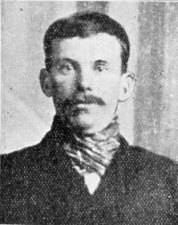
Henry Edward was born in Peel, Isle of Man on 16th June 1886, the eldest son of of Henry Edward and Maretta Quilliam McGarry who married on 24th August 1886 and had seven children, one of whom died young. Henry had younger sisters Sarah Ann, Susan, and Emily, and younger brothers John and James.
On official records as well as in newspaper notices, the surname is spelt McGeary as well as McGarry. His father was known as Edward, and his mother’s first name is transcribed a number of different ways.
At the time of the 1891 census his mother (Annetta), 26, listed as daughter, Henry, 4, and Sarah Ann, six months old, are living with Mary Fitzpatrick, 66, single, born in Ireland, and two lodgers, at 34 Douglas Street, Peel. Her husband is not found on the census.
By 1901 the family is living at 9 Christian Street, Peel. His father is 40, a labourer, his mother Meritta is 29, Edward H. is 14, Sarah 8, John 5, and Susan 3.
In October 1906, Edward Henry McGarry was charged with being drunk and disorderly, and fighting with his father. He had been found guilty of a previous offense in June, and was fined 5/- and costs. Multiple notices appear in the local newspapers for his father on charges of drunkenness and child truancy.
In 1910 his father Edward McGarry, a mason’s labourer employed by William Cowell, fell 22’ on a building site. He sued his employer for £35.
In 1911 the family (McGarey) is found in Keowns Lane, Peel. His father is 54, a mason’s labourer, his mother Maita is 40. Henry, 24, is a general labourer, John 18, is a sailor, Susan, 15, and Emily, 8, are at school, and James is 4.
His father died before May 1915.
In January 1916 conscription was introduced. Henry had received a conditional exemption in late July 1916 from the local Military Service Tribunal. Men could apply for an exemption on the grounds of their doing work of national importance, business or domestic hardship, medical unfitness, or conscientious objection. Nationwide, by the end of June 1916, 748,587 men had applied to tribunals. Over the same period around 770,000 men joined the Army. Exemptions were usually temporary (between a few weeks and six months) or conditional on their situation at work or home remaining serious enough to warrant their retention at home.
The military authorities appealed against his exemption, and the case of Henry McGeary, carter, aged 30, of Jib Lane, Peel, came before the Tribunal on 5th August 1916. The military authorities claimed that his application for exemption should not have been heard as other men ineligible for military service were available to fill his position.
His employer, James Curphey, explained that he employed six men and a lad, and in addition to contracting carting work from the Peel town commissioners, he carted the mails to Knockaloe (the alien internment camp just south of Peel), sometimes 20 loads a day. He stated it was impossible to get other help and when asked why aliens, under guard, could not fill the positions, Curphey stated that thousands of pounds were often carried in the mail and the aliens could not be trusted. Despite his employer’s petition, Henry lost his exemption, “the tribunal thought the man should go to the army.”
It is assumed that Henry was conscripted soon after this date, and after enlisting in Liverpool and training in the U.K., went to France likely in early 1917.
He was serving with the 18th Battalion of The King's Liverpool Regiment when he was killed in action on 23rd April 1917, aged 30.
On that day the Battalion had occupied old German Trenches at Henniel on the Arras sector of the front. In the evening, it moved to a sunken road to support an attack by the 18th and 19th Battalion’s of the Manchester Regiment. Elements of the Pals were to provide mopping up parties for both the Manchester Battalions, who were to move forward at 18.00pm. However, as the orders were not received until 17.45pm,it proved impossible to join the Manchester’s in time for their attack and the mopping up parties followed from where they presumed that the assaulting waves had left.
By this time, the German retaliatory barrage had begun, and the British Front Line was so heavily shelled, that the Battalion took up position in the shell holes in front. As the situation was chaotic, some troops on the right flank had begun to pullback, it was decided to withdraw to the British front line under cover of darkness to consolidate. Eventually, by morning the position became clearer, and the Battalion was able to move forward to occupy the old front line which had been vacated by the Germans, who had retired over the next crest.
Altogether the Battalion’s losses were four officers and one hundred and one other ranks, killed, wounded or missing.
Henry was buried close to where he fell and after the war, when graves were concentrated, his body was removed and reinterred in Wancourt British Cemetery, about 5 miles southeast of Arras, where he now rests.
Wancourt was captured on 12 April 1917 after very heavy fighting and the advance was continued on the following days. The cemetery, called at first Cojeul Valley Cemetery, or River Road Cemetery, was opened about ten days later; it was used until October 1918, but was in German hands from March 1918 until 26 August, when the Canadian Corps recaptured Wancourt. At the Armistice, the cemetery contained 410 graves, but was very greatly increased in the following years when graves were brought in from the following small cemeteries and isolated positions on the battlefields south-east of Arras including HENIN-SUR-COJEUL, about 800 metres North of the village, contained the graves of 29 British soldiers who fell on 9 April 1917, almost all of whom belonged to the 2nd Wilts or the 18th King's Liverpools. The cemetery now contains 1,936 burials and commemorations of the First World War. 829 of the burials are unidentified but there are special memorials to 76 casualties known or believed to be buried among them, and to 20 who were buried in Signal Trench Cemetery whose graves were destroyed in later battles. The cemetery was designed by Sir Edwin Lutyens.
According to his birth record, Henry would have been 30 years old, but a Manx memorial site commemorating the seven Manxmen who died on 23/4/1917, lists his age as 31.
His death was reported in the Peel City Guardian on 19th May 1917:
“Official notification has been received by Mrs. McGeary, that her eldest son, Pte. H. E. McGeary, who was serving in the 18th King’s Liverpool Reg’t., was killed in action in France on April 23rd. Mrs. McGeary also received a letter of sympathy from the King. The deceased was well-known in Peel. He was a keen footballer, and very frequently played in the Peel football team. He was very good to his widowed mother, who will greatly miss him.”
His Army effects and a War Gratuity of £3 went to his mother. The pension card shows two claimants, but no amount specified: his mother Maria, 8 Gib Lane, Peel, and Mrs. S. Fargher, Raby Beg (?) Road, Peel, guardian of illegitimate child. The name of the child is not shown on the card.
In August 1917 the local tribunal ruled on the military exemption application of his brother John McGeary, 22, of 8 Jib Lane, a coal heaver who worked discharging and loading boats, in the employ of Mr. T. E. Cashin. His mother made the application, as she could not work owing to a bad leg. John was the sole support of his widowed mother and two young children ages 13 and 10. Another son had died in the war. He was granted a conditional exemption.
Henry Edward is commemorated on the following Memorials:
Peel, Isle of Man
The Manx National Memorial, St Johns, Isle of Man
St. German Cathedral Cross, Peel
St. German Cathedral Roll of Honour, Peel.
We currently have no further information on Henry Edward McGarry. If you have or know someone who may be able to add to the history of this soldier, please contact us.