
1885 - 1916

CPL David Wallace Crawford
1887 - 1916

Lce-Corpl John Joseph Nickle
1894 - 1916

Pte 17911 Morton Neill
1897 - 1916

Lieut Edward Stanley Ashcroft
1883 - 1918

Pte 57435 David Anderson McGregor
- Age: 19
- From: Glasgow
- Regiment: The King's (Liverpool Regiment) 18th Btn
- K.I.A Tuesday 31st July 1917
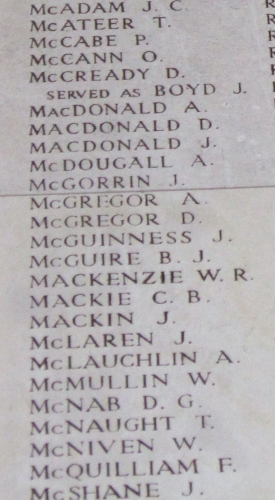
- Commemorated at: Menin Gate Memorial
Panel Ref: Panel 4 & 6
David Anderson McGregor was born on 23rd May 1898 at 54 Kidston Street, Hutchesontown, Glasgow, the son of Alexander and his wife Annie (nee Wright). His father was born in Johnston, Dumfriesshire, whilst his mother was born in Cambusnethan in Lanarkshire. They married in 1896 in the United Presbyterian Church in Cambusnethan, his father listed as a railway signalman and his mother as a domestic servant.
The 1901 census finds them still at 54 Kidston Street, with his father, 30, a railway signalman, his mother, 28, and his aunt Jeannie Wright, 22, a mantle machinist.
Unfortunately, the 1911 Scotland census is not available, so further family details are not known. By the time he enlisted, the family had moved to Bridge of Weir, a village in Renfrewshire about 12 miles west of Glasgow.
He enlisted in Glasgow and originally served as Private 1114, in the Army Cyclist Corps. The amount of the War Gratuity suggests that he served for two years, enlisting in about August 1915, when he would have been 17 years old. The Paisley and Renfrewshire Gazette, on 28th August 1915, published David's name among those who had "taken Oath of Allegiance to King and Country - David McGregor, Gryffe-view [Bridge of Weir]."
He was transferred and was serving in the 18th Battalion, The King’s Liverpool Regiment as Private No 57435 when he was killed in action on the 31st July 1917 during the Third Battle of Ypres.
18th Battalion
On this day, before Zero Hour, the 18th Battalion was part of 21st Brigade and was to form up for the attack from trenches from the area of Sanctuary Wood to Observatory Ridge but it was dark and continually falling rain gave very poor visibility. The departure of the 21st Brigade was delayed by heavy shelling.
The 18th King’s began to move forward in the rear of the 2nd Battalion of the Wiltshire Regiment who had been detailed as the left attacking battalion of the 21st Brigade.
No’s 1 and 3 Companies of the King’s led the way followed by No’s 2 and 4. In Sanctuary Wood there was considerable confusion, as a result No.2 and No.4 Companies became separated from the others, and were moved over to the left flank towards positions known as Surbiton Villas and Clapham Junction in the direction of the 90th Brigade.
No.1 and 3 Companies were soon in action with the enemy, and were for a time, held up against an enemy strong point. They pushed forward with their right on a trench known as Jar Row and their left on the tramway south of Stirling Castle. Advance along Jar Row was held up by the Germans who put up a fierce resistance and the party was forced to withdraw.
Another group of men from No.1 and No.3 Companies led by 2nd Lieutenant Graham were being held up by another strongpoint which was south of Stirling Castle, which was eventually stormed and taken. Not far away from this action, an attempt, by other men of No.1 and No.3 companies, was made to penetrate a broad belt of uncut wire, but this was covered by Machine-guns which killed almost every man attempting to pass through the two gaps that were discovered.
The situation was similar with No.2 and 4 Companies, who had attacked along the wrong axis. Their advance was met with fierce opposition, and once all the experienced officer’s had been killed or wounded, all cohesion was lost, although some men did reach and cross the Menin Road at Clapham Junction.
By that time, the situation had become extremely confused, and the whereabouts of all four companies being unknown to Battalion Headquarters, urgent attempts were made to discover their locations. Eventually by mid- afternoon, it was established that the bulk of the companies, although all mixed together, were dug in the vicinity of Stirling Castle and by mid evening, the Battalion Headquarters moved forward to meet them.
During its time in the line the 18th Battalion lost 7 officers and 76 men killed or died of wounds and 7 officers and 177 men wounded. They were relieved on the 2nd August.
David was declared Missing, his name published in the Weekly Casualty List on 18th September 1917.
His death was later assumed, for official purposes, as having occurred on 31st July 1917. His documents were received in the Pension Office from the Paymaster in March 1918, indicating a delay of about 7 months before he was officially declared killed in action.
He has no known grave and is commemorated on the Menin Gate Memorial, at Ypres in Belgium.
The site of the Menin Gate was chosen because of the hundreds of thousands of men who passed through it on their way to the battlefields. It commemorates casualties from the forces of Australia, Canada, India, South Africa and United Kingdom who died in the Salient. In the case of United Kingdom casualties, only those prior 16 August 1917 (with some exceptions). United Kingdom and New Zealand servicemen who died after that date are named on the memorial at Tyne Cot, a site which marks the furthest point reached by Commonwealth forces in Belgium until nearly the end of the war. New Zealand casualties that died prior to 16 August 1917 are commemorated on memorials at Buttes New British Cemetery and Messines Ridge British Cemetery.
The YPRES (MENIN GATE) MEMORIAL now bears the names of more than 54,000 officers and men whose graves are not known. The memorial, designed by Sir Reginald Blomfield with sculpture by Sir William Reid-Dick, was unveiled by Lord Plumer on 24 July 1927.
His Army effects and a War Gratuity of £9 went to his father Alexander.
The pension card in the name of his mother Annie at 12 Robertson Street, Partick, Glasgow, does not indicate the amount awarded. After her death, his father, later living at 75 Viewmont Drive, Maryhill, Glasgow, received the pension.
David is commemorated on the following memorials -
Ranfurly Church Memorial, Bridge of Weir
Bridge of Weir Memorial, the inscription on which reads,
"They were men in the might of their manhood,
Or boys in the beauty of youth,
But they held all as dust in the balance
To battling for freedom and truth,"
Scotland's National War Memorial
Biographical details from Bridge of Weir Memorial site (BridgeOfWeirMemorial.co.uk).
David is among the 72 fallen from Bridge of Weir profiled in the book, "Supreme Sacrifice: A Small Village and the Great War", by Reid, Masterton and Birch.
We currently have no further information on David Anderson McGregor. If you have or know someone who may be able to add to the history of this soldier, please contact us.
Killed On This Day.
(110 Years this day)Saturday 28th October 1916.
2nd Lieutenant Ernest Bailey
24 years old
(110 Years this day)
Saturday 28th October 1916.
2nd Lieutenant Stafford Thomas Eaton-Jones
20 years old
(110 Years this day)
Saturday 28th October 1916.
2nd Lieutenant Ronald Hamilton William Murdoch
21 years old
(110 Years this day)
Saturday 28th October 1916.
2nd Lieutenant James Stewart
39 years old
(109 Years this day)
Sunday 28th October 1917.
Serjeant 38645 John McGlashan
32 years old
(108 Years this day)
Monday 28th October 1918.
Pte 12056 Sandford Woods
30 years old
(108 Years this day)
Monday 28th October 1918.
Rifleman 22814 Charles Reginald Pollington
30 years old