
1885 - 1916

CPL David Wallace Crawford
1887 - 1916

Lce-Corpl John Joseph Nickle
1894 - 1916

Pte 17911 Morton Neill
1897 - 1916

Lieut Edward Stanley Ashcroft
1883 - 1918

Pte 29256 George Bellion
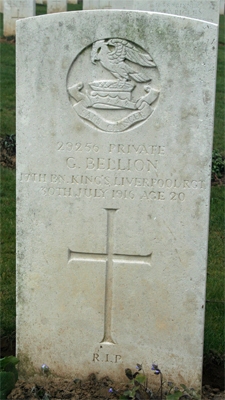
- Age: 20
- From: Liverpool
- Regiment: The King's (Liverpool Regiment) 17th Btn
- K.I.A Sunday 30th July 1916
- Commemorated at: Guillemont Rd Cem
Panel Ref: I.Y.9
George was born on 02nd May 1896 at 12 Webb Street, Edge Hill, Liverpool to Liverpool born retail carpet dealer, Alfred Birch Bellion and his Liverpool born wife Alicia (nee Voiels). His mother was baptised Alicia Voyles, but also found on records as Alicia Voiles and Voyels. They were married in March 1891 in St. Patrick's R.C. Church. His father Alfred, born in 1870, was baptised Church of England and converted to Catholicism in 1889.
In 1891 Alfred was lodging with Alicia's family in Upper Warwick Street. They had nine children. Sadly the first born twin sons died in 1892, William lived just 15 days and Daniel 21 days. Their eighth child Francis died, aged 2 in 1909. George was their fourth child and he was baptised at St. Patrick's Church, Toxteth on 12 May 1896.
George had an elder brother Alfred James (born in 1893), and younger siblings Alicia Gertrude (1898), Florence (1900), Mary Agnes (1903), and Walter (1910).
The 1911 Census shows 14 year old George as a Post Office Telegraph Messenger, still living at 12 Webb Street Edge Hill with his parents and five siblings. His parents have been married for 20 years and have had nine children, three of whom have died. George's siblings are listed as; Alfred aged 18 and an indoor carpet porter, Alicia Gertrude is 13, Florence is 11, Mary Agnes is 7 and Walter is 1.
By 1913-14 the family have moved to 17 Ash Grove in Wavertree.
George enlisted in Knowsley as Private 29256 in June 1915 joining the 17th (Pals) Battalion of The King's Liverpool Regiment.
On 30th April 1915 the 17th Battalion alongside the other three Pals battalions left Liverpool via Prescot Station for further training at Belton Park, Grantham. They remained here until September 1915 when they reached Larkhill Camp on Salisbury Plain.
He shipped to France with his battalion, disembarking at Boulogne on 07th November 1915.
George was killed in action at Guillemont on 30th July 1916, aged 20.
17th Battalion Diary 30th July 1916
The Battalion was in support to 19 & 20 Battalions K.L.R. 2 Coys. behind 19th & 2 Coys. behind 20th. Very thick mist. The attack was pushed home to the objective in places but in the main was held up by machine gun fire from hidden machine guns.
Fighting continued all day swaying backwards and forwards until by 6pm about 300 yards in depth had been gained & consolidated all along our front.
Casualties in the 17th Battalion were 15 Officers and 281 Other Ranks
Further details are reported in more detailed by Everard Wyrall in his book The History of the King’s Regiment (Liverpool) 1914-1919 Volume II 1916-1917
The 17th King’s had advanced (two companies each behind the 19th and 20th Battalions) in small columns. They too suffered heavily from machine-gun fire and were quickly absorbed into the waves that preceded them. They also shared the gains and losses of that terrible day.
When darkness fell on the battlefield the 30th Division held a line from the railway on the eastern side of Trones Wood , southwards and including Arrow Head Copse, to east of Maltz Horn Farm. On this line the division was relieved by the 55th Division during the early hours of the 31st July.
The events of 30th July 1916 were regarded at the time as Liverpool’s blackest day. There follows an extract from The History of the 89th Brigade written by Brigadier General Ferdinand Stanley which gives an indication of the events of the day.
Guillemont
Well the hour to advance came, and of all bad luck in the world it was a thick fog; so thick that you couldn’t see more than about ten yards. It was next to impossible to delay the attack – it was much too big an operation- so forward they had to go. It will give some idea when I say that on one flank we had to go 1,750 yards over big rolling country. Everyone knows what it is like to cross enclosed country which you know really well in a fog and how easy it is to lose your way. Therefore, imagine these rolling hills, with no landmarks and absolutely unknown to anyone. Is it surprising that people lost their way and lost touch with those next to them? As a matter of fact, it was wonderful the way in which many men found their way right to the place we wanted to get to. But as a connected attack it was impossible.
The fog was intense it was practically impossible to keep direction and parties got split up. Owing to the heavy shelling all the Bosches had left their main trenches and were lying out in the open with snipers and machine guns in shell holes, so of course our fellows were the most easy prey.
It is so awfully sad now going about and finding so many splendid fellows gone.
His parents unaware of his fate placed "Missing " adverts in the Liverpool Echo on Monday 28th August 1916 and Liverpool Daily Post on Tuesday 29th August 1916 asking for information about his whereabouts.George was buried close to where he fell and after the war when the graves were concentrated he was reburied and now rests at Guillemont Road Cemetery, where the inscription on his headstone reads, "R.I.P.".
Guillemont was an important point in the German defences at the beginning of the Battle of the Somme in July 1916. It was taken by the 2nd Royal Scots Fusiliers on 30 July but the battalion was obliged to fall back, and it was again entered for a short time by the 55th (West Lancashire) Division on 8 August. On 18 August, the village was reached by the 2nd Division, and on 3 September (in the Battle of Guillemont) it was captured and cleared by the 20th (Light) and part of the 16th (Irish) Divisions. It was lost in March 1918 during the German advance, but retaken on 29 August by the 18th and 38th (Welsh) Divisions.
The cemetery was begun by fighting units (mainly of the Guards Division) and field ambulances after the Battle of Guillemont, and was closed in March 1917, when it contained 121 burials. It was greatly increased after the Armistice when graves (almost all of July-September 1916) were brought in from the battlefields immediately surrounding the village and certain smaller cemeteries, including:-
HARDECOURT FRENCH MILITARY CEMETERY. The village of Hardecourt-au-Bois was captured by French troops on the 8th July 1916, and again by the 58th (London) and 12th (Eastern) Divisions on 28 August 1918. Five British Artillerymen were buried by their unit in the French Military Cemetery, in the middle of the village, in September 1916; and in 1918 the 12th Division buried in the same cemetery 14 men of the 9th Royal Fusiliers and two of the 7th Royal Sussex.
Guillemont Road Cemetery now contains 2,263 Commonwealth burials and commemorations of the First World War. 1,523 of the burials are unidentified but there are special memorials to eight casualties known or believed to be buried among them.
The cemetery was designed by Sir Herbert Baker.
George earned his three medals.It is not known when they were informed about his death, however, in the Liverpool Echo, on 30th July 1917 under the heading Lost At The Battle of Guillemont his family paid tribute to George:
“Previously reported missing, since presumed killed in action, July 30, 1916, aged 20 years, Private George Bellion (29256) 17th K.L.R. (Pals), second dearly beloved son of Alfred and Alecia Bellion, 17 Ash Grove, Wavertree.”
Liverpool Post Office Staff, (now in the Met Quarter Shopping Centre, Liverpool)
Hall of Remembrance, Liverpool Town Hall Panel 13, Left
His brother, Alfred James, enlisted on 06th November 1914 and served in the K.L.R. as Private 240912. He served overseas and was treated at Haworth, near Keighley in Yorkshire (likely at the Red Cross Hospital). He was transferred to the Labour Corps Home Service Employment Company and was discharged on 24/6/1918 (sickness) with a Silver War Badge. He returned to Liverpool, living at 64 Picton Road in Wavertree. Alfred had a son in 1925 he called George.
His parents suffered further loss when youngest son Walter died in 1939 aged 29. Walter was married with young children.
In September 1939 his parents still lived at 17 Ash Grove. His father Alfred was 69, by then a retired carpet planner, his mother Alicia was 68.
His mother died in the June quarter of 1950, aged 78.
His father lived long enough to see the deaths of two more children: Alicia in 1951 and Alfred James in 1957. He died at the age of 90 in 1961, outlived by only two of the nine children.
We currently have no further information on George Bellion, if you have or know someone who may be able to add to the history of this soldier, please contact us.
Killed On This Day.
(110 Years this day)Tuesday 24th October 1916.
Pte 33220 David Brocken
24 years old
(109 Years this day)
Wednesday 24th October 1917.
Pte 17690 Henry Phipps
22 years old
(109 Years this day)
Wednesday 24th October 1917.
Pte 308326 James Speakman
26 years old
(108 Years this day)
Thursday 24th October 1918.
Serjeant 17245 Robert George Evans (MM)
22 years old