
1885 - 1916

CPL David Wallace Crawford
1887 - 1916

Lce-Corpl John Joseph Nickle
1894 - 1916

Pte 17911 Morton Neill
1897 - 1916

Lieut Edward Stanley Ashcroft
1883 - 1918

Cpl 22200 Austin Owens
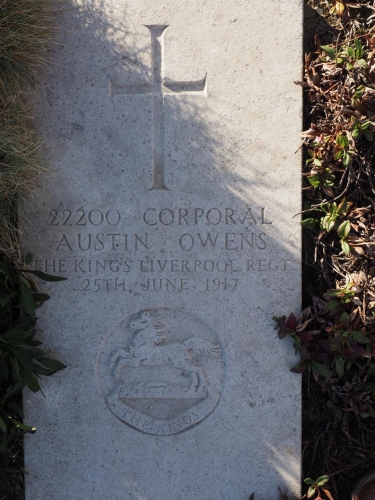
- Age: 25
- From: Liverpool
- Regiment: The King's (Liverpool Regiment) 20th Btn
- D.O.W Monday 25th June 1917
- Commemorated at: Wimereux Cc
Panel Ref: II.N.3
Austin Owens was born on 27 April, 1892 in Holly Street, Islington, Liverpool and was baptised three days later, on 30 April, by Fr Timothy Griffin, at St Joseph’s Curch, Grosvenor St, Liverpool. He was the son of John and Sarah Jane Owens (nee Murney), of 15 Holly Street, Liverpool. They had married at St Peter's Church, Liverpool in 1880.
He joined the Royal Navy on the 22nd April, 1908 and his papers show he was a telegraph messenger. He was five feet, two and three quarter inches tall, had a fresh complexion, brown eyes and light brown hair. He was on the ship Impregnable as a boy rating and discharged to shore on 25th August, 1908.
The 1901 and 1911 Census shows the family living at 15 Holly Street, Liverpool. His father John is aged 50, born in Liverpool in 1861 and is a casual Carter, his mother Jane is aged 45, born 1866 and has no occupation and was also born in Liverpool. They have been married for 30 years and have had fifteen children of which twelve died. John aged 27, born is a labourer for a sugar refiner and Austin aged 19 born 1892 occupation assistant grocer for a provisions merchant, both being born in Liverpool. They also had a daughter named Mary born in 1887 who by the time of the 1911 Census had left the family home.
He enlisted on the 05th November, 1915, in Liverpool joining the 20th Battalion of The King’s Liverpool Regiment as Private 22200. He gave his age as 22 years and 217 days, occupation is a Clerk. He also states that he left after failing in wireless telegraphy. He is five feet eight and half inches tall, weighed 126lbs, fresh complexion, brown eyes, brown hair and gave his religion as Roman Catholic.
07.11.15: Embarked for France with his battalion.
25.05.16: Septic foot to Field Ambulance before being admitted to 5 C.C.S.
04.06.16: Discharged to duty.
10.06.16: rejoined 20th Battalion.
30.07.16: Appointed unpaid Lance-Corporal.
05.08.16: Wounded in action, gunshot wound to hand.
13.12.16: Appointed paid Lance-Corporal.
25.03.17: Appointed acting Corporal to complete establishment.
26.03.17: Confirmed in rank.
09.06.17: Gunshot wound to left foot and fractured femur.
25.06.17; Gunshot wound to legs, amputation.
26.06.17: Army letter dated confirming Austin in 8th Stationary Hospital, Wimereux with gunshot wound to left foot and was seriously ill on the 21st June, 1917.
He died of wounds on the 25th June, 1917 aged 25.
His father received his personal effects which included letters, photos, a pipe, two religious books, two unidentified books, a rosary and a bag.
Austin now rests at Wimereux Communal Cemetery, France.
Wimereux was the headquarters of the Queen Mary's Army Auxilliary Corps during the First World War and in 1919 it became the General Headquarters of the British Army. From October 1914 onwards, Boulogne and Wimereux formed an important hospital centre and until June 1918, the medical units at Wimereux used the communal cemetery for burials, the south-eastern half having been set aside for Commonwealth graves, although a few burial were also made among the civilian graves. By June 1918, this half of the cemetery was filled, and subsequent burials from the hospitals at Wimereux were made in the new military cemetery at Terlincthun. During the Second World War, British Rear Headquarters moved from Boulogne to Wimereux for a few days in May 1940, prior to the evacuation of the British Expeditionary Force from Dunkirk. Thereafter, Wimereux was in German hands and the German Naval Headquarters were situated on the northern side of the town. After D-Day, as Allied forces moved northwards, the town was shelled from Cap Griz-Nez, and was re-taken by the Canadian 1st Army on 22 September 1944. Wimereux Communal Cemetery contains 2,847, Commonwealth burials of the First World War, two of them unidentified. Buried among them is Lt.-Col. John McCrae, author of the poem "In Flanders Fields." There are also five French and a plot of 170 German war graves. The cemetery also contains 14 Second World War burials, six of them unidentified. The Commonwealth section was designed by Charles Holden.
Reported wounded in Daily Post on 12th Sept 1916, and again on 22nd Nov 1916
Family notices in Liverpool Echo 24th June 1918, they are adamant his death was the 24th June:-
OWENS - In sad but loving memory of our dear son Corpl. AUSTIN OWENS, K.L.R., who died of wounds June 24th, 1917.
Sleep on their son, and take your rest,
We miss you most who loves you best.
No loved ones stuck beside you
To bid you a last farewell,
But though your grave we cannot see
We know you like a soldier fell.
You are gone but not forgotten,
For often do we call your name,
But now there is nothing left to answer
But your picture in a frame R.I.P.
Never to be forgotten by his loving mother and father, 15 Holly Street.
OWENS - In loving memory of my dear brother, Corpl. AUSTIN OWENS, who died of wounds June 24th, 1917.
A loving brother, true and kind,
A beautiful memory left behind, R.I.P.
Never forgotten by his only Brother John and Sister-in-law, 15 Peover Street.
OWENS - In loving memory of my dear brother, Corpl. AUSTIN OWENS, who died of wounds June 24th, 1917.
We mourn for him in silence,
No eye can see us weep;
But deep within our aching hearts
His memory we keep. R.I.P.
Never forgotten why is only Sister and Brother-in-law. 19 Holly Street.
OWENS - In sad but loving remembrance of Corpl. AUSTIN OWENS, K.L.R., who died of wounds June 24th, 1917, and buried at Wimereux Cemetery, France. R.I.P. (Memory is the only friend that grief can call its own.) - Never forgotten by Mary and all at 55 Harebell Street.
OWENS - In loving memory of my dear cousin, Corpl. AUSTIN OWENS, who died of wounds June 24th, 1917. R.I.P. - Never forgotten by Eliza and George, Durban Road, Old Swan.
Soldiers Effects to father John and pension to mother Sarah Jane.
Austin is commemorated in the Hall of Remembrance in Liverpool Town Hall at Panel 62.
Below is the testimony of Sister Janet Fearns who kindly shared her understanding of Austin's life with us.
Corporal Austin Owens, unique, but one of many
Corporal Austin Owens, my great uncle, was born to John and Jane Owens on 27 April, 1892 in Holly Street, Islington, Liverpool. He was baptised three days later, on 30 April, by a Fr Timothy Griffin, at St Joseph’s church, Grosvenor St, a church which was eventually demolished in 1979.
There were at least three children in the family: John, my grandmother Mary Jane, and Austin. According to the records, in 1914, Austin signed up the Royal Navy It seems that Austin may have worked as a grocer’s assistant prior to volunteering to serve. However he only stayed with the Navy for nine months and left after failing in wireless telegraphy.
On 7 November 1915, aged 23 and unmarried, Austin signed up for the 20th Battalion King's (Liverpool) Regiment. In his sign-up papers, he described himself as a clerk. He was very quickly sent to France with the “Liverpool Pals”, so quickly that any training must have been very basic. Although a couple of World War I training camps have been excavated within the last few years in places such as Grantham, Abergele and Tring, it appears that many believed that “too much training” took the ingenuity and initiative from the individual. Even in those locations where realistic trenches were dug to give the recruits a sense of what life would be like once deployed in France and Belgium, nothing prepared them for the reality they discovered on their arrival. The Pals moved in September 1915 to Larkhill, Wiltshire, before being deployed to France. They landed at on 7 November, 1915. Two months later, Austin, was promoted to Lance Corporal.
February 1916 saw 23 year-old Austin at Arras. Three months later he was hospitalised with a septic foot, the infection spreading to his whole leg. Although hospitalised on 28 May 1916, he was discharged back to his unit only a week later on 4 June and was ready to return to duty on 10 June – and this despite the absence of antibiotics! Three weeks later, on 1 July, 1916, the first day of the Somme Offensive, Austin, was there at the front, along with the rest of the Liverpool Pals.
The next record we have of Austin is that of 30th of July 1916, by which time he is 24. This time he is in Picardy, with wounds to his right hand and arm and is hospitalised in Étaples at the Liverpool Merchants Hospital. He was part of the failed attack on Guillemont in which the Liverpool Pals lost nearly 500 men in what was later described as “Liverpool’s blackest day”. One week after his admission to hospital, Austin is discharged on 7 August and returned to duty.
Austin is injured again in October 1916, this time, admitted to hospital in Étaples, but this time with shrapnel wounds. On this occasion, his injuries were more serious, so that he was not discharged to rejoin his unit until 18 November.
In January 1917 Austin was given 10 days’ leave in Liverpool and on his return was promoted to Corporal on 26 March.
Austin was again wounded on 9 April 1917. Now aged 25, the first day of the Battle of the Scarpe saw him with gunshot wounds to his left foot, a fractured left femur and both ankles. His left leg was amputated in the less-than-ideal situation of high casualty numbers and overstretched facilities. On this occasion, there was no hope of recovery and return to duty. Austin died at 06.45 on 25 June, 1917. He was buried in the Wimereux Communal Cemetery, north of Calais.
Unbelievably, in view of today’s instant electronic communications, nobody thought to inform Austin’s family of his death. On 22 June, 1917, the Infantry Records Office in Preston received a letter from my grandmother and Austin’s sister, Mary Jane. Part of the letter is missing, but the following words can be deciphered: “Sir, could you kindly... any information about Cpl A Owens as... letter returned of... June 15th... And receiving no word from either the office or himself, I am very anxious and would be deeply gratified if you would favour me with any news of his whereabouts. I remain, Yours... Mary Jane Owens”.
The reply to this letter was damaged during its preservation. However, the telegram is sufficiently intact to be able to recognise that somebody, on behalf of the War Office, was responsible for passing on some sort of information. It states that Austin, “now at the 8th Stationary Hospital, Wimereux, is suffering from gunshot wounds. Left Foot was seriously ill on 21 June, 1917”. The form continues with its generic formality: “Any further information received in this office as to his condition or progress will be at once notified to you. I am, Sir or Madam, your obedient servant... [indecipherable signature] Officer-in-charge of Records”. Austin’s family received this communication the day after his death.
On 18 December, 1917, an unsigned form from the “Major for Colonel... Officer in charge of records” accompanied Austin’s personal effects. The form stated, “These are the only articles at present, forthcoming, but should any further articles be received at any time they will be duly forwarded. Yours faithfully”. The items in question consisted of letters and photos, a pipe, two religious books, two unidentified books, a rosary and a bag. Sadly, the same form also includes the words, “Sir, I have to acknowledge receipt of the articles as stated opposite. Yours faithfully”. The dispatcher at Fulwood Barracks in Preston had placed an X on the dotted line, where Austin’s father, John was meant to sign when he received his son’s belongings.
Yes, there were medals. Yet their reception was as impersonal as everything else related to the officialdom of Austin’s death. His father, John, was unable to write and so it was left to my grandmother to fill in the form on her father’s behalf in order to claim the medals. This she did on 23 July, 1919. Her father made his mark on the form, but the signature of their parish priest, Father John McCarthy of St Joseph’s church in Grosvenor Street, Liverpool, was required to testify that my grandmother was whom she claimed to be. Part of the tragedy of all this is that she had just lost a baby girl and, in World War II, would lose her 19 year-old son as a Flight Engineer with Bomber Command. On receiving that telegram revealing that he was “missing in action, presumed dead”, her husband and my grandfather had a heart attack and died.
We currently have no further information on Austin Owens, If you have or know someone who may be able to add to the history of this soldier, please contact us.
Killed On This Day.
(110 Years this day)Sunday 25th June 1916.
Pte 17742 Henry Wild
30 years old
(109 Years this day)
Monday 25th June 1917.
Cpl 22200 Austin Owens
25 years old
(108 Years this day)
Tuesday 25th June 1918.
Pte 24596 William Andrew Madden
29 years old