
1885 - 1916

CPL David Wallace Crawford
1887 - 1916

Lce-Corpl John Joseph Nickle
1894 - 1916

Pte 17911 Morton Neill
1897 - 1916

Lieut Edward Stanley Ashcroft
1883 - 1918

Pte 27521 Harold John Bickerton
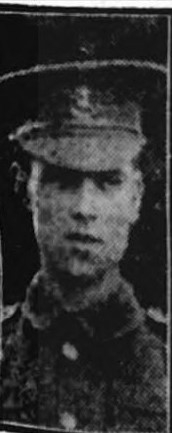
- Age: 22
- From: Crewe, Cheshire
- Regiment: The King's (Liverpool Regiment) 17th Btn
- K.I.A Sunday 30th July 1916
- Commemorated at: Guillemont Rd Cem
Panel Ref: IV.M.10
Harold John Bickerton (known as Jack), was born in September 1893, the eldest son of Joseph Bickerton and his wife Agnes (née Parks), who married in 1890 at St Michael's Church, Coppenhall. They had six children, all born in Crewe. John had an older sister Phoebe Annie, born in 1891, and younger siblings Josephine Agnes 1895, Lucy May 1897, Joseph Edward 1899, and Leonard Norman, born in 1904. Harold John was baptised on 10th November 1893 in St. Paul’s Church, Crewe.
At the time of the 1901 census the family is living at 20 Alban Street, Coppenhall Monks, Crewe. His father is a 34 year old coppersmith, born in Lenton, Cheshire, whilst his mother is 31 years old and born in Coppenhall, Cheshire. Harold J. is 7 years old and has four siblings listed as; Annie aged 9, Josephine A. aged 5, Lucy May aged 4 and Joseph E. aged 2.
As his father worked at the Railway Works, Jack attended the L.N.W.R. Company's Hightown School in Adelaide Street, Crewe.
By 1911 they have moved to 60 McLaren Street, Crewe. His father, 44, is a coppersmith for the railway works, his mother is 40. They have been married for 21 years and have had six children, all of whom have survived. Harold John is 17, an apprentice tailor, Josephine, 15, and Lucy, 14, are listed as at home with no occupations recorded, and Joseph, 12, and Leonard, 7, are schoolboys.
Before the outbreak of the war Jack had been employed by Mr Pemberton, a tailor of Market Street, Crewe.
He enlisted in Knowsley joining the 17th Battalion of The King’s Liverpool Regiment as Private 27521. An online memorial site (Cheshire Roll of Honour) states that John was prompted to enlist by the sinking of the Lusitania (07th May 1915). The amount of the War Gratuity coincides with an enlistment in May 1915. He arrived in France on 29th December 1915, thus earning the 1914-1915 Star.
Jack was killed in action on the 30th July 1916, aged 22, at the village of Guillemont, France, during the Somme Offensive, having been initially declared Missing on 30th July 1916, his death was later presumed to have occurred on or since that date.
17th Battalion Diary 30th July 1916
The Battalion was in support to 19 & 20 Battalions K.L.R. 2 Coys. behind 19th & 2 Coys. behind 20th. Very thick mist. The attack was pushed home to the objective in places but in the main was held up by machine gun fire from hidden machine guns.
Fighting continued all day swaying backwards and forwards until by 6pm about 300 yards in depth had been gained & consolidated all along our front.
Casualties in the 17th Battalion were 15 Officers and 281 Other Ranks
Further details are reported in more detailed by Everard Wyrall in his book The History of the King’s Regiment (Liverpool) 1914-1919 Volume II 1916-1917
The 17th King’s had advanced (two companies each behind the 19th and 20th Battalions) in small columns. They too suffered heavily from machine-gun fire and were quickly absorbed into the waves that preceded them. They also shared the gains and losses of that terrible day.
When darkness fell on the battlefield the 30th Division held a line from the railway on the eastern side of Trones Wood , southwards and including Arrow Head Copse, to east of Maltz Horn Farm. On this line the division was relieved by the 55th Division during the early hours of the 31st July.
The events of 30th July 1916 were regarded at the time as Liverpool’s blackest day. There follows an extract from The History of the 89th Brigade written by Brigadier General Ferdinand Stanley which gives an indication of the events of the day.
Guillemont
Well the hour to advance came, and of all bad luck in the world it was a thick fog; so thick that you couldn’t see more than about ten yards. It was next to impossible to delay the attack – it was much too big an operation- so forward they had to go. It will give some idea when I say that on one flank we had to go 1,750 yards over big rolling country. Everyone knows what it is like to cross enclosed country which you know really well in a fog and how easy it is to lose your way. Therefore, imagine these rolling hills, with no landmarks and absolutely unknown to anyone. Is it surprising that people lost their way and lost touch with those next to them? As a matter of fact, it was wonderful the way in which many men found their way right to the place we wanted to get to. But as a connected attack it was impossible.
The fog was intense it was practically impossible to keep direction and parties got split up. Owing to the heavy shelling all the Bosches had left their main trenches and were lying out in the open with snipers and machine guns in shell holes, so of course our fellows were the most easy prey.
It is so awfully sad now going about and finding so many splendid fellows gone.
Such was the confusion following the events of 30th July 1916 that his family were not aware that he had been killed.
He was reported Missing in the Nantwich Guardian on Friday 08th September 1916:
“Private Bickerton, of 60 McLaren Street, has been officially reported missing; it was his 23rd birthday on Thursday this week”.
Jack was declared as killed in action in the Liverpool Daily Post on 18th September 1916:
CREWE CASUALTIES.
Mr. and Mrs. Bickerton, of M’Laren-street, Crewe, have received information that their son, Private H. J. Bickerton, has been killed action. He was formerly a Crewe shop assistant.
Despite this, his mother placed an appeal in the Nantwich Guardian on 13th April 1917, over eight months since he had been declared missing, still hoping to learn about her son’s fate:
“Private J. Bickerton (27521), of the King’s (Liverpool Regiment), has been missing since July 30th, 1916. He is 23 years of age, and went to the front at Christmas, 1915. Prior to the war he was employed for ten years by Mr. Pemberton, tailor, Market Street, Crewe. Any information regarding this soldier will be gladly received by his mother, who resides at 60, McLaren Street, Crewe, Cheshire.”
Jack was buried close to where he fell and after the war when graves were concentrated, his body was removed and reinterred in Guillemont Road Cemetery, where the inscription on his headstone reads;
"IN CHERISHED MEMORY OF OUR DEAR JACK, GRANT HIM O LORD ETERNAL REST"
Guillemont was an important point in the German defences at the beginning of the Battle of the Somme in July 1916. It was taken by the 2nd Royal Scots Fusiliers on 30 July but the battalion was obliged to fall back, and it was again entered for a short time by the 55th (West Lancashire) Division on 8 August. On 18 August, the village was reached by the 2nd Division, and on 3 September (in the Battle of Guillemont) it was captured and cleared by the 20th (Light) and part of the 16th (Irish) Divisions. It was lost in March 1918 during the German advance, but retaken on 29 August by the 18th and 38th (Welsh) Divisions.
The cemetery was begun by fighting units (mainly of the Guards Division) and field ambulances after the Battle of Guillemont, and was closed in March 1917, when it contained 121 burials. It was greatly increased after the Armistice when graves (almost all of July-September 1916) were brought in from the battlefields immediately surrounding the village and certain smaller cemeteries, including:-
HARDECOURT FRENCH MILITARY CEMETERY. The village of Hardecourt-au-Bois was captured by French troops on the 8th July 1916, and again by the 58th (London) and 12th (Eastern) Divisions on 28 August 1918. Five British Artillerymen were buried by their unit in the French Military Cemetery, in the middle of the village, in September 1916; and in 1918 the 12th Division buried in the same cemetery 14 men of the 9th Royal Fusiliers and two of the 7th Royal Sussex.
Guillemont Road Cemetery now contains 2,263 Commonwealth burials and commemorations of the First World War. 1,523 of the burials are unidentified but there are special memorials to eight casualties known or believed to be buried among them.
The cemetery was designed by Sir Herbert Baker.
When his headstone was erected his father had just died and the CWGC corresponded with his mother Agnes, at 67 Park Place, Victoria Avenue, Crewe.
A pension card in the name of his mother Agnes, does not specify the amount awarded.
His father Joseph received John’s Army effects and a War Gratuity of £4-10s. He died in 1924 aged 57.
In 1939 his mother, now 70, is living with daughter (Josephine) Agnes, 44, at 67 Park Place.
His mother lived to the age of 84, and died in 1952.
Harold J. Bickerton is commemorated on the following Memorials:
Coppenhall Memorial
St. Michael’s Lych Gate, Coppenhall.
We currently have no further information on Harold John Bickerton, if you have or know someone who may be able to add to the history of this soldier, please contact us.
Killed On This Day.
(110 Years this day)Tuesday 24th October 1916.
Pte 33220 David Brocken
24 years old
(109 Years this day)
Wednesday 24th October 1917.
Pte 17690 Henry Phipps
22 years old
(109 Years this day)
Wednesday 24th October 1917.
Pte 308326 James Speakman
26 years old
(108 Years this day)
Thursday 24th October 1918.
Serjeant 17245 Robert George Evans (MM)
22 years old