
1885 - 1916

CPL David Wallace Crawford
1887 - 1916

Lce-Corpl John Joseph Nickle
1894 - 1916

Pte 17911 Morton Neill
1897 - 1916

Lieut Edward Stanley Ashcroft
1883 - 1918

L/Cpl 16016 Frank Alfred Pierce
- Age: 24
- From: Bagillt, Flintshire
- Regiment: The King's (Liverpool Regiment) 17th Btn
- K.I.A Sunday 30th July 1916
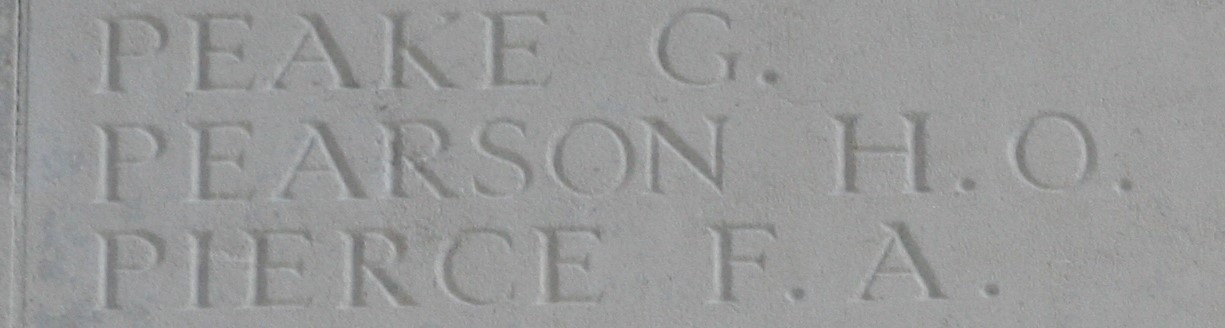
- Commemorated at: Thiepval Memorial
Panel Ref: P&F1D8B &8 C.
Frank Alfred Pierce, known to the family as Frankie, was born in 1891 in Bagillt, Flintshire, Wales, about new year of 1892, the son of William Thomas Pierce and Sarah Selina (nee Foulkes), both born in Bagillt, and who married in 1883. They had five children: Judith, William, twins Frank and Sara, and Violet, all born in Bagillt. Frank was baptised on the 03rd December 1891 in Bagillt, his father was a brewer of Oaklands.
The family moved to Chester after 1894, and by 1901 they are living at 20 Brook Lane, with five children. His father, is aged 48, a corn and hop merchant, his mother, Sarah, is aged 41, at school are Judith 15, William V.E. 13, twins Frank A. and Sarah I. 9, and Violet 7. Also in the household is paternal grandfather William Pierce, 75.
On the 1911 Census, Frank, aged 19, is living with his parents and two sisters at 4 Gladstone Road, Chester. His father, is aged 58, a commission agent, his mother Sarah is aged 51. They advised that they had been married for 27 years, and have had 5 children. There are 3 children declared in the household; Frank, aged 19, is a bookkeeper in an insurance office, his twin sister Sara, 19, is a ‘lady help’, and Violet, 17, is an artist’s assistant. They also have a boarder, Louie Hughes, aged 5 (she was their adopted daughter).
Frank enlisted in Liverpool on 2nd September 1914 as Private 16016, No.4 Company, 17th (Pals) Battalion of The King's Liverpool Regiment, giving his age as 22 years and 246 days, and his occupation as cashier. He is described as being 5’ 9 and three quarter inches tall, weighing 146 lbs, 37” chest, with a fresh complexion, grey eyes, and brown hair. He gives his religion as Church of England and his next of kin as his father, William Thomas Pierce, 4 Gladstone road, Chester.
Frank was billeted at Prescot Watch Factory and trained there and at Knowsley Hall until the Pals battalions moved to Belton Park Camp in Lincolnshire, on 30th April 1915. Whilst there, on 14th August 1915, Frank was confined to barracks for three days for being ‘late falling in for fatigue’. The battalions moved to Larkhill Camp on Salisbury Plain on 5th September for final infantry training before being sent to the front. Frank shipped to France with his battalion from Folkestone, disembarking at Boulogne on 7th November 1915.
By the summer of 1916 the Pals are in the front lines at Maricourt on the Somme front. Frank was promoted unpaid Lance Corporal on 16th July 1916. On the 30th three Pals battalions are involved in the attack on the village of Guillemont, still held by the Germans. With close to 500 men killed in action, missing, or later dying of wounds, this becomes the blackest day of the war for the Liverpool Pals battalions. Frank was one of the many killed in action that day.
Graham Maddocks, in his book “Liverpool Pals” (p.123-4), gives details of the events:-
No.3 and No.4 Companies, intermingled because of the fog, soon came across a small German strongpoint on their line of advance, just to the south of Arrowhead Copse, and after a fierce hand-to-hand encounter, they captured it. Two friends from Chester wrote home separately to describe their experiences.
“We were in reserve for a week just behind the line waiting for our third attack. On the night of 29th July we moved up to our position just ahead and on the right of Trones Wood. Here we took up our position in shell holes just behind the 19th, and dug ourselves in for safety, awaiting early morning when the advance was due to take place at 4.45. We were in our stations, myself being with Ossy Eyes [Pte 15985 J.O. Eyes]. Frank [16016 F.A. Pierce] and his mates were quite near, also Sam’s [15938 S.H. Thomas] gun team. We were under constant fire, but not heavy, being mostly gas shells. It would be towards one or two o’clock when poor old Sam met his fate. Our sergeant had just given us our rum ration and gone to the shell hole where the gun team were, and here, unfortunately, one gas shell found its mark, landing in the centre of the gunners. Poor lads, it wiped the whole of them out.
It was a bad start for us, but at 4.45 the boys were up – into the mist they went headed by our section commanders. We ploughed along taking shelter here and there, for they poured one continual rain of lead at us. We were suffering terrible losses but the boys kept on. When we first started the attack, I saw Frank leading his section on. He was on our right, but he disappeared into the mist. We kept pushing forward and were then held up by a German advance trench (a strong point). Here we fought for three-quarters of an hour, when the enemy saw their chance was hopeless they downed arms, hands up, and cried like children for mercy.
We took up our position in what was once the German trench – only three of us out of our section, our NCO, Ossy, and myself. Getting lost, we attached ourselves to the 19th. Here we met another of our Pals who had also got lost. He was one of Frank’s section. Then he told us the terrible news. Frank was leading his section in the charge, and unfortunately was shot through the heart. The sights were bad enough, but the shock of losing Frank and Sam as well! I can’t describe my feelings – it’s heart-breaking. They were two fine fellows, so very popular in the company, and not only were they excellent soldiers, but thorough gentlemen too!” - 15971 Lance Corporal H. Foster (who survived the war).
“Ossy Eyes [15985, J.O. Eyes] and I who managed to come out of this without a scratch are badly cut up over this terrible affair, and I know you, and all those who know those dear comrades of ours will be badly upset about it. Poor old Charlie [21518 C. Heath] met his death while performing a very brave act. Our battalion were in the first wave that went over, and when we advanced so far, we got orders to get down, and Charlie, who noticed a German machine-gun a few yards ahead of him, charged with one or two others to try and capture it, but was fatally hit by a bomb. Frank Pierce [16016 F.A. Pierce] was sniped through the head and Sam Thomas [15938 S.H. Thomas] was knocked out by a gas shell while going up the trenches the night previous to the attack. Gordon Pinches [21589 N.G. Pinches] was killed with a bullet, but where it caught him exactly, I could not say.” – 21646 Private C.J. Wright (recipient of the Military Medal, himself hit and killed by an aerial bomb on 8th October 1918, just a month before the Armistice).
17th Battalion Diary 30th July 1916
The Battalion was in support to 19 & 20 Battalions K.L.R. 2 Coys. behind 19th & 2 Coys. behind 20th. Very thick mist. The attack was pushed home to the objective in places but in the main was held up by machine gun fire from hidden machine guns.
Fighting continued all day swaying backwards and forwards until by 6pm about 300 yards in depth had been gained & consolidated all along our front.
Casualties in the 17th Battalion were 15 Officers and 281 Other Ranks
Further details are reported in more detailed by Everard Wyrall in his book The History of the King’s Regiment (Liverpool) 1914-1919 Volume II 1916-1917
The 17th King’s had advanced (two companies each behind the 19th and 20th Battalions) in small columns. They too suffered heavily from machine-gun fire and were quickly absorbed into the waves that preceded them. They also shared the gains and losses of that terrible day.
When darkness fell on the battlefield the 30th Division held a line from the railway on the eastern side of Trones Wood , southwards and including Arrow Head Copse, to east of Maltz Horn Farm. On this line the division was relieved by the 55th Division during the early hours of the 31st July.
The events of 30th July 1916 were regarded at the time as Liverpool’s blackest day. There follows an extract from The History of the 89th Brigade written by Brigadier General Ferdinand Stanley which gives an indication of the events of the day.
Guillemont
Well the hour to advance came, and of all bad luck in the world it was a thick fog; so thick that you couldn’t see more than about ten yards. It was next to impossible to delay the attack – it was much too big an operation- so forward they had to go. It will give some idea when I say that on one flank we had to go 1,750 yards over big rolling country. Everyone knows what it is like to cross enclosed country which you know really well in a fog and how easy it is to lose your way. Therefore, imagine these rolling hills, with no landmarks and absolutely unknown to anyone. Is it surprising that people lost their way and lost touch with those next to them? As a matter of fact, it was wonderful the way in which many men found their way right to the place we wanted to get to. But as a connected attack it was impossible.
The fog was intense it was practically impossible to keep direction and parties got split up. Owing to the heavy shelling all the Bosches had left their main trenches and were lying out in the open with snipers and machine guns in shell holes, so of course our fellows were the most easy prey.
It is so awfully sad now going about and finding so many splendid fellows gone.
Frank has no known grave and is commemorated on the Thiepval Memorial to the Missing of The Somme.
The Thiepval Memorial, the Memorial to the Missing of the Somme, bears the names of more than 72,000 officers and men of the United Kingdom and South African forces who died in the Somme sector before 20 March 1918 and have no known grave. Over 90% of those commemorated died between July and November 1916.
On 01st August 1932 the Prince of Wales and the President of France inaugurated the Thiepval Memorial in Picardy. The inscription reads: “Here are recorded the names of officers and men of the British Armies who fell on the Somme battlefields between July 1915 and March 1918 but to whom the fortune of war denied the known and honoured burial given to their comrades in death.”
News of his death was received by Frank’s family nearly three weeks later, and announced by his parents in the Cheshire Observer, on 19th August 1916:
“On the 30th July, Lance-Corpl. Frank A. Pierce (Frankie) (“Pals”), the dearly-beloved and loving twin son of Mr. and Mrs. W. T. Pierce, 4 Gladstone Road, Chester. Sadly missed.”
Also in same edition:
CHESTER FOOTBALL CAPTAIN
KILLED IN ACTION.
A TEAM’S HEAVY LOSSES
It is with deep regret we now record that official intimation has been received by his parents, Mr and Mrs W. T. Pierce, of 4 Gladstone Road, Chester, that their youngest son, Lance Corpl. Frank A. Pierce, of the Liverpool “Pals,” has been killed in action. “Frankie,” as he was popularly known, was one of the patriotic members of the Sealand United F.C., well known as one of the smartest junior football teams in the district. Enlisting in a body, the team have now lost most of their personnel in the greatest of all fights, and have given their lives for King and country. “Frankie” was 24 years of age and the captain of the team. In our national summer game he often played with the Broughton Hall Club, and his prowess as a batsman was well known. The gallant sportsman joined the Liverpool “Pals” at Liverpool Town Hall in August, 1914, on the first day that the “Pal’s” scheme came into operation. The rest of the team joined at the same time. Going on active service in November, 1915, the lance-corporal escaped all injury and did not have a days illness while in the army up to the time of his death. He went through the “Big Push,” also through some of the heavy fighting for a certain wood[Trones]. Educated at Chester College School, he then entered the office of Mr Walter Conway, chartered accountants, and afterwards obtained a position in the office of the Law Insurance office ,Liverpool, where he held the responsible post of bookkeeper. Writing to the soldier’s parents, Mr B. E. Adams, the secretary of the company, says: “It is with profound regret that I learned from your letter that your son has been killed in action. I hasten to tender to you and yours the heartfelt sympathy of all at this office. Frank was beloved by all, and will be very sadly missed. You must try and get consolation in the fact that he laid down his life for his country. I always found Frank to be such a splendid fellow, a thorough sportsman, and I think he would have preferred such a death to any other. It is, however, to you and irreparable loss, and I only hope that the peace which is to come will be worth the price.”
Harry Foster, one of the boys who enlisted at the same time as the Lance Corporal, writing to Mr Robinson jnr, Abbey Gateway, says: “It is with deep regret I send this most terrible news. Poor old Frank and Sam. Believe me, since the awful thing happened most things have been a blank. I cannot realise it yet, it's too awful and terrible. We were in reserve for a week just behind the line, waiting for our third attack. On the night of July, 29th, we moved off to our position, just ahead, and on the right of ------ Wood. Here we took up our position in shellholes, just behind the ----. Here we dug in for safety, awaiting early morning when the advance was to commence at 4.45. We were in our sections, myself being with Ossy, Frank and his men being quite near, also Sam’s gun team. We were under constant fire, but not heavy, being mostly gas shells. It would be towards one or two o'clock when Sam met his fate. Our sergeant had just given us our rum ration, and gone to the shell hole where the gun team were. There, unfortunately, one gas shell found its mark. It was a bad start for us, but at 4.45 the boys knew they were up, on into the mist they went, headed by our section commanders. We ploughed along taking shelter here and there, for they poured one continuous rain of lead at us. The boys kept on. When we first started I saw Frank leading his section on. He was just on our right, but he disappeared in the mist, his men following him with confidence. We kept pushing forward, but were held up by a German advance trench (a strong point). Here we fought for three-quarters of an hour. Then they saw their chance was hopeless, and they downed arms, hands up, and cried like children for mercy. We took up the position, our N.C.O., Ossy, and myself getting lost. We attached ourselves to -----. Here we met another of our pals, who had also got lost. He was one of Frank section, and then he told us the terrible news. Frank was leading his section in the charge, and unfortunately was shot through the heart. The shock of losing Frank and Sam were really, well, I cannot explain my feelings, it's heartbreaking. They were two fine fellows, so very popular in this company, and not only were such excellent soldiers, but thorough gentleman too. Our past experience with two such fine lads has proved our loss. I shall always remember their true sport. A helping hand was always ready. Then poor old Charlie Heath had his pal, really it's terrible.”
An official of the Broughton Hall Cricket Club, writing to the deceased soldier's parents expresses regret and says: “You have the consolation of knowing your brave boy died for his country. He was a clean youth, a dutiful, unselfish son, an affectionate brother, and a loveable chum.”
A year later in the Liverpool Echo, on 30th July 1917 under the heading ‘Lost At The Battle of Guillemont’ friends paid tribute to their fallen "chums":
Pierce, Heath, Pinches, and Thomas – To the memory of Frank Pierce, Charles Heath, Gordon Pinches, and Sam Thomas, K.L.R. (Pals), killed in action on Sunday, July 30, 1916, at Guillemont. (Ever dear to all their Chums.)”
An In Memoriam notice was placed in the Cheshire Observer Saturday 4th August 1917;
In Memoriam.
PIERCE - In loving memory of our dear brother Frank, who was killed in action, July 30th, 1916.
Never forgotten by his loving sister Violet, also Louie.
(Louisa Hughes was an adopted daughter on 1921 census)
PIERCE – In loving memory of my dear brother, Frank, killed in action, July 30th, 1916.
Never forgotten, fondly remembered by his twin sister Ivy.
Frank is commemorated on the Chester Town Hall War Memorial.
He earned his three medals, which his father signed for.
He earned his three medals, which his father signed for. His parents received his army pay of £3 15s 4d, War Gratuity £10 10s and pension of 5/- pw. They were notified on the 04th November 1916 that there were no personal effects to be sent.
Frank’s father, died in 1933, aged 80.
His mother Selina, date of birth 16th July 1858, appears on the 1939 Register at 4 Gladstone Road with daughter Sara, and Louie Hughes.
His mother, died aged 82, in 1942, in Chester.
We currently have no further information on Frank Alfred Pierce, If you have or know someone who may be able to add to the history of this soldier, please contact us.
Killed On This Day.
(110 Years this day)Saturday 28th October 1916.
2nd Lieutenant Ernest Bailey
24 years old
(110 Years this day)
Saturday 28th October 1916.
2nd Lieutenant Stafford Thomas Eaton-Jones
20 years old
(110 Years this day)
Saturday 28th October 1916.
2nd Lieutenant Ronald Hamilton William Murdoch
21 years old
(110 Years this day)
Saturday 28th October 1916.
2nd Lieutenant James Stewart
39 years old
(109 Years this day)
Sunday 28th October 1917.
Serjeant 38645 John McGlashan
32 years old
(108 Years this day)
Monday 28th October 1918.
Pte 12056 Sandford Woods
30 years old
(108 Years this day)
Monday 28th October 1918.
Rifleman 22814 Charles Reginald Pollington
30 years old