
1885 - 1916

CPL David Wallace Crawford
1887 - 1916

Lce-Corpl John Joseph Nickle
1894 - 1916

Pte 17911 Morton Neill
1897 - 1916

Lieut Edward Stanley Ashcroft
1883 - 1918

2nd Lieut George Woods Sharples
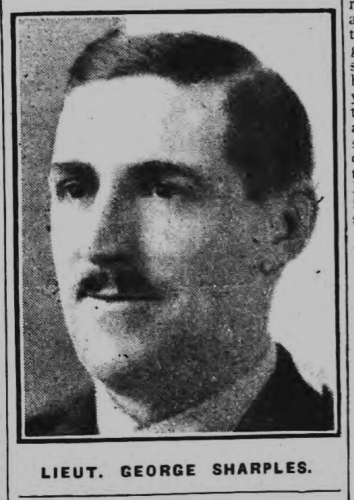
- Age: 33
- From: Preston, Lancs
- Regiment: The King's (Liverpool Regiment) 19th Btn
- K.I.A Thursday 7th June 1917
- Commemorated at: Railway Dugout B.g. Zillebeke
Panel Ref: V.M.7
George was born in Preston in 1884 the son of William Sharples and his wife Elizabeth (nee Woods) of Bushell Place, Preston, Lancashire. His father was the proprietor of the Corporation and Victoria Hotels in Preston, and was also a director of Preston North End Football Club. His parents married in 1879.
The 1891 Census shows the family are living at 7 Wharf Street, Preston. Head of household is George's grandfather George Woods 84 a licensed victualler born Samlesbury, father William is aged 36 and a manager for licensed victualler born in Preston, mother Elizabeth 34 born in Preston, their children were all born in Preston and were shown as; Elizabeth 11 scholar, Mary 8 scholar, George 6 scholar, Margaret 4 scholar, William 2, and servants Margaret Valentine 27, Mary Dunn 25.
The 1901 Census shows the family are still living at 7 Wharf Street, Preston. Father, William is now aged 46 and a publican, mother Elizabeth is 44. Their children are shown as: Elizabeth aged 21, and a telegraphist, Mary aged 18, George aged 16, is a junior bank clerk, Margaret is aged 14, William is aged 12, Henry is aged 10, Winifrede is aged 4, and servants, Alice Cross aged 21, Ann Cross aged 20 of Preston.
George was educated at Preston Catholic College, and after first being employed at the Preston Branch of the Lancashire and Yorkshire Bank, he joined his father in business as a brewer. He was a member of the Preston and County Catholic Club and was its first member to be killed in the war. He was also a keen all round athlete, being a good boxer, playing football for Winckley Football Club and golf at Preston Golf Club.
The 1911 Census showed George, aged 26, was a publican living with his sister Elizabeth, aged 31, who was the manageress, and two servants at the Grand Function Hotel, Watery Lane, Preston. The rest of the family are at the Corporation Arms.
George joined the 19th battalion of the Kings Liverpool Regiment as Private 21624 in October 1914, and obtained his commission in the 19th Battalion in the late summer of the following year. He crossed to France in November 1915, attached to No.3 Company. He earned a commission to 2nd Lieutenant before promotion to Lieutenant.
He is first mentioned in the 19th Battalion War Diary, on the 25th April 1916 when he and five privates from No.3 Company were wounded by shell fire at Maricourt, on the Somme Front. This was clearly before the Somme Offensive began and the severity of his wounds on that occasion was not known. He is next mentioned in the 19th Battalion War Diary on the 06th December 1916, when he returned from a transport course and then again on May 19th 1917,when he is reported as having joined the Battalion from the 18th K. L. R. Presumably he was attached to that unit between December 1916,and May 1917; this does not tally with the newspaper report either, which states that after being wounded, he spent some months in England before returning to France in mid May 1917. He does not appear in the 18th Battalion War Diary during the specified time.
George was killed in action, aged 33, on 07th June 1917. Details of the action in which George fell are contained in the 19th Battalion War Diary:
07th June 1917 – The Battle of Messines.
"Attack on the Messines Ridge by the Second Army, this battalion and the 2nd Bedfordshire Regt holding the line on the left flank of the attack. Immediately after zero (3.10 a.m.) four patrols under 2nd Lieuts J. Ross, G.W. Sharples, A.S. Calvert, C.W. Cackett. The first patrol under 2nd Lieut Ross got to within 40 yards of the German front line. 2nd Lt Ross then left his patrol and went forward to reconnoitre. In climbing over the parapet he found that the front line was strongly held. With great difficulty he got his patrol back to our front line having suffered only 1 casualty (wounded). The report was immediately sent in with the result that artillery commenced to bombard the enemy front line. The other three patrols were unable to get far owing to the heavy enemy machine gun and rifle fire. One patrol leader, 2nd Lt. Sharples, was killed and his patrol suffered casualties, 2 OR killed and 4 OR wounded. In 2nd Lt. Calvert’s patrol 1 OR was killed. During the day repeated reports were received of the progress of the attack on the right and late in the afternoon reports were received that most of the objectives had been reached.”
Further detail is provided;
On the day he was killed in action, the Battalion was holding the line on the left flank of the attack, near Hooge, after the explosion of nineteen mines under the Messines Ridge, patrols were sent to see if the Germans still held the line. They suddenly came under rifle and machine gun fire from a group of about two dozen Germans, who had left their trenches and were lying in wait out in the open. The patrols scattered, and Lewis Gun fire from the British Trenches also dispersed the Germans. It was not until after dark that the stragglers made it back to the British lines and they reported that Second-Lieutenant Sharples and two others had been killed. Another patrol was then went out to look for their bodies, which were eventually found and recovered about forty yards from the German wire.
There were three Other Ranks killed during this action they were Pte 52098 Alfred Jackson, Pte 204299 George Wiseman, and Pte 23106 Samuel McIlroy. They lie together in Railway Dugout Burial Ground at Zillebeke.
George also rests at Railway Dugouts Burial Ground in Belgium at Plot VII, Row M, Grave 7. where his headstone bears the epitaph:
"RIP"
Railway Dugouts Burial Ground is 2 Km west of Zillebeke village, where the railway runs on an embankment overlooking a small farmstead, which was known to the troops as Transport Farm. Burials began there in April 1915 and continued until the Armistice, especially in 1916 and 1917, when Advanced Dressing Stations were located in the dugouts and the farm. The names "Railway Dugouts" and "Transport Farm" were both used for the cemetery. In the summer of 1917 a considerable number were obliterated by shell fire before they could be marked.
The commune of Zillebeke contains many Commonwealth cemeteries as the front line trenches ran through it during the greater part of the First World War.
Railway Dugouts Cemetery is 2 Kms west of Zillebeke village, where the railway runs on an embankment overlooking a small farmstead, which was known to the troops as Transport Farm. The site of the cemetery was screened by slightly rising ground to the east, and burials began there in April 1915. They continued until the Armistice, especially in 1916 and 1917, when Advanced Dressing Stations were placed in the dugouts and the farm. They were made in small groups, without any definite arrangement and in the summer of 1917 a considerable number were obliterated by shell fire before they could be marked. The names "Railway Dugouts" and "Transport Farm" were both used for the cemetery.
At the time of the Armistice, more than 1,700 graves in the cemetery were known and marked. Other graves were then brought in from the battlefields and small cemeteries in the vicinity, and a number of the known graves destroyed by artillery fire were specially commemorated. The latter were mainly in the present Plots IV and VII.
The cemetery now contains 2,459 Commonwealth burials and commemorations of the First World War. 430 of the burials are unidentified and 261 casualties are represented by special memorials. Other special memorials record the names of 72 casualties buried in Valley Cottages and Transport Farm Annexe Cemeteries whose graves were destroyed in later fighting.
The cemetery was designed by Sir Edwin Lutyens.
In an obituary written in the edition of the ‘Preston Guardian on June 16th 1917, it is recorded that while in France, he was thrown from his horse and injured. At a later date, in the summer of 1916, he was wounded during the Somme Offensive and returned to England.
Preston Herald 16th June 1917
Lieut. G. Sharples Killed
Well Known Local Athlete
Son Of Former North End Director
A telegram was received on Monday night stating that Lieutenant George Sharples (33), King's Liverpool Regiment, was killed in action on June 7th. He was the eldest son of the late Mr William Sharples, proprietor of the Victoria and Corporation hotels, and the director of P.N.E. Football Club.
Deceased joined the army in October 1914 as a private, and about 10 months later received his commission. While in France he was thrown from his horse and injured. After his recovery he took part in the Somme offensive, was wounded and returned to England, where he remained for some months. He only returned to France 5 weeks ago.
He was educated up the Catholic College, Winckley Square, and some time was employed at the Preston branch of the Lancashire and Yorkshire Bank. Later he assisted his father. He is the first member of the County Catholic Club to make the supreme sacrifice. He was a well-known local athlete, a capital footballer, scratch man at golf as a member of the Preston Club, and a clever boxer. He has two brothers serving King and Country, viz., Lieutenant Henry Sharples, King's Liverpool Regiment, recently mentioned in dispatches, and Lieutenant William Sharples R.G.A.
Soldiers Effects to mother Elizabeth.
His father died, aged 62, in 1917.
His death was reported in the Preston Herald on Saturday 03rd March 1917;
DEATH OF MR. WM. SHARPLES.
The death occurred on Thursday morning of Mr Wm. Sharples, brewer and licensee of the Corporation Arms. He was 62 years of age and had been in indifferent health for some time. A Roman Catholic, he was held in the highest esteem by the that religious community, and indeed by everyone in the town. Some 40 years ago he was one of the little band of enthusiasts who built up the North End Football Club from the old Rugby Club, and he and Mr Pomfret were the only two “old originals” left in active participation of the management of the club. Two of Mr Sharples’ sons have played for the club, and all three of the sons now hold commissions in the army. The internment takes place today at St Michael's Church, Bonds, Garstang, following requiem mass at Wilfrid's, Preston.
After George’s death his sister, Winefreda, died, aged 21, in 1918.
George's death was reported in the Nottingham and Midland Catholic News on Saturday 30th November 1918;
PRESTON BROTHERS' WAR
MEN WHO FOUGHT IN THE WAR.
Three Preston Catholics, sons of Mrs Sharples, Fishergate Hill, have achieved a remarkable record in war. On the outbreak of hostilities they joined the Liverpool “Pals” together as privates, and all subsequently were raised to command rank, two in their own regiment, the 19th King’s Liverpool, and the other in the R.G.A. ieutenant George Sharples, the eldest, was killed whilst fighting at Messines in June 1917, and for gallantry on the same occasion Captain Harry Sharples(then Lieutenant), the youngest brother, was awarded the Military Cross. Captain Sharples, who lost an arm at Kemmel in April this year, had been previously mentioned in despatches for bravery and devotion to duty at Fleurs on the Somme in September 1916. On Saturday he was decorated with his Military Cross by the King at Buckingham Palace, his majesty speaking with him for some time and sympathetically asking questions about the Captain's lost arm.
Captain W. Sharples, the second son, has also received the Military Cross, this being awarded for his gallantry during the retreat of March last, when, according to the official report, he went under heavy shell fire to the various outposts of his Brigade when all communications had been cut, and when the enemy had captured the forward section of our defences he went forward to reconnoitre right into the enemies’ forward troops. He twice made valuable reconnaissances of the enemy position, and “his dashing gallantry was a splendid example to all.”
Soldiers Effects of over £100 to mother Elizabeth, no pension record found.
Probate 1917 to Elizabeth Sharples.
Probate 1917:-
SHARPLES George Woods of the Victoria and Station Hotel, Fishergate, Preston Lancashire a lieutenant in His Majesty's Forces died 7 June 1917 at Messines in France killed in action Administration Lancaster 16 November to Elizabeth Sharples widow. Effects £148 15s 1d.
By the 1921 Census at 10 Bushell Place, Preston, his mother, Elizabeth, is aged 64, and is living with children Elizabeth, Margaret, William and Henry. She died, aged 65, in 1922.
George is commemorated on the Memorial at Preston Catholic College.
We currently have no further information on George Woods Sharples, If you have or know someone who may be able to add to the history of this soldier, please contact us.
Killed On This Day.
(109 Years this day)Thursday 7th June 1917.
Pte 52098 Alfred Jackson
20 years old
(109 Years this day)
Thursday 7th June 1917.
Pte 23106 Samuel McIlroy
27 years old
(109 Years this day)
Thursday 7th June 1917.
2nd Lieut George Woods Sharples
33 years old
(109 Years this day)
Thursday 7th June 1917.
Pte 204299 George Wiseman
27 years old