
1885 - 1916

CPL David Wallace Crawford
1887 - 1916

Lce-Corpl John Joseph Nickle
1894 - 1916

Pte 17911 Morton Neill
1897 - 1916

Lieut Edward Stanley Ashcroft
1883 - 1918

Pte 38140 James Smallshaw
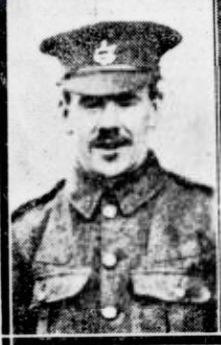
- Age: 26
- From: Liverpool
- Regiment: The King's (Liverpool Regiment) 20th Btn
- K.I.A Thursday 12th October 1916
- Commemorated at: Thiepval Memorial
Panel Ref: P&F1D8B &8 C.
James Smallshaw (Jim) was born on the 17th October 1889 in Liverpool, the son of William John Smallshaw and his wife Margaret Ellen(nee Gilroy) who were married on the 07th August 1882 at Our Lady, St. Nicholas and St. Anne's Church, Liverpool. William was a 20 year old porter, Margaret was 19, both of Penhryn St, Everton. Jim was baptised on the 20th November 1889 at St Peter's Church, Everton, father William of 17 Sackville Street.
On the 1891 Census the family, all born Liverpool, are living at 26 Joshua St, Everton. Father William aged 29, a dock porter, mother Margaret Ellen aged 26, children Anna aged 6, William aged 4, Nellie aged 3, and Jane aged 1.
On the 1901 Census the family are living at 1 Butterfield Street, Everton. His father, William J., is aged 39, a fowl? porter, mother Margaret E. aged 36, children Hannah aged 16, William aged 14, an errand boy for toy shop, Ellen aged 13, James aged 11, George aged 9, Ernest aged 7, Eva aged 4, Florence aged 2, Hector Baden aged 11 months.
On the 1911 Census the family have moved to 119 Gwladys Street, Walton. His father William is not present, mother Margaret Ellen is aged 36 and advises that she has been married for 29 years, and has had 13 children with 9 surviving. All of her children are declared in the household; Hannah aged 26, William aged 24, a packer at Ogden’s Tobacco Factory, Ellen aged 23, a cigar maker at Cope Bros. James aged 21 a packer at Ogden’s, George aged 19 not working, Ernest aged 17, at Liverpool tin cannister works, Eva aged 14, a dressmaker apprentice, Florence aged 12 at school, Hector aged 11 at school, and Leah 6.
Jim married Edith Bamber in the June quarter of 1912 at St. John The Baptist Church, Tuebrook and they had 3 children Edith (1913), Ellen (1915) and James William (1916).
Jim worked at Ogden's Tobacco factory prior to enlisting.
He enlisted in Liverpool joining the 20th Battalion of The King's Liverpool Regiment as Private 38140.
The 20th Battalion were placed in support of the 17th Battalion during the attack of 12th October 1916:
According to the 20th Bn War Diary, on 10th October 1916 the battalion marched from Dernancourt via Mametz to Bazentin Le Grand where it bivouacked for the night. The next day the battalion moved up to site for assembly trenches, arriving about 11 p.m., where it dug in two good trenches, Nos.1 and 2 Coys front and Nos.3 and 4 Coys in rear.
From the War Diary:
Near Eaucourt L’Abbaye. 12/10/1916. The 4th British and 6th French armies continued the attack. Zero 2.5 p.m. The whole XVth Corps attacked […] The attack of 89th Inf Bde was carried out with 2nd Bn Bedf Regt on right, 17th Bn KLR on left, 20th Bn KLR in support, 19th Bn KLR in reserve. Battalions attacked in four waves. On the departure of the attacking battalions Nos. 1 and 2 companies advanced, each in two waves, to garrison the front line trench vacated by 2nd Bn Bedf Regt on right and 17th KLR on left. On Nos 1 and 2 Coys vacating front assembly trench, it was occupied by two platoons of Nos. 3 and 4 Coys respectively, from rear assembly trench. As the assaulting waves left their trenches they were met by intense machine gun fire, especially on our left. The enemy also opened heavy barrages on our front support and assembly trenches. […] Capt. H. Beckett, commanding No.1 company, reached the front line with few casualties, but Lieut R.D. Paterson leading No.2 company was killed. His company also had few casualties. The assaulting battalions were held up by very heavy machine gun fire, and made little progress. […] At 4.20 p.m. two platoons, No.4 Coy, under Cpl Brighouse, were sent up to reinforce the left, and No.3 Coy under Cpl Sutton followed at 4.45 p.m. Battalion HQ moved up to front line at 4.55 and remaining two platoons of No.4 Coy moved up to join Cpl Brighouse.
Casualties during action:
Officers – Killed Lieut. R.D. Paterson, 2nd Lieut G.L. Grennan, Wounded – 2nd Lieuts A.E. Griffin, L.E. Mclean Hayes, C. Buttemer, Wounded Cpl g. Brighouse.
Other Ranks killed – 20.
It had rained incessantly at the beginning of October 1916 and the ground was full of mud. In his book ‘The Liverpool Pals’ Graham Maddocks describes the day Herbert was killed.
It was obvious that the Germans knew an attack was coming and from which direction it would be mounted. On the evening of the 11th the 20th Battalion moved up the line and dug two deep assembly trenches behind the 17th Battalion’s position for the attack the next day. The 19th Battalion also moved into its reserve positions known as Flers Trench. Although the rain has stopped, the ground was like a morass, with all the natural vegetation destroyed, it was difficult to tell exactly where the objectives lay. On the afternoon of the 12th at exactly 2.05pm, the attack began along the whole Corps line, covered by the local batteries of the Royal Field Artillery which still had line of sight. As the whistles blew, the 17th Battalion left its trenches to move forwards, at the same time No.1 and 2 Companies of the 20th Battalion moved forward and occupied the trenches vacated by the 17th. As they too went over the top, No.3 and 4 Companies took their place and waited in their turn to follow. No.2 and 3 Companies of the 19th Battalion moved up to occupy the assembly trenches dug the previous night by the 20th.
As soon as the attacking waves left their trenches the enemy artillery began to register on them and at the same time the defending infantry commenced a murderous rain of fire. Those German regiments were trained and experienced soldiers, well dug in on high ground, and for the most part, looking out on uncut wire. As such it was virtually impossible for them to miss the City Battalion men struggling to advance in the mud towards them.
Brigadier-General F.C.Stanley wrote that the Battalions were also suffering casualties due to the short shooting of the British heavy artillery fire. “I know from practical experience that they were our own guns which were shooting, and which were causing us quite a considerable number of casualties. The fault lay at that time from the fact that the heavy gunners would not send their FOO’s (Forward Observation Officers) far enough forward, but were content to observe us from right back”
Some ground was gained that day, about 150 yards, the 20th Battalion were not relieved until 24 hours later causing the men to endure another day and night in the front line trench.
James was killed in action during the battle described above.
His body was not recovered or was subsequently lost as he has no known grave and is commemorated on the Thiepval Memorial, France.
The Thiepval Memorial, the Memorial to the Missing of the Somme, bears the names of more than 72,000 officers and men of the United Kingdom and South African forces who died in the Somme sector before 20 March 1918 and have no known grave. Over 90% of those commemorated died between July and November 1916.
On 01st August 1932 the Prince of Wales and the President of France inaugurated the Thiepval Memorial in Picardy. The inscription reads: “Here are recorded the names of officers and men of the British Armies who fell on the Somme battlefields between July 1915 and March 1918 but to whom the fortune of war denied the known and honoured burial given to their comrades in death.”
A short obituary in the Liverpool Echo dated 02nd November 1916 which simply states:
SMALLSHAW-October 12, killed in action, aged 28 years, James (Jim), K.L.R., dearly beloved husband of Edith Smallshaw, 8 Lampeter-road, Anfield. “Sadly missed by his sorrowing wife and family”.
His family photo was posted in the Liverpool Weekly Courier on Saturday 04th November 1916:
A PATHETIC GROUP.
A photo shows Private James Smallshaw of the K.L.R. (who was killed in action on October 12th) and his widow and three children aged respectively, three years, 15 months, and nine weeks, who reside at 8 Lampeter-road, Anfield, Liverpool. Private Smallshaw joined the King’s in April last and after only six months service was killed. His commanding officer, in a sympathetic letter to Mrs Smallshaw, says:- “As far as I can find out he was killed by a shell, and the stretcher bearers gave him and several of his comrades a decent burial. One of the boys who was with him a little previous told me that the last words he heard your husband say were of you, and that the 12th was his eldest child's birthday. I am very sorry to lose him, as he was a good soldier, did his duty, and was well liked by the boys who send their deepest sympathy.”
James earned two medals which suggests that he didn't serve overseas until 1916.
Soldiers Effects, Army Pay of £2 5s 11 to widow Edith, and Pension to widow Edith and children Edith, Ellen and James William, 8 Lampeter Road, Anfield which was the address of her parents. . The War Gratuity of £3 and a pension of 26/3 pw went to Ellen Bamber (her mother), of 8 Lampeter Road, the guardian of the three children, 8 Lampeter Road, Anfield.
He is commemorated on the following Memorials:
Hall of Remembrance, Liverpool Town Hall, Panel 42
Ogdens Tobacco Memorial
St. John the Baptist C.of E. Church, Tuebrook, Liverpool.
Jim's family paid tribute to him in the Liverpool Echo on the second anniversary of his death on 12th October 1918:
SMALLSHAW— in loving memory of my dear husband, killed in action October 12, 1916.
For us he always did his best;
May God grant him eternal rest.
- From his loving wife and children, 8 Lampeter Road.
SMALLSHAW— In loving memory of Jim, killed in action October 12, 1916. - Every remembered by all at 10 Lampeter Road.
His widow Edith died, aged 25, just a few days after the previous week's family notice. Her death was recorded in the Liverpool Echo on 21st October 1918:
SMALLSHAW—October 19, at 8, Lampeter-road, aged 25 years, EDITH, wife of the late James Smallshaw; (killed in action) and beloved daughter of William and Ellen Bamber, 10, Lampeter-Toad (At rest. No flowers.)
Her death was recorded in the Liverpool Echo on 21st October 1918
SMALLSHAW—October 19, at 8, Lampeter-road, aged 25 years, EDITH, the late James Smallshaw; (killed in action) and beloved daughter of William and Ellen Bamber, 10, Lampeter-Toad (At rest. No flowers.)
Jim was one of three brothers who gave their lives during the Great War. His brothers William and George also fell.
William served as Driver 696033 with the Royal Field Artillery. He died of wounds on 08th July 1917 and rests at Merville Communal Cemetery Extension.
George served as Private 359246 with the 2/10th Battalion of The King's Liverpool Regiment. He died of wounds on 24th August 1916 and is commemorated on Panel 3 of the Ploegsteert Memorial in Belgium.
Their father died, aged 67, in the December quarter of 1928.
Their mother died, aged 88, on the 05th March 1953
Probate:-
SMALLSHAW Margaret Ellen of 12 Whitehedge Road, Liverpool 19 widow died 6 March 1953 Probate Liverpool 28 April to Hannah McBride widow and Florence Smallshaw spinster. Effects £2715 10s 1d.
James Smallshaw was the great Uncle of Dr. Lance Smallshaw, Belgium. Here is a summary of the accounts about him and his brothers from information passed down from his father.
SMALLSHAW FAMILY (LIVERPOOL) THE GREAT WAR (The Fate of 4 Great / Grand Uncles from Everton).
Background: The Smallshaws are of a single-line family first recorded in the 13th century in an entry of the Court Rolls of Wakefield in Holne (now Holme) in the West Riding, Yorkshire, England under William de Smalschaghe (1277) and Robert de Smaleschawe (1298). In a Yorkshire Deed (1322) is mentioned the vaccary (a cow-pasture, of Lancashire origin) of Smaleshagh. The Smallshaw name is of 7th century origin Smael-sceaga, meaning a small wood (shaw). This homestead was to become a hamlet and is now a suburb of Ashton-Under-Lyne, Greater Manchester. In the 14th century the Smallshaw’s left their homestead and settled in the ancient priory village of Upholland, Lancashire. The family are mentioned in various documents throughout and beyond the 17th century, particularly in the period of the English Civil War, they were Royalists. It is here they would remain and the family origins would be traced to and then through the 19th century. It is at this time (1830s) during advent of Industrial Revolution when the nearby city of Liverpool expanded due to its thriving port. Like many families in this region during that time, some would relocate from their farming village communities in search of regular work in that city and internationally.
William Smallshaw (Wills) (DOB 9th July 1886) Eldest son of 12 of William John and Margret Ellen Smallshaw (nee Gilroy) born in Liverpool (the parental family home was at 119, Gwladys Street, Everton in Liverpool next to Everton F.C.). Husband to Alice (nee Graham ) 11th May 1912 and father to William, Nora and Alice. He was described by my Great Aunt Hannah as a very responsible, mature family man of smaller stature, 5ft 3inches (1m 60cm) with a tattoo on his left forearm of Buffalo Bill. Interesting Buffalo Bill actually toured the UK in the 1900s and visited Liverpool twice during his time there. Maybe William saw him during that time? Prior to the advent of the Great War in August 1914 he had served for 4 1/2 years with the 1st West Lancashire Division, Liverpool, which had since been disbanded. In November 1915 the War Office authorised its reformation (now designated 55th (West Lancashire) Division. In December 1915 he re-enlisted as a driver 696033 for the 57th (2nd/1st West Lancashire) Divisional Ammunition Column (DAC), Royal Field Artillery (RFA), which was a 2nd- line unit for the Territorial Force (TF), based at the Drill Hall on Stanley Street in Liverpool. In May 1916 as part of the Great War on-going troops expansion they became the 276th (CCLXXXVI) Brigade RFA DAC, commanded by Brigadier-General N.H. Bray. After completing further training in Aldershot they moved to France in February 1917 and disembarked at Le Havre. On 25th February they took over a section of the Western Front under the command of the II ANZAC Corps. On 6th July 1917 near Estaires in France William, another younger driver Bartholomew Dodding 695980 (whose parents lived close by) plus others were severely injured by heavy enemy shelling. William and Bartholomew died from wounds on / around 8th July 1917, sadly on his 31st birthday. Both are buried at Merville Communal Cemetery Extension (B.I.37 and B.I.35 respectively) in France. Buried in between them at B.I.36. is a Private. H.P. Moore 335857, 2nd/10th Bn. Liverpool Scottish (The King’s Regiment).
George Smallshaw (Georgie, dob 24th June 1891), younger brother of William and James, husband to Dorothy (nee Mercedes Forrest) April 1910 and father to George Frederick and Dorothy Leah. My Great Aunts, Florence (Flo.) and Hannah described George as a true Liverpool character with a great sense of humour. It states in the 1911 Census that he was in between jobs after previously working at the Ogden’s Tobacco Factory in Boundary Lane, Liverpool. Maybe James had helped him get that job. On 31st August 1914 the War Office authorised the formation of a reserve / 2nd-line unit for each of the TF units. In September the 2nd/1st South Lancashire Brigade came into existence. In November 1914 it was composed of 2nd-Line duplicates of the battalions of the peacetime South Lancashire Brigade that were due to be sent overseas. George 359246 later enlisted in the 2nd/10th Battalion King’s Liverpool Regiment (KLR) (Liverpool Scottish). The Liverpool Scottish, known diminutively as "the Scottish", is a unit of the British Territorial Army which was originally raised in 1900 as an infantry battalion of the KLR. This was the battalion of Noel Godfrey Chavasse, the Battalions Surgeon-Captain between 1916 to 1917, who was the only soldier during the Great War to be awarded 2 Victoria Crosses (VCs), the King awarding him an award of a bar for his second VC. The battalion was a second line feeder battalion having to undertake a lot of continued training for their significant lack of practical soldiering experience. In August 1915 these formations were assigned numbers, 172nd (2nd/1st South Lancashire) Brigade and 57th (2nd West Lancashire) Division respectively. On 20th February 1917 they left Southampton to go to Le Havre, France arriving the following day, eventually reaching Estaires 3 days later. On 26th February 1917 they took up their positions in the trenches at Bois Grenier, Rue du Bois, on the Western Front, France serving on an 8 days on, 8 days off shift rota commended by the temporary Brigadier-General, G.C.B. Paynter. In August 1917 there was heavy enemy shelling and aircraft activity in this region. The records are unclear but it is believed that George and another were severely wounded on /around 21st August 1917 but died of wounds on 24th August 2017, age 26. A Cairn memorial for the battalion has since been laid for those who served at Bois Grenier region in 1917. George is remembered 2 km across the border in Belgium at the Ploegsteert Memorial, Panel 3, Hainaut. He is mentioned in the 2nd/10th battalion Liverpool Scottish beautifully bound decorative Roll of Honour Book, Section Sm. It is currently held in St George’s Hall in Liverpool (I’d like to mention Major Ian Riley from the Regimental Museum for various communications and his valued help with this). 2nd Lt. Lancelot Slocock (killed at Guillemont in August 1916) who was one of England’s finest rugby union players before he left to do business in the U.S.A, he is mentioned just below but one to George’s inscription. During the Great War there was an on-going close interaction between George, the Scottish and the Queens Own Cameron Highlanders Regiment (see the regiment Great War cap badge and piece of kilt tartan sent to the family after George died). In the final year of the war, what was left of the 2nd/10th Bn. were swallowed up by the 1st/10th Bn. and eventually transferred to the 55th (West Lancashire) Division on 21th April 1918. The Liverpool Scottish formalised its relationship with the Queen's Own Cameron Highlanders and transferred in 1937 to become the regiment's second territorial battalion. The sailor in the picture with George is Ernest (Ernie) another brother (DOB 1893), Married Hilda Stewart in 1948, son Gilroy (Grandmother Mothers maiden name) who served with HMS Dove and with some merchant ships (two of these he served on were torpedoed miraculously he survived both attacks) and the only brother to survive the Great War. George is mentioned in the Roll of Honour at Liverpool Town Hall.
James Smallshaw (“Jim”, dob 17th October 1889), younger brother to William, husband to Edith (nee Bamber) 1912 and father to Ellen, Edith and James William. He had worked at the Ogden’s Tobacco factory, Liverpool prior to the war. He probably had helped his brother George to get a job there. The Liverpool of the 1914s of early summer was prosperous, proud, alive with trading and bustling with people engaged in all types of commerce. James 38140 enlisted in the Pals Kitchener’s New Army, 20th (Service) Battalion (4th City) KLR TF. Formed in Liverpool on 16th October 1914 by Lord Derby, in the old watch factory, Prescot Watches, Liverpool. By the time the last battalion (20th Bn.) of the Pals was formed they were quartered at the Tournament Hall, Knotty Ash and trained each day in Knowsley Park, Liverpool. On 30th April 1915 they came under orders of 89th Brigade, 30th Division. The idea of the formation of the Liverpool Pals battalions is associated with the 17th Earl of Derby (Lord Derby), Stanley family seat nearby at Knowsley Hall at the on-set of war, August 1914. In fact, for the 4 Liverpool Pals battalions their cap badge is in the image of the Family Crest of the Derby Family, Eagle and Child and Motto, Sans Changer (Latin: Without Changing) which was worn by the Pals with distinction from the standard cap badge worn by of the other battalions of the KLR, the Horse of Hanover. The Pals badge had many nicknames not all reverent, ˜the duck and illegitimate”, or words to that effect etc. They were commanded by the brother of Lord Derby, Brigadier-General F.C. Stanley. They landed at Boulogne, France on 8th November 1915. They stayed one night at Ostrehove Camp and the next day James arrived for training at Pont Remy. On 18th December he moved to the Western Front to be deployed at Bienvillers, they were split into platoons attached to the 6th Bn. and 8th Bn. of The Leicestershire Regiment. They came out of the frontline for an uneventful Christmas Eve of 1915 and moved to Louvencourt for Christmas Day where they temporarily came under the Command of Brigadier-General C.J. Sackville-West’s 21st Brigade. In fact during this time the 20th Bn. were recognised by Brigadier-General E.G.T. Bainbridge, commanding the 110th Infantry Brigade, “This is certainly the best Bn. which has been sent to this Brigade for the instruction”. By 23rd June 1916 James was in the front-line N. of Maricourt, Somme Valley. 24th June, 20th Bn. in the front-line trenches suffered quite serious bombardment losses. So the Somme Big Push Offensive had begun. On 1st July 2016 the 20th Bn., zero hour was 07.30hr, No Mans Land was about 450 yards ( 411m) wide. After heavy British bombardment they went over the top. When they reached the front line trenches the shelling had been so effective there was very little resistance. Next was the fight for Montauban, then the debacle of Trones Wood. 30th July, Guillemont, where the 20th Bn. experienced heavy losses, 9 officers and 130 other ranks were KIA or DOW. On 2nd August they were able to get some rest at Abbeville. By August 1916, people at home were beginning to feel uneasy about the euphoric way in which the press were reporting the war, and realizing that the breakthrough that had been promise by the Somme offensive was not going to be realised. The spirit that had bound the Pals Bn’s together at their inception in 1914 was now to bind them together in sorrow and mourning. The 20th Bn. being left with only 8 sergeants and 12 Lieutenants. On 26th August they left for the Givenchy sector. The fighting here, although not quiet wasn’t at all like the Somme, this sector had been involved in mining detonation warfare tactics since 1915. It was a different experience for the Pals which they didn’t find too comfortable, as the trenches were very close to each other in places and so they entered into a new world of close trench warfare. By mid-October 1916 the 20th Bn. KLR had just moved from Moutauban to Bazentin le Grand and were situated at Eaucourt l'Abbaye (Eaucourt), which is NW. of Martinpuich, SE. of Le Sars, S. of the Butte de Warlencourt, W. of Gueudecourt and NW. of Flers, in support of the capture of the Ridges above Thiepval, Le Sars and le Transloy, the Battle of Ligny-Thilloy. There was a sudden inclement change in the weather due to heavy rain fall which made battle logistics very difficult, hindering the artilleries advancement and making it virtually useless. The Royal Flying Corps. spotter planes could rarely fly due to the total cloud. So, the assault faltered and some impetus was lost. It was at this point that General Douglas Haig intervened and insisted that the main attack should continue with an offensive on 12th October in the area south of Ligny-Thilloy. During the night of 10th/11th October, the 17th Bn. moved into assembly trenches which ran N. of Flers, NE. of the ruins of the village of Eaucourt l'Abbaye. At mid-day on 11th October the British artillery bombardment began and there was also an exchange of artillery and the 11th and 20th Bn. including James moved up and dug 2 deep assembly trenches behind the 17th Bn. for the attack the following day and the 19th Bn. moved in the reserve position in Flers Trench. Zero hour was 2.05pm on 12th October 1916, The Pals 17th Bn. left the trenches, both Companies of the Pals 20th Bn. moved forward and occupied those trenches before going over the top then the other companies advanced into the newly vacated trenches behind them and so on. As soon as the Bn’s left the trenches they were faced with incoming artillery bombardment from the Brandenburgers of 4., Brandenburgisches Infanterie-Regiment Nr.24, from Nueruppin, Bavarians of 16, Bayerisches Reserve Infantrie-Regiment from Passau, and 21, Bayerisches Infanterie-Regiment from Furth. These were very experienced soldiers compared to the Pals Bn’s, and were well dug in on high ground. The British bombardment hadn’t cut their barbed wire and the 17th Bn. were badly cut down in the planned cross fire as they had become silhouetted against the sky due to slight rise in the ground in No Mans Land as they advanced. Those on the left were trapped by the uncut barbed wire and were also easy targeted. Seeing the first waves being mowed down some turned back causing congestion to the advancing British troops and so again they became easy prey for the machine guns. Due to the inclement weather the British artillery hadn’t been able to advance sufficiently and as a consequence British shells, the friendly fire, began falling short onto the Pals Bn’s. A British plane was shot down at 2.40pm both occupants were killed. Some ground had been taken, about 150 yards (137m). Then, daylight turned to darkness at 4pm as the 17th Bn., who had taken the brunt of it were relieved by the 1st/2nd Company of the 20th Bn. Sadly, during the battle James was reported as being killed in action. 31 were killed from the 20th Bn. and total of 152 from all the 4 Pals Bn’s. Throughout the month of October 1916, the Liverpool Pals had 226 KIAs, 567 were either wounded or missing. During the first 2 years of the Great War, the Liverpool Pals had lost almost 1750 soldiers. James is listed at the Thiepval Memorial, Somme, France, Pier and Face 1 D 8 B and 8 C.
James is mentioned in the Roll of Honour at Liverpool Town Hall, on the Ogdens Tobacco Memorial and also in the St. John the Baptist C.of E. Church, Tuebrook, Liverpool.
This work has been in progress for some 20 years and now I have been able document it properly on-behalf of the family.
Personal Note: Like many parents during the Great War, Margret Ellen, my Great Grandmother was so overcome with grief of the loss of my 3 Great Uncles with their deaths happening in such a short space of time she reacted by stripping the house of all their belongings, nobody was allowed to discuss them as a way to try to move on in her / family life. I won’t ever truly understand the pain she must have gone through with their loss but I do truly believe now is the right time to share this information and respectfully remember them as we should do.
Lance Smallshaw (Great / Grand Nephew) October 2017.
We currently have no further information on James Smallshaw, if you have or know someone who may be able to add to the history of this soldier, please contact us.
Killed On This Day.
(109 Years this day)Monday 21st May 1917.
Pte 57903 George Frederick Smith
35 years old