
1885 - 1916

CPL David Wallace Crawford
1887 - 1916

Lce-Corpl John Joseph Nickle
1894 - 1916

Pte 17911 Morton Neill
1897 - 1916

Lieut Edward Stanley Ashcroft
1883 - 1918

2nd Lieut Herbert Leonard Stacey
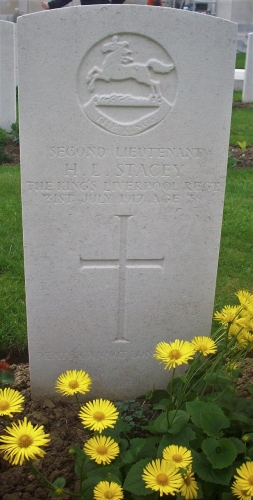
- Age: 39
- From: Liverpool
- Regiment: The King's (Liverpool Regiment) 18th Btn
- K.I.A Tuesday 31st July 1917
- Commemorated at: Tyne Cot Cemetery
Panel Ref: LVIII.D.14
Herbert Leonard Stacey was born 19th March 1878 in Liverpool, the son of Leonard and Louisa (nee Chatham) Stacey who were married on the 22nd Sept 1874 at St. John The Divine, Fairfield. Leonard was a clerk of 84 Prescot Rd, Louisa of 78 Prescot Rd. Herbert was baptised 12th May 1878 in St Anne’s C. of E. Church, Stanley, Liverpool.
The 1891 Census shows the family residing at 15 Brookland Road, West Derby, Liverpool.
The father, Leonard is aged 41 born 1850 in Warwickshire and occupation is a Clerk. His wife Louisa is aged 40 born 1851 in Liverpool. They have five children: Everlina aged 15 born 1876 and occupation Coffee Shop apprentice. Harry aged 14 born 1877, Herbert aged 14 born 1878, Louisa aged 10 born 1881 and Rhoda aged 3 born 1888 and all were still at school. They were all born in Liverpool.
His father Leonard died aged 48 on 21st December 1898
The 1901 Census shows the family living at 24 Greenwood Street, Everton.
His widowed mother, Louisa, now aged 50 is a Hotel Manageress, son Harry aged 24 is an Engineers Fitter, Herbert aged 23 is a General Clerk, Louisa aged 21 is a barmaid and Rhoda aged 13 at school.
He married Mary (Pollie) Dalrymple on the 30th Sept 1901 at Christ Church, Edge Hill. Herbert was a 25 year old cashier of 54 Saxony Rd, Mary was 26 of 123 Adelaide Rd, father Charles.
The 1911 Census shows Herbert and Mary living at 9 Hampstead Road, Fairfield, Liverpool.
Herbert is aged 33 and his occupation is Solicitor. Mary is aged 36 born 1875 in Liverpool and they have one child Herbert Wilson aged 7 born 1904 and also living at the address is Mabel Dalrymple sister-in-law aged 23 born 1888 and has no occupation listed.
Herbert was formerly a Private in The King’s Liverpool Regiment and had formerly been the following service numbers 6402, 9622, 243635 before obtaining his commission and serving in the 18th Battalion, The King’s Liverpool Regiment as a Second Lieutenant. It is not known as to when he joined the 18th Battalion, as he does not appear in the Battalion War Diary until the day of his death in action. ‘Officers Died in the Great War ‘and the records of the Commonwealth War Graves Commission both list his Battalion as the 7th Kings Liverpool Regiment so perhaps he was transferred to the 18th Battalion fairly soon before his death.
This occurred on 31st July 1917 on the first day of the Third Battle of Ypres, better know as the Battle of Passchendaele. On this day, before Zero Hour, which was 04.00.am, the Battalion was to form up for the attack in Sanctuary Wood but it was dark and continually falling rain gave very poor visibility. As a result of, No.2 and No.4 Companies became separated from the others, and were moved over to the left flank towards positions known as Surbiton Villas and Clapham Junction.
No.1 and 3 Companies were soon in action with the enemy, and were for a time, held up against a strong point until the German defenders withdrew. Following that, an attempt was made to penetrate a broad belt of uncut wire, but this was covered by Machine-guns which killed every man attempting to pass through the two gaps that were discovered. The party was led by Captain RP Heywood, MC, but once he had been wounded, the advance came to a halt.
The situation was similar with No.2 and 4 Companies, who had attacked along the wrong axis. Their advance was met with fierce opposition, and once all the experienced officer’s had been killed or wounded, all cohesion was lost, although some men did reach and cross the Menin Road at Clapham Junction.
By that time, the situation had become extremely confused, and the whereabouts of all four companies being unknown to Battalion Headquarters, urgent attempts were made to discover their locations. Eventually by mid afternoon, it was established that the bulk of the companies, although all mixed together, were dug in the vicinity of Stirling Castle and by mid evening, the Battalion Headquarters moved forward to meet them. Casualties assessed at the time were fourteen officers and two hundred and fifty other ranks, and it was subsequently established that seven officers and seventy six other ranks were also killed during the course of the day. One of these was Second-Lieutenant Stacey. He was 39 years of age.
18th Battalion
On this day, before Zero Hour, the 18th Battalion was part of 21st Brigade and was to form up for the attack from trenches from the area of Sanctuary Wood to Observatory Ridge but it was dark and continually falling rain gave very poor visibility. The departure of the 21st Brigade was delayed by heavy shelling.
The 18th King’s began to move forward in the rear of the 2nd Battalion of the Wiltshire Regiment who had been detailed as the left attacking battalion of the 21st Brigade.
No’s 1 and 3 Companies of the King’s led the way followed by No’s 2 and 4. In Sanctuary Wood there was considerable confusion, as a result No.2 and No.4 Companies became separated from the others, and were moved over to the left flank towards positions known as Surbiton Villas and Clapham Junction in the direction of the 90th Brigade.
No.1 and 3 Companies were soon in action with the enemy, and were for a time, held up against an enemy strong point. They pushed forward with their right on a trench known as Jar Row and their left on the tramway south of Stirling Castle. Advance along Jar Row was held up by the Germans who put up a fierce resistance and the party was forced to withdraw.
Another group of men from No.1 and No.3 Companies led by 2nd Lieutenant Graham were being held up by another strongpoint which was south of Stirling Castle, which was eventually stormed and taken. Not far away from this action, an attempt, by other men of No.1 and No.3 companies, was made to penetrate a broad belt of uncut wire, but this was covered by Machine-guns which killed almost every man attempting to pass through the two gaps that were discovered.
The situation was similar with No.2 and 4 Companies, who had attacked along the wrong axis. Their advance was met with fierce opposition, and once all the experienced officer’s had been killed or wounded, all cohesion was lost, although some men did reach and cross the Menin Road at Clapham Junction.
By that time, the situation had become extremely confused, and the whereabouts of all four companies being unknown to Battalion Headquarters, urgent attempts were made to discover their locations. Eventually by mid- afternoon, it was established that the bulk of the companies, although all mixed together, were dug in the vicinity of Stirling Castle and by mid evening, the Battalion Headquarters moved forward to meet them.
During its time in the line the 18th Battalion lost 7 officers and 76 men killed or died of wounds and 7 officers and 177 men wounded. They were relieved on the 2nd August.
Herbert Leonard now rests at Tyne Cot Cemetery, Belgium where his headstone bears the epitaph:
“DEATH CANNOT LONG DIVIDE”
Tyne Cot Cemetery is located in an area which was known as the Ypres Salient where Commonwealth, French, Belgian and German forces fought almost continuously throughout the First World War.
In 1917, British forces launched the Third Battle of Ypres, which raged from July to November. Forces from the UK, Australia, Canada, New Zealand and South Africa fought to push the Germans off the low ridges that dominate the area. On 4 October 1917, during the phase known as the Battle of Passchendaele, the 3rd Australian Division captured a group of German Bunkers on the ridge below the village of Passchendaele.
One of these bunkers was unusually large and was used as an advanced dressing station after its capture. From 6 October 1917 to the end of March 1918, 343 graves were made, on two sides of it, by the 50th (Northumbrian) and 33rd Divisions, and by two Canadian units. The cemetery was in German hands again from 13 April to 28 September, when it was finally recaptured, with Passchendaele, by the Belgian Army.
Tyne Cot Cemetery was greatly enlarged after the Armistice when remains were brought in from the battlefields of Passchendaele and Langemarck, and from a few small burial grounds.
He is officially listed as serving with the 7th Kings Liverpool Regiment, and his headstone does not bear the Eagle and Child of the Pals Battalions, but the White Horse of Hanover worn by the the 7th Battalion and the Regular units of the Regiment.
Liverpool Daily Post 9th Aug 1917
STACEY - July 31, died of wounds received an action, Second-lieutenant H. L. Stacey, the loving and beloved husband of Pollie Stacey of 9 Hampstead Road, Elm Park, Fairfield.
His probate was granted on 23rd October 1917.
STACEY - Herbert Leonard of 9 Hampstead Road, Fairfield Liverpool solicitor second lieutenant 7th K.L.R. died 31 July 1917 in France Probate Liverpool 23 October to Mary Stacey widow. Effects £8094 6s 10d.
Soldiers Effects to widow Mary, Pension record has no award
Mary, dob 29th Jan 1874, appears on the 1939 register still at 9 Hampstead Rd.
She died aged 71 in 1946
His mother Louisa died aged 66 shortly after Herbert on the 24th Sept 1917 at her daughters residence 73 Knocklaid Road, Clubmoor. Late husband Leonard of 30 Venus Rd(Liverpool Daily Post 25th Sept 1917). She was buried on the 27th Sept at St Anne, Stanley.
We currently have no further information on Herbert Leonard Stacey, If you have or know someone who may be able to add to the history of this soldier, please contact us.
Killed On This Day.
(108 Years this day)Sunday 16th June 1918.
Pte 57615 Fred William Preddy
23 years old
(105 Years this day)
Thursday 16th June 1921.
Captain Leonard George Duncan
43 years old