At the time of the 1891 census the family is living at 13 Stanger Street, Keswick. His father is a 30 year old draper's assistant who was born in Keswick, his mother is 36 years of age and was born in Pooley Bridge, Westmorland, she has no occupation listed. They have four children in the household; twins Jessie and Joseph are 10, Walter is 9, John is 4. Also present is a boarder, Alfred E. Ward a 20 year old bankers clerk born in Bradford.
In 1898 his father purchased the drapery business in Main Street where he worked. He came from a very old Keswick family and later served as Chairman of the Keswick Council.
In 1901 they are living at 11 Main Street, Keswick, where his father, now aged 41, works on the premises as a draper, employer, his mother is 45 years of age. There are four children in the household; twins Jessie and Joseph are 20 years old and Joseph is a draper's apprentice, Walter is 19 years old and is a joiner's apprentice, John is aged 14. Also living with them is his uncle John Swinburn, 43, a joiner.
In 1911 his parents and three siblings are at the same address, Market Square, 11 Main Street, Keswick. His father, 51, is a general draper, employer, his mother is 56. Joseph, 30, is assisting his father, Jessie, 30, has no occupation, and Walter, 28, is a house joiner.
John is found as a boarder with the Coward family in Kelsick Villa, Kelsick Road, Ambleside. He is 24 years old and is employed as a bank clerk.
He moved to Liverpool and worked in banking before he enlisted.
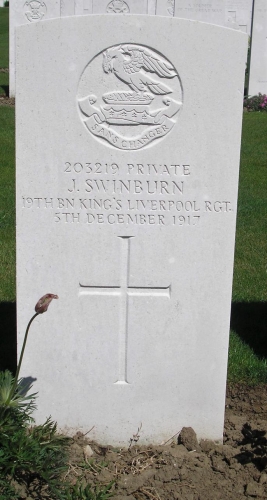
He enlisted in Liverpool joining the 19th Battalion of The King's Liverpool Regiment as Private 203219.
He was killed in action on 05th December 1917, aged 30.
The Battalion diary for the 05th December 1917 records:
"Bodmin Copse and Unknown Copse heavily shelled. 2 O.R. wounded. Working parties were again found for 202nd Company. Royal Engineers. A Company moved from Bodmin Copse to vicinity of Stirling Castle in support of 2nd Bedford Regiment who had taken over Front Line. Polderhoek Chateau Sector from the New Zealand brigade.Bodmin Copse shelled during the night. Working party from Details (Railway Dugouts Party) suffer casualties about 10pm the officer in charge 2nd Lieutenant J.B.Olley being wounded, 3 O.R. killed and 1 O.R. wounded."
John was one of the other ranks referred to in the diary as having been killed. The other two men were Private John Hugh Baxter and Private Clifford Smith.
John was buried in Sanctuary Wood Old British Cemetery, Zillebeke, and his grave marked with a cross: “In memory of 203219 Pte. J. Swinburn, 19 K.L.R. 5/12/1917”. The CWGC exhumation record notes, “Disc says 5/KLR”, and that effects were forwarded to base. After the Armistice, when graves were concentrated, the bodies of 54 Commonwealth Soldiers, including John’s, were removed and reinterred in Hooge Crater Cemetery, where he now rests.
Hooge Chateau and its stables were the scene of very fierce fighting throughout the First World War. On 31 October 1914, the staff of the 1st and 2nd Divisions were wiped out when the chateau was shelled; from 24 May to 3 June 1915, the chateau was defended against German attacks and in July 1915, the crater was made by a mine sprung by the 3rd Division. On 30 July, the Germans took the chateau, and on 9 August, it and the crater were regained by the 6th Division. The Germans retook Hooge on 6 June 1916 and on 31 July 1917, the 8th Division advanced 1.6 Kms beyond it. It was lost for the last time in April 1918, but regained by the 9th (Scottish) and 29th Divisions on 28 September.
Hooge Crater Cemetery was begun by the 7th Division Burial Officer early in October 1917. It contained originally 76 graves, in Rows A to D of Plot I, but was greatly increased after the Armistice when graves were brought in from the battlefields of Zillebeke, Zantvoorde and Gheluvelt and other smaller cemeteries.
There are now 5,916 Commonwealth servicemen of the First World War buried or commemorated in this cemetery. 3,570 of the burials are unidentified, but special memorials record the names of a number of casualties either known or believed to be buried among them, or whose graves in other cemeteries were destroyed by shell fire.
The cemetery was designed by Sir Edwin Lutyens.
No pension card has been found, indicating that John had no dependants.
His father Henry received John’s Army effects, including a War Gratuity of £3.
Probate, giving John’s address as 11 Market Square, Keswick, and effects of £546-17s-5d, was granted to his father Henry Swinburn, draper.
John's elder brother Joseph was also lost to the family in the Great War. He was a Gunner in the Royal Field Artillery and died of wounds on 24th April 1918, aged 37.
He now rests at Etaples Military Cemetery in France where his headstone bears the epitaph:
"UNTIL THE DAY BREAKS AND THE SHADOWS FLEE AWAY"Joseph was married to Eleanor and they lived at 5 Gretna Hamlet in Keswick.
His brother Walter, who played rugby for Keswick, served with the Border Regiment and arrived in France on 26th September 1915. He was awarded the Meritorious Service Medal and was wounded in action (GSW left forearm). He was discharged with the rank of Sergeant on 16th March 1920 with a disability pension.
His parents lost another child when their daughter Jessie died in 1923, aged 42.
His father died in 1931, aged 71, and his mother, having lost her husband and three of her four children, died two years later. The surviving brother Walter succeeded his father as Chairman of Keswick Council, and died in 1954.
Both brothers also commemorated on the following Memorials:
Brigham School, Keswick
St. John’s Parish, Keswick
Keswick War Memorial
Also on the family headstone at St Kentigerns Church, Keswick.
In loving Memory of
ALSO OF JOHN, THEIR SON
WHO WAS KILLED IN THE GREAT WAR
DEC 6TH [sic] 1917, AGED 30 YEARS
AND WAS INTERRED IN
SANCTUARY WOOD, YPRES
ALSO OF JOSEPH THEIR SON
WHO DIED OF WOUNDS APRIL
24TH 1918, AGED 37 YEARS
AND WAS INTERRED AT
ETAPLES CEMETERY