
1885 - 1916

CPL David Wallace Crawford
1887 - 1916

Lce-Corpl John Joseph Nickle
1894 - 1916

Pte 17911 Morton Neill
1897 - 1916

Lieut Edward Stanley Ashcroft
1883 - 1918

Lieut Frank Everard Boundy (MC)
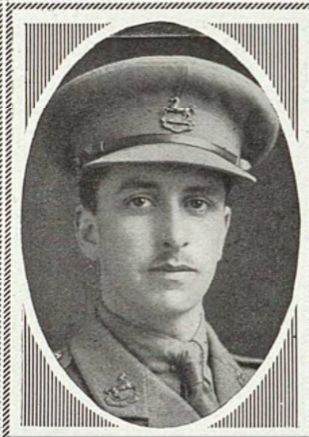
- Age: 21
- From: Valparaíso, Chile
- Regiment: The King's (Liverpool Regiment) 17th Btn
- D.O.W Sunday 30th July 1916
- Commemorated at: Guillemont Rd Cem
Panel Ref: II.M.5
Francis Everard Boundy was born on the 11th November 1894 in Valparaíso, Chile the son of Francis Jenkin Boundy and his wife Lizzie Leys (nee Jones) who were married on 19th October 1892 in Tongoy, about 240 miles north of Valparaíso. Another son Hugh Llewellyn was born in Chile on the 29th June 1896.
On the 1871 Census his father is a pupil at Treworth School, Truro. He took up engineering and around 1880 was in Newcastle-upon-Tyne long enough to join the Freemasons at St John’s Lodge. He is not found on the 1881 Census so by then he had probably sailed to Valparaíso where he started a family
For a short period they returned to England and appear on the 1901 Census. Frank was 6 and living with his parents Frank Jenkin Boundy and Elizabeth Leys Boundy and his 4 year old brother Hugh Llewellyn at 54 Richmond Hill in Truro. His father’s occupation is given as a Mechanical Engineer and his place of birth as Gwennap, Cornwall. His wife and two sons have place of birth recorded as Chile/British Subject.
A keen sportsman Frank was one of the founder members of the Everton Football Club in Valparaiso and was the club's first president. The club was formed following a tour of South America in 1909 by Everton Football Club. Frank was also part of the Boy Scout movement in his adoptive homeland at Valparaiso.
Upon the declaration of war he sailed home to volunteer for military service. He embarked on 29th August 1914 at Valparaiso on the S.S. Orduna bound for Liverpool via Punta Arenas, Chile, Montevideo, Uruguay, Rio de Janeiro, Brazil.
The British community in Valparaiso assisted those men who wished to go to the front as outlined below:
Once they had enrolled the British Ministry of War paid the volunteers training and salary, but they had to pay for their own travel to Europe. The British colony in Valparaiso joined together to raise the funds to be able to send those wishing to go to the front:
"As many of the British community of Chile, who for various reasons are unable to return home to fight for their country, but who would willingly assist in other ways, may I suggest that two funds be started: one for the Widows and Orphans and the other for defraying the travelling expenses of those Britishers who wish to return home to fight, but cannot afford to pay their passage to England. By this means all of us will feel that we are doing something to help our country in this time of need.
The Pacific Steam Navigation Company, offered pre war ticket prices to those men going to enlist. The community established local branches of funds such as the British Patriotic Fund, the Patriotic League of Ladies and the Prince of Wales Fund, in order to collect money to send young men to the front. Between 1914 and 1918 nearly 330 passages were bought and those sent were given uniforms, a little money and living expenses. With this help, the Valparaiso contingent were sent off to war by their family and friends.
The departure of the S.S. Orduna was described as follows:
The departure of the S.S. Orduna on Sunday morning for home, brought a great assembly of friends, who waited at the dock to bid farewell to their comrades who went to the front. Shortly after 11 the bell announced that those who weren't passengers should leave the ship, and they boarded the boats that waited alongside, waving and singing patriotic songs until the ship set sail, beginning the journey to the sound of Rule Britannia.
Frank arrived in Liverpool on 30th September. 1914. The passenger list shows him as Frank Everard Boundy with the address ‘Sheppey’, Clivedon (sic) Road, Wimbledon, SW. He is listed as resident in Chile, 19 years old and his occupation is given as clerk.
He enlisted in Kingsway, London on 02nd October 1914 joining the Scots Guards at Caterham as a Private 11156. He gave his age as 19 years and 11 months, he stated that he was born in Redruth, Cornwall, and gave his occupation as a clerk. He was described as being five foot eight inches tall, weighed 116lbs, 35” chest, with a dark complexion, brown eyes and brown hair. He stated his religion as Church of England. His intended address was c/o Balfour Williamson & Co., 7 Gracechurch Street, London.
Frank reached France in August, 1915. He subsequently applied for a Commission and having requested that he be posted to a Liverpool battalion he was duly appointed:
From the "London Gazette" 15/10/15 -
"The undermentioned temporary Officers are transferred from Reserve to Regular Battalions, with seniority from the dates shown against their names:- The King's (Liverpool Regiment). Second Lieutenant F. E. Boundy. 25th January 1915".
He joined the 1/9th King's, in France, on 23rd August, 1915 during the build-up to the Battle of Loos.
He was awarded the Military Cross, the Citation was dated: 1st March, 1916
Temp 2/Lt Frank Everard BOUNDY
Liverpool Regt attached 1/9th Bn (Now attached 17th Bn Liverpool Regt)
For conspicuous coolness and gallantry near HULLUCH on night 23/24th November, 1915, in putting up, with the Brigade Wiring Party, 250 yards of chevaux de fries in front of the front line trenches close to the enemy while constantly fired on by machine guns. This operation had been attempted once previously by the same party, and on several occasions by parties of other Brigades during the preceding month without success. 2/Lt Boundy organised the whole operation, which was exceptionally difficult, with great skill and carried it through successfully. On several other occasions he has done bold and skilful work in putting up wire close to the enemy’s trenches.
Award recommended: Military Cross
MC Gazetted 03/06/16.
He was subsequently attached to the 17th Battalion (1st Pals)..
The following is taken from the 17th King's War Diary and the figures contained in the report give an indication of the scale of losses at Guillemont on 30th July 1916.
29th July 1916 9 p.m.
Battalion moved up to assembly positions for attack on German system of trenches from Guillemont exclusive to Falemont Farm inclusive.
30/7/16 4.45am
‘Zero hour’. The Battalion was in support to 19th and 20th Battalions KLR. Two Companies behind 19th and two Companies behind 20th. Very thick mist. The attack was pushed home to the objective in places but in the main was held up by machine gun fire from hidden machine guns. Fighting continued all day swaying backwards and forwards until by 6pm about 300 yards in depth had been gained and consolidated all along our front.
Casualties Officers Killed
2nd Lieutenant ER Porritt
2nd Lieutenant RH Smith
2nd Lieutenant SJ Faris (attd 20 KLR)
Died of wounds
FE Boundy (attd 89 TMB [Trench Mortar Battery])
Wounded
A/Captain HN Brinson
Lieutenant BS Thompson
Lieutenant EW Willmer
2nd Lieutenant JR Blabey
2nd Lieutenant FY Peet
2nd Lieutenant GM Morris
2nd Lieutenant JFW Berry
2nd Lieutenant WH Johnston
2nd Lieutenant T Lanceley
2nd Lieutenant ET Lewis
2nd Lieutenant WS Standring
Other Ranks Killed 56
Other Ranks Wounded 130
Other Ranks Missing 95
31/7/16
Relieved by 4 King’s Own Duke of Lancaster’s Regt and Battalion returned to camp.
Further details are reported in more detailed by Everard Wyrall in his book The History of the King’s Regiment (Liverpool) 1914-1919 Volume II 1916-1917
The 17th King’s had advanced (two companies each behind the 19th and 20th Battalions) in small columns. They too suffered heavily from machine-gun fire and were quickly absorbed into the waves that preceded them. They also shared the gains and losses of that terrible day.
When darkness fell on the battlefield the 30th Division held a line from the railway on the eastern side of Trones Wood , southwards and including Arrow Head Copse, to east of Maltz Horn Farm. On this line the division was relieved by the 55th Division during the early hours of the 31st July.
The events of 30th July 1916 were regarded at the time as Liverpool’s blackest day. There follows an extract from The History of the 89th Brigade written by Brigadier General Ferdinand Stanley which gives an indication of the events of the day.
Guillemont
Well the hour to advance came, and of all bad luck in the world it was a thick fog; so thick that you couldn’t see more than about ten yards. It was next to impossible to delay the attack – it was much too big an operation- so forward they had to go. It will give some idea when I say that on one flank we had to go 1,750 yards over big rolling country. Everyone knows what it is like to cross enclosed country which you know really well in a fog and how easy it is to lose your way. Therefore, imagine these rolling hills, with no landmarks and absolutely unknown to anyone. Is it surprising that people lost their way and lost touch with those next to them? As a matter of fact, it was wonderful the way in which many men found their way right to the place we wanted to get to. But as a connected attack it was impossible.
The fog was intense it was practically impossible to keep direction and parties got split up. Owing to the heavy shelling all the Bosches had left their main trenches and were lying out in the open with snipers and machine guns in shell holes, so of course our fellows were the most easy prey.
It is so awfully sad now going about and finding so many splendid fellows gone.
Frank's death was reported in the Liverpool Echo on 12th August 1916 as follows:
"Second Lieutenant Frank E.Boundy, the King's (Liverpool) Regiment, has been killed in action. He left Valparaiso on August, 29, 1914, as a volunteer for the British Army, and arrived in England on September 30. He enlisted on October 2 in the ranks of the Scots Guards. He was recommended on January 18th 1915, for a commission and was gazetted on January 25. He went through the Battle of Loos. In February, 1916, he was recommended for a commission in the Regular Army, and was gazetted in March. He was awarded the Military Cross in June. He was the eldest son of Mr. and Mrs.F. J. Boundy, of Valparaiso, and was greatly esteemed for his amiable qualities and devotion to duty. He was on the staff of the Valparaiso office of Messrs. Balfour, Williamson and Co"
[Note: The company was founded in Valparaiso in 1863 as a subsidiary of the Liverpool shipping company Balfour Williamson (founded by the Scots Alexander Balfour and Stephen Williamson). The company was involved in the export of nitrates and wool to England, and later the west coast of the United States]
Private Harry Redhead of the 17th Battalion was interviewed in December 1984 by Graham Maddocks as part of his research for his excellent book The Liverpool Pals. Harry was attached to the 89th Trench Mortar Battery and as he was waiting to go over the top at Guillemont he was gassed by German shells, and had to retire to a dugout. He gave a detailed account of Frank Boundy's last moments:
'After a time one of our chaps came in badly shell shocked in no mans land and he told us Boundy (Lieut.F.E.Boundy) had been mortally wounded. So we helped him to a shell hole and Boundy didn't want to go. He said stop with me until I die or something like that. So he did, he stopped with Boundy. Another chap joined them, a chap called Green and while they were there a German put his head over the side of the thing (shell hole) and threw a bomb at them. It went off but it didn't injure any of them. After Boundy died Green pushed off.'
Frank Boundy was 21 years of age when he died on 30th July 1916.
He was buried close to where he fell and after the war when graves were concentrated, his body was removed and reinterred in Guillemont Road Cemetery at II.M.5.
Guillemont was an important point in the German defences at the beginning of the Battle of the Somme in July 1916. It was taken by the 2nd Royal Scots Fusiliers on 30 July but the battalion was obliged to fall back, and it was again entered for a short time by the 55th (West Lancashire) Division on 8 August. On 18 August, the village was reached by the 2nd Division, and on 3 September (in the Battle of Guillemont) it was captured and cleared by the 20th (Light) and part of the 16th (Irish) Divisions. It was lost in March 1918 during the German advance, but retaken on 29 August by the 18th and 38th (Welsh) Divisions.
The cemetery was begun by fighting units (mainly of the Guards Division) and field ambulances after the Battle of Guillemont, and was closed in March 1917, when it contained 121 burials. It was greatly increased after the Armistice when graves (almost all of July-September 1916) were brought in from the battlefields immediately surrounding the village.
Guillemont Road Cemetery now contains 2,263 Commonwealth burials and commemorations of the First World War. 1,523 of the burials are unidentified but there are special memorials to eight casualties known or believed to be buried among them.
The cemetery was designed by Sir Herbert Baker.
The Commonwealth War Graves Commission were given his parents details, at the time the records were collated in the early 1920's, as Frank Jenkin Boundy and his wife Elizabeth Leys Boundy of 613 Calle Tubildad, Valparaiso, Chile.
Frank is commemorated at the Anglican church of St Paul in Valparaiso and on the Scout Association's First World War Roll of Honour.
On his Medal Card his father’s address is Casilla 1200, Valparaiso.
His brother Hugh married Alice Heather McFarlane on the 26th April 1941 in Erskine, Alberta. His parents were declared a Mrs Boundy and the late F.J.Boundy of Valparaiso.
The legacy of Frank Boundy can still be felt. The football club he helped to found are known as CD Everton and are now based in Vina Del Mar. They have won the Chilean National Championship on four occasions. In August 2010 the club were invited to play Everton FC at Goodison Park.
Grateful thanks are extended to Pete Jones for his assistance with this biography.
We currently have no further information on Frank Everard Boundy, if you have or know someone who may be able to add to the history of this soldier, please contact us.
Killed On This Day.
(110 Years this day)Tuesday 24th October 1916.
Pte 33220 David Brocken
24 years old
(109 Years this day)
Wednesday 24th October 1917.
Pte 17690 Henry Phipps
22 years old
(109 Years this day)
Wednesday 24th October 1917.
Pte 308326 James Speakman
26 years old
(108 Years this day)
Thursday 24th October 1918.
Serjeant 17245 Robert George Evans (MM)
22 years old