
1885 - 1916

CPL David Wallace Crawford
1887 - 1916

Lce-Corpl John Joseph Nickle
1894 - 1916

Pte 17911 Morton Neill
1897 - 1916

Lieut Edward Stanley Ashcroft
1883 - 1918

Serjeant 130468 Harold Grange Jones
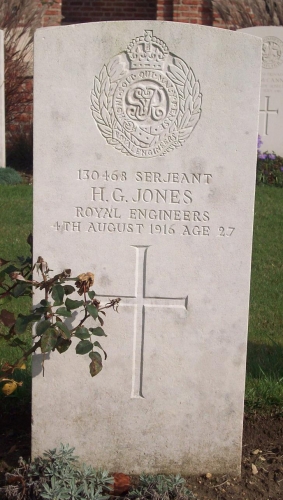
- Age: 27
- From: Runcorn, Cheshire
- Regiment: ROYAL ENGINEERS
- Died on Friday 4th August 1916
- Commemorated at: Bapaume Post Military Cemetery, Albert
Panel Ref: I.B.19
Harold Grange Jones was born in 1889, the son of Walter Jones and Emma (nee Grange), who married in Warrington in 1888. His father was born in Runcorn and his mother in Sankey, Lancashire. Harold was baptised in All Saint’s Runcorn, on 29th August 1889. Harold had one sibling, a brother Thomas Lionel, born in 1892.
In 1901 the family is living at 9 Stanley villas. His father is a clerk in the District Council office. Harold is 11.
They are still at 9 Stanley Villas in 1911. His father is a clerk for Runcorn Council. Harold is 21, articled to a Runcorn Council surveyor. His brother Thomas, 19, is a shipping clerk in the White Star Line office, Liverpool.
Harold’s service record has not survived, but we do know that he enlisted in the 17th Battalion of The King’s Liverpool Regiment as Private 15554 and after a period with the 21st Reserve Battalion he was subsequently transferred to 5th Bn, Special Brigade, Royal Engineers, regimental number 130468. He had reached the rank of Sergeant when he was killed in action on 4th August 1916. He now rests in Bapaume Post Military Cemetery, Albert, Somme.
Bapaume Post Military Cemetery lies on the west side of "Tara Hill," and south-west of "Usna Hill," and at times it was called by those names. In June 1916, the front line crossed the Bapaume road between the site of this cemetery and the village of La Boisselle. The attack on La Boisselle on 1 July was not successful, and several days passed before the village was taken. The cemetery was begun almost at once by the divisions engaged in this sector and 152 graves in Plot I, Rows B to I, were made before the end of January 1917, when the cemetery was closed. On 26 March 1918, the cemetery, with the town of Albert, fell into German hands, but it was recovered towards the end of August. After the Armistice, graves from the battlefields east and west of the cemetery were brought in, including many of the 34th (Tyneside) Division, which attacked along the Bapaume road on 1 July 1916, and some of the 38th (Welsh) Division, which recaptured Usna Hill on 23 August 1918. The cemetery now contains 410 burials and commemorations of the First World War. 181 of the burials are unidentified, but there are special memorials to three casualties believed to be buried among them. The cemetery was designed by Charles Holden.
His death was announced in the Runcorn Guardian on 15th August 1916:
“On Saturday morning, Mr. and Mrs. Walter Jones, of Stanley villas, Runcorn, received word of the death of their son, Sergeant Harold G. Jones, of the Royal Engineers. A letter from the second-lieutenant of his battalion came to hand, from which the following is an extract: ‘It is with the most profound regret I have to undertake the painful duty of informing you of the death of your son, which occurred in action on the night of August 4th, and at the same time to offer my deep sympathy and condolence with you and the members of your family in the bereavement sustained by his death. I desire to express my appreciation of his devotion to duty, his cheerful willingness at all times to carry out orders, and his genial spirit amongst the men which will make his loss keenly felt. You will, I am sure, be glad to know that his body was recovered and buried, a clergyman officiating at the service. In due course the locality of the cemetery will be communicated to you.’
A letter received later from another lieutenant states:
‘You will no doubt have heard through the official channels of the loss you have sustained in the death of your son, Sergeant Harold G. Jones. As the commander of the section in which he served I herewith tender to you the sympathy of his comrades, and my own, in your great loss. A few particulars as to how he met his death will be of interest to you. The action was a night attack on the 4th inst. against a strongly fortified ridge held by the enemy. We were working for some of our famous Colonial troops. The attack was launched, the ridge carried and we were successful in accomplishing our part of the work. Sergeant Jones, as usual, behaved with great coolness throughout the attack, and gave the greatest help in getting the work in hand accomplished. I was not actually present when the end came, but I gather that, whilst going round seeing to the safety of his men, a shell burst right over the trenches, killing Sergeant Jones instantly, and wounding two of his comrades. I feel his loss keenly, as he was one of my best sergeants. Only just recently I had put his name before our captain as a candidate for a commission, which, no doubt, he would have obtained. I am glad to say that his comrades were able to get him away from the battlefield, and he was buried in the British Cemetery at Tarahill, which is near Albert, an English clergyman officiating.’
Sergeant Jones joined the 1st Battalion of the King’s (Liverpool Regiment) soon after the beginning of the war. Shortly after he was promoted to the rank of sergeant he was transferred to the Royal Engineers. He left for France on March 17th of this year and he was one who took part in the “big push” of July 1st.By profession Sergeant Jones was a surveyor, having served his apprenticeship under Mr. James Wilding. He had been employed for some time as draughtsman by the Mersey Power Company. He was an “old boy” of the Runcorn Secondary School, and was a capital athlete who always shone at the school sports. In the first year of the sports he had the distinction of capturing a prize in every event for which he entered. He played cricket with the Runcorn Club and had captained the second team. He was 27 years of age. His brother, Lionel Jones, is serving with the Naval Reserve.”
His father, living at 9 Stanley Villas, Runcorn, received his pension of 5/- a week
Harold is commemorated on the Runcorn War Memorial.
We currently have no further information on Harold Grange Jones. If you have or know someone who may be able to add to the history of this soldier, please contact us.
Killed On This Day.
(110 Years this day)Monday 1st May 1916.
L/Sgt 15959 Neville Brookes Fogg
32 years old
(109 Years this day)
Tuesday 1st May 1917.
Pte 33195 George Allen
30 years old
(109 Years this day)
Tuesday 1st May 1917.
L/Cpl 17823 Harry Cuthbert Fletcher
27 years old
(108 Years this day)
Wednesday 1st May 1918.
Pte 300188 Albert Charles Bausor
31 years old
(108 Years this day)
Wednesday 1st May 1918.
Pte 64776 Gerald Blank
20 years old
(108 Years this day)
Wednesday 1st May 1918.
Sgt 57831 Leonard Conolly
25 years old
(108 Years this day)
Wednesday 1st May 1918.
L/Cpl 94253 Ernest Firth
22 years old
(108 Years this day)
Wednesday 1st May 1918.
Pte 49533 Henry Rigby
32 years old
(108 Years this day)
Wednesday 1st May 1918.
Pte 17721 Charles Henry Squirrell
26 years old
(107 Years this day)
Thursday 1st May 1919.
Pte 91536 John Alfred Croft Kelly
26 years old