
1885 - 1916

CPL David Wallace Crawford
1887 - 1916

Lce-Corpl John Joseph Nickle
1894 - 1916

Pte 17911 Morton Neill
1897 - 1916

Lieut Edward Stanley Ashcroft
1883 - 1918

Major Frank Harvey Bowring
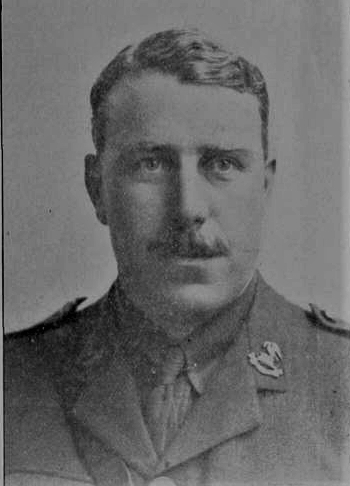
- Age: 39
- From: St Johns Newfoundland
- Regiment: 9th Kings
- Died on Wednesday 28th August 1918
- Commemorated at: St Martin Calvaire
South of Arras in the hamlet of Hendicourt there fell on 28th day of August 1918, a fine type of officer, in the person of Major Frank Harvey Bowring. In the course of a bitter attack he was killed by machine gun bullets.
Like many members of the Bowring family, this officer was a Newfoundlander by birth being born at St John's, in December 1878, the third son of the late Honourable Charles Bowring of St John's Newfoundland, and Mrs Bowring of "Chiselhurst", Aigburth Drive, Sefton Park, Liverpool.
Coming to the Motherland early in life, he was a pupil at the Liverpool College, and five years at Shrewsbury School preceded his entrance as an undergraduate into Christ Church, Oxford. In 1902 he took his degree as Bachelor of Arts. Leaving Oxford, he entered the office of Messrs Hill, Dickinson & Co and qualified as a Solicitor. In 1913 he became a member of the Liverpool Stock Exchange.
Few names were more widely known in the annals of local sport than that of Frank Harvey Bowring's. He had a zest for athletics of many types. Shrewsbury boys past and present, recall him as a first class cricketer and footballer, and from 1909 to 1911 he was the popular captain of Liverpool Cricket Club. He was also the Honorary Secretary of the Liverpool racquet Club for three years. Sports, however did not monopolise his leisure. One interest of another kind that enlisted his sympathies, and with which he indentified himself as a member of the Committee with typical devotion, was that of the Royal Southern Hospital, Liverpool.
Major Bowring's career in the army began as a Lieutenant, but he was a man whose gifts, dominating character, and energy marked him for speedy promotion. Joining the 17th Service Battalion of the King's (Liverpool Regiment) on its formation he was promoted to Captain in December 1914, and to Major in May 1916. He served overseas with the 23rd and 24th Battalions of the (London) Regiment and the gallant King's Liverpools. He was an officer who could be relied on implicitly, and his conduct had been ever upright and manly.
The above information was taken from the Liverpool's Scroll of Fame
The circumstances surrounding Frank's death are recorded in the battalion diary of the 9th King's Liverpool Regiment. He joined the 9th Battalion in June 1918 following a tranfer from the 8th Bn KLR as temporary second in command:
|
Bn War Diary, 27th August 1918. Henin. The Battn paraded in Fighting Order at 6 p.m. & proceeded to vicinity of HENIN, where they had tea at about 8 p.m. At 9.30 p.m. the Battn moved forward to the HINDENBURGH LINE & took over trenches in U.7.c relieving a Battn of 52nd Division, the relieving unit being unknown. Occupation of trenches was complete by 4 a.m. 28th August 1918 Verbal orders were received at 6 a.m. on the 28th inst. that the Battn would attack during the day. At 9 a.m. Bn. H.Q. which was established at BLOCK HOUSE at T.6.d.5.3. moved forward to U.7.c.9.6. While moving, written instructions were received from Brigade detailing the Battn to attack the following objectives. Zero hour, to be at 12.30 p.m. this Battn to be on the right. |
Frank Harvey Bowring was born on the 10th December 1878.
The 1911 census shows Frank aged 32, single, solicitor, living at Chislehurst, Sefton Park with his widowed mother Laura 61, brothers Eric 26 merchants clerk, Cyril 24 cornbrokers clerk, all born St John's, Newfoundland. Also Edward Arthur Woodall, the executor of his affairs, and four servants. (His elder sister Ethel had married in 1906).
Liverpool Daily Post 18th September 1916
At a cricket match between E.C.Hornby's X1 v Public Schools X1 at Liverpools ground (Aigburth), Major Bowring was behind the stumps and E.A.Woodall bowling for Hornby's.
Frank was 39 when he was killed in action on the 28th Augut 1918. and he now rests at St Martin Calvaire British Cemetery, France where his headstone bears the epitaph:
"IN LOVING MEMORY OF MY SON"
The village of St. Martin-sur-Cojeul was taken by the 30th Division on 9 April 1917. It was lost in March 1918 but retaken in the following August. St. Martin Calvaire British Cemetery was named from a calvary which was destroyed during the war. It was begun by units of the 30th Division in April 1917 and used until March 1918. Plot II was made in August and September 1918. The cemetery contains 228 Commonwealth burials of the First World War, five of them unidentified. There are also three German graves within the cemetery. The cemetery was designed by Sir Edwin Lutyens.
The St John’s, Newfoundland newspaper reported:
“The family of Bowring, so long and honourably associated with the commercial life of this country, has been well represented in the fighting line in France, and during October the sad news was received by Mr. Eric Bowring, local manager of Bowring Brothers, that his brother, Mr. Frank H. Bowring, had been killed in action on August 28th. The deceased had been a Major in the second battalion of the King's Liverpool Irish Regiment, was born in Newfoundland in 1878, and was the son of the late Hon. Charles Bowring, and of Mrs. Bowring now residing at Sefton Park, Liverpool. Major Bowring, when the war began, was a member of the Liverpool Stock Exchange. He enlisted as a private in Lord Derby's " Pals Brigade" and served all through the war. Harold, Medical Officer with the 5St British Cavalry Division in France, William, a Lieutenant in the 9th Scottish Rifles, and Cyril, a Captain with the Royal Welsh Fusiliers in Egypt, are brothers of the deceased officer, and all like him were born in Newfoundland. The deceased is a cousin of Sir Edgar Bowring and Mr. Henry Bowring, the latter now in Liverpool, and whose two sons are also on active service.”
Ormskirk Advertiser 12 Sept 1918
WELL-KNOWN LIVERPOOL CRICKETER KILLED
Supporters of Brook Lane (Ormskirk) cricket will regret to learn Major F. H. Bowring, the well-known Liverpool cricketer, has been killed in action in France. Major Bowring, in pre-war days, was a regular visitor with the Liverpool team to the Brook Lane enclosure, where his prowess, particularly as a batsman, won the admiration of friend and foe. When cricket is resumed again, as it surely will be, scores of the familiar figures will be missing in Liverpool District records, they have played their last game, and played it well.
Birkenhead News 18th Sept 1918
A host of sportsmen and general friends heard of the death of Major F. H. Bowring with infinite regret. I remember the gallant fellow as a Liverpool and Lancashire rugby player, and he was a great force with north club football. Educated at Shrewsbury and Oxford, he was with the finest type of men. As a cricketer, he was often seen at Birkenhead Park, against whom the Liverpool Club found their most serious rivals.
His Estate amounted to £13,499 8s 11d. Probate granted to Edward Arthur Woodall, Fruit Broker.
Frank is also commemorated on the following Memorials:
Christ Church, Oxford University War Memorial,
Page 16 of the Newfoundland Book of Rememberance,
Shrewsbury School War Memorial
Liverpool Cricket and Rugby Football Clubs Memorial Board located in Liverpool Cricket Club, Aigburth, Liverpool.
Liverpool Stock Exchange now situated in Our Lady and St Nicholas Church, Liverpool.
Soldiers Effects to executor Edward Arthur Woodall.
We currently have no further information on Frank Harvey Bowring, If you have or know someone who may be able to add to the history of this soldier, please contact us.
Killed On This Day.
(110 Years this day)Tuesday 24th October 1916.
Pte 33220 David Brocken
24 years old
(109 Years this day)
Wednesday 24th October 1917.
Pte 17690 Henry Phipps
22 years old
(109 Years this day)
Wednesday 24th October 1917.
Pte 308326 James Speakman
26 years old
(108 Years this day)
Thursday 24th October 1918.
Serjeant 17245 Robert George Evans (MM)
22 years old