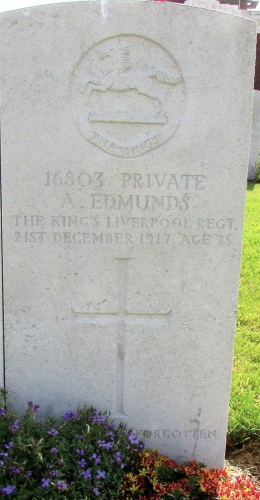
Arthur Cecil James Edmunds was born in Liverpool on 06th May 1893, the youngest son of William Edmunds and his wife Mary Ellen (née Corless). He was baptised on 29th May in St. Peter’s Church, Liverpool, his parents’ residence stated as Garrick Street, and his father’s occupation given as iron moulder. His parents were both born in Liverpool, married in 1869, and had eleven children, all of whom survived. Arthur was the youngest; his siblings were Emily, William, Thomas, Mary, Gertrude, Edith, Alice, Florence, Percival, and Mabel.
In 1901 the family is living at 62 Garrick Street, off Smithdown Road, with nine children. His father, 53, is an ironworks manager, Arthur is 7.
By 1911 they have moved to 23 Hereford Road, Wavertree, and have six children at home. His father is 63, an ironworks manager, his mother is 61, Edith, 28, and Florence, 24, are municipal school teachers, Alice, 26, is a milliner, Percival, 22, is a loco engineer, Mabel, 20, has no occupation, and Arthur is 17, a shipping clerk.
Arthur enlisted at St George's Hall in Liverpool on 03rd September 1914 as Private 16803 joining the 18th Battalion of The King’s Liverpool Regiment. He gave his age as 21 years and 120 days, and his occupation as clerk. He was described as being 5’ 4 and a half inches tall, weighing 107 lbs, with a fresh complexion, brown hair and brown eyes. He advised that his next of kin was his father William at 23 Hereford Road, Church Road, Wavertree.
From the 23rd September 1914 he was billeted at Hooton Park Race Course and remained there until 03rd December 1914 when they moved into the hutted accommodation at Lord Derby’s estate at Knowsley Hall. On 30th April 1915 the 18th Battalion alongside the other three Pals battalions left Liverpool via Prescot Station for further training at Belton Park, Grantham. They remained here until September 1915 when they reached Larkhill Camp on Salisbury Plain.
Arthur shipped to France with his battalion, disembarking at Boulogne on 07th November 1915. His service record survives and shows -
29th February 1916 to 98 Field Ambulance, gastritis
07th March 1916 rejoined unit in the field
On the first day of the Battle of the Somme the 18th Battalion takes its objective, the Glatz Redoubt, with about 500 casualties of all ranks. Arthur was wounded in action.
02nd July 1916 to No.21 C.C.S., gunshot wound to right hand
03rd July 1916 evacuated to U.K. on Hospital Ship Cambrai from 3rd Canadian General Hospital, Boulogne, with gunshot wounds to hand and foot
04th July 1916 admitted 3rd Southern General Hospital, Oxford
10th July 1916 transferred to Milton Hill Sectional Hospital (This was the rural Berkshire home of the son of Singer Sewing Machine Company fame, who offered his house to the military two days after the outbreak of war. It was used as a hospital for soldiers and NCOs until 1920).
Arthur’s name appeared in the list of Wounded published in the Liverpool Post & Mercury on 26th July 1916.
18th August 1916 discharged to Convalescent Hospital, Epsom
27th September 1916 discharged
06th October 1916 posted to 3rd (Garrison) Bn K.L.R.
19th December 1916 returned to France, posted to 1st Bn K.L.R.
23rd Decemebr 1916 posted to 13th Bn K.L.R., No.3 (C) Company
In March 1917 Arthur was charged 2s-2d for being deficient two pair of socks.
The 13th battalion saw action at Arras in 1917, including the Battles of the Scarpe and at Arleux.
Arthur sprained his ankle playing football (in camp at Beaulencourt) on 15th September 1917 and was sent to 109 Field Ambulance.
On 22nd September the battalion moved to Brandhoek in the Ypres Salient.
On 29th November they took over trenches in the right sub-sector at Lagnicourt and on 11th December moved to the Noreuil sector, with “A”, “B” and “C” companies in the front line, and “D” in support.
The battalion War Diary for 12th December 1917 records:
“At 6 a.m. the enemy opened an intense barrage on our front line, supports, and C.T.s [communication trenches] including Bn H.Q., the battalion already having “stood to” in expectation of an attack.
The barrage lasted for 40 minutes, and then a low flying hostile aeroplane gave the signal to lift by firing a white rocket.
Immediately the barrage lifted from the front line and the enemy attacked our line. Rifle and Lewis Gun fire was directed on them and they were driven off.
Our left and centre companies did good execution by enfilade fire from rifles and L.G.s, catching the enemy in groups advancing to the APEX.
At this time our men from “A” Company were fighting in shell holes as all their trenches were blown in.
At 7:15 a.m. a second barrage was opened on our lines as before. This lasted for 25 minutes then lifted from front to support lines. The enemy followed up to attack but was met with very heavy fire and machine gun fire from our lines, and the men of the left Coy (A), after all the wire in front of their trenches had been blown up, left their lines with a cheer and advanced to meet the enemy who retired, leaving many dead and wounded behind.
Three wounded were brought in prisoners and evacuated.
At 8:40 a.m. everything was quiet. All men were sent into front line from SHEFFIELD SUPPORT owing to the very heavy shell fire directed on this trench.
At 10:40 a.m. the enemy again barraged our trenches for half an hour, but no infantry action resulted.
At 2:30 p.m. another barrage was put down on our lines, lasting for 15 minutes.
At 4:15 p.m. the enemy again barraged our lines for half an hour. During the intervals of times stated the enemy intermittently shelled the whole of our sector.
Owing to the severe casualties suffered by “A” and “C” Coys, one platoon of “D” Coy was sent up to “A” Coy to reinforce and one platoon of “D” Coy was sent up to “C” Coy at 8:50 a.m.
[...]
During the day enemy shelled our lines all day, increasing to barrage fire at 3:15 p.m. and lasting to 4:30 p.m.
At 3:30 p.m. the enemy made a bombing attack on our left ... but our line was held intact.”
Casualties: Killed - 1 Officer, 21 O.R., Wounded - 3 Officers, 48 O.R.
Arthur was one of the wounded from “C” Company. He was sent to No.45 Casualty Clearing Station and on the 17th was admitted to No.11 Stationary Hospital, Rouen.
Arthur died from his wounds at 9:45 p.m. on 21st December 1917. He was 24 years of age. (CWGC gives his age as 25.)
Arthur is buried at St Sever Cemetery Extension, Rouen, France at plot P.V.D.9B where his headstone bears the epitaph:
"GONE BUT NOT FORGOTTEN"
During the First World War, Commonwealth camps and hospitals were stationed on the southern outskirts of Rouen. A base supply depot and the 3rd Echelon of General Headquarters were also established in the city.
Almost all of the hospitals at Rouen remained there for practically the whole of the war. They included eight general, five stationary, one British Red Cross and one labour hospital, and No. 2 Convalescent Depot. A number of the dead from these hospitals were buried in other cemeteries, but the great majority were taken to the city cemetery of St. Sever. In September 1916, it was found necessary to begin an extension, where the last burial took place in April 1920.
The Cemetery and the Extension adjoin each other but have separate Registers.
During the Second World War, Rouen was again a hospital centre and the extension was used once more for the burial of Commonwealth servicemen, many of whom died as prisoners of war during the German occupation.
The cemetery extension contains 8,348 Commonwealth burials of the First World War (ten of them unidentified) and in Block "S" there are 328 from the Second World War (18 of them unidentified). There are also 8 Foreign National burials here. The adjoining St. Sever Cemetery contains 3,082 Commonwealth burials of the First World War. There is also 1 French burial and 1 non war service burial here.
The extension was designed by Sir Reginald Blomfield.
His family placed a notice in the Liverpool Echo on 29th December 1917:
“December 22 [sic] died of wounds in hospital, Arthur, aged 24 years, youngest and dearly beloved son of W. and M.E. Edmunds, 23, Hereford Road, Wavertree. Deeply mourned by Father, Mother, Sisters and Brothers. (He fought and died for his country.)”
An In Memoriam notice was placed in the Liverpool Echo on 21st December 1918:
“In loving memory of Private Arthur Edmunds, who died of wounds in hospital at Rouen, France, on December 21, 1917. (One of the best.)
So sad yet so true
We cannot tell why,
The best are the first
That are called to die.
From Jack and Maud, Antrim Hotel, Manchester.”
Arthur earned his three medals. His mother received his personal effects on 17th April 1918: 1 Identity disc & chain, 1 Notebook, Waist belt & badge, 2 Cloth titles, Metal mirror, 4 1/2d in copper, as well as Arthur’s Army effects of £19-12s-3d and a War Gratuity of £15. The pension card, showing 18th King’s, records “claim withdrawn”.
His parents both lived to the age of 80. His father died on Armistice Day in 1928, leaving £1,714 to son William. His mother died in November 1929, still living in Hereford Road.
Arthur is commemorated on the following Memorials;
Holy Trinity Church Roll of Service, Wavertree
Hall of Remembrance, Liverpool Town Hall
The following is transcribed from a headstone in Toxteth Park Cemetery, Liverpool:-
In loving memory of William, the beloved husband of Mary E. Edmunds, who died 11th November 1928, aged 80 years. Also the above Mary E. Edmunds, who died 19th November 1929, aged 80 years.
Also Private Arthur Edmunds, (King’s Liverpool Regt.) son of the above, died of wounds in France 21st December 1917, aged 24 years.
We currently have no further information on Arthur Cecil James Edmunds. If you have or know someone who may be able to add to the history of this soldier, please contact us.