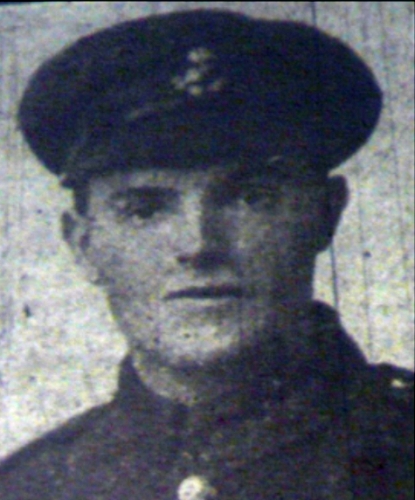
Ernest was born at Marbury, Cheshire in January 1897, the son of Thomas Frederick (or Frederic Thomas) Fisher and his wife Ann (née Wood). His father was born in Lichfield, Staffordshire, and his mother in Whiston, Lancashire. The only possible marriage found is that of Thomas Frederick Fisher and Annie Wood in St. George, Hanover Square, Middlesex, in the summer of 1888. They had five children; their first child apparently died in infancy.
In 1891 his parents, with no children, are living in the Old Garden House at Marbury Hall, Comberbach, Cheshire, where his father, 31, is a groom, and his mother Annie is 32. Marbury Hall, home of the Smith-Barry family, has since been demolished and the grounds now form part of Marbury Park.
Ernie had older siblings Frederick, Nellie, and Julia, all born in Marbury.
By 1901 his parents are no longer living together. His mother, 42, with four children, is living with her parents, Isaac and Ellen Woods (sic), and two siblings in Sugar Lane, Knowsley. Ernest is 4. His father has not been found on the census.
1911 finds Annie and three children at Maiden’s Bower, Knowsley. Maiden’s Bower was a group of cottages very close to Knowsley Hall. His mother, 52, is a housemaid, private stables. Frederick is 18, a bricklayer’s apprentice, Julia, 16, is a white embroiderer (embroidery school), and Ernest is 14, no occupation or school listed.
Annie lists herself as wife, married, but subsequently changed to head of household, widow. Apparently she did not know the whereabouts of her husband, or if he was still alive. His father Thomas, 51, a domestic groom, is lodging in New Street, Northwich.
Shortly after the census was taken, on 21st May 1911, Ernie, 14, was confirmed in St. Mary the Virgin, Knowsley. The church register records next to his name, “Enlisted in Great War, killed”.
Ernie enlisted in Liverpool on 11th November 1914, as Private 23001, 20th Bn., King’s Liverpool Regiment, giving his age as 19 years and one month (in fact he was 17), and his occupation as wheelwright. He is described as being 5’8” tall, weighing 112 lbs, with a fresh complexion, brown eyes, and black hair. He gives his religion as C of E.
Formed in November 1914 the 20th Battalion were originally billeted at Tournament Hall, Knotty Ash before on 29th January 1915 they moved to the hutted accommodation purposely built at Lord Derby’s estate at Knowsley Hall, very close to Ernie’s home.
On 26th March 1915 whilst training at Knowsley, he was confined to barracks for three days for breaking out of barracks when on fire picquet.
In April the Pals battalions moved to Belton Park, Lincolnshire, and in September to Larkhill Camp on Salisbury Plain for final infantry training before being sent to the front.
Ernie shipped to France with his battalion, disembarking at Boulogne on 07th November 1915. His service record survives and shows that he served in 1st Section, 9th Platoon, 3rd Company.
30/7/1916: appointed paid L/Cpl
03/8/1917: appointed paid Acting Cpl
22/9/1917: confirmed in rank
Ernie was posted to the 18th (Pals) Bn on 07/02/1918 when the 20th Bn was disbanded in France. He was on leave to the U.K. from 23/2/1918 and resumed duty on 11/3/1918.
He would have seen action during the German Spring Offensive later in March.
The 18th Bn War Diary records the award of the Military Medal for Gallantry to Pte. 23001 E. Fisher on 19th May 1918. The award was published in the Supplement to the London Gazette on 29th August 1918.
08/5/1918 wounded in action
09/5/1918 to 99 F.A., shell wound, face, then No.2 Canadian C.C.S.
10/5/1918 to No.14 Stationary Hospital
23/5/1918 to ‘G’ Base Depot
After recovering from his wounds, Ernie was posted to 1/6th Bn. K.L.R. on 06th June 1918. In June 1918 the 1/6th were in trenches in the Festubert sector.
04/8/1918 reprimanded for being absent from roll call from 9:30 pm until 10 p.m.
04/9/1918 wounded in action (gas shell) and admitted No.6 C.C.S.
Ernie died of gas poisoning at 54th General Hospital, Boulogne, on 09th September 1918. He was 21 years old.
He now rests at Terlincthun British Cemetery where his headstone bears the epitaph:
"AT REST HIS LIFE FOR HIS COUNTRY HIS SOUL FOR GOD".
The first rest camps for Commonwealth forces were established near Terlincthun in August 1914 and during the whole of the First World War, Boulogne and Wimereux housed numerous hospitals and other medical establishments.
The cemetery at Terlincthun was begun in June 1918 when the space available for service burials in the civil cemeteries of Boulogne and Wimereux was exhausted. It was used chiefly for burials from the base hospitals, but Plot IV Row C contains the graves of 46 RAF personnel killed at Marquise in September 1918 in a bombing raid by German aircraft.
In July 1920, the cemetery contained more than 3,300 burials, but for many years Terlincthun remained an 'open' cemetery and graves continued to be brought into it from isolated sites and other burials grounds throughout France where maintenance could not be assured.
During the Second World War, there was heavy fighting in the area in 1940. Wimille was devastated when, from 22 - 25 May, the garrison at Boulogne fought a spirited delaying action covering the withdrawal to Dunkirk. There was some fighting in Wimille again in 1944. The cemetery suffered considerable damage both from the shelling in 1940 and during the German occupation.
The cemetery now contains 4,378 Commonwealth burials of the First World War and more than 200 war graves of other nationalities, most of them German. Second World War burials number 149.
The cemetery was designed by Sir Herbert Baker.
In April 1919 Nellie, 25, and Julia, 24, were living at home with their mother at Maiden’s Bower. His brother Frederick, 26, was living at Potters Pitts Farm, Kirby, and his mother reported that the whereabouts of his father were not known. However, a few months later she was able to provide his address: Mr. T. Fisher, Station Hotel, Hartford, near Northwich.
Ernie’s personal belongings were sent to his mother in July 1919: 2 Identity discs, Letters, Sponge, Photographs, Religious medallion, Razor strap, 2 Razors, Comb, Toothbrush, Shaving brush + soap, Holdall, Wallet, Metal cigarette case, Wristwatch + strap, Scissors, Pencil, 1 Pr glasses, Purse, Mirror.
Ernie earned his three medals, which his father signed for in 1920 and 1921.
His mother received Ernie’s Army effects, including a War Gratuity of £19. The pension card, giving his cause of death as gas poisoning, in the name of his mother, Mrs. Ann Fisher, Maiden’s Bower, Knowsley, shows that she was awarded a pension of 5/- a week.
Twenty one years after Ernie’s death, on what would have been his 42nd birthday, his mother placed an In Memoriam notice in the Prescott Reporter on 13th January 1939:
“In sad but loving birthday remembrance of my dear son Ernie, Corpl. E. Fisher M.M., K.R.R. [sic] (Pals) who died from gas poisoning in France, September 9, 1918. We often sit and talk of you,
Of things you used to say and do,
And wonder why you had to die,
Without a chance to say good-bye.
- Never one day forgotten by his loving Mother and Family.”
In September 1939 his mother, 80, is still living at Maiden’s Bower Cottages, with her sister Julia Wood, 72, and daughter Nellie, 45. His mother lived to see another world war, and died in 1944, aged 84, and is buried in St. Mary’s churchyard.
Ernie is commemorated in St. Mary’s Church, Knowsley Village.
We currently have no further information on Ernest Fisher. If you have or know someone who may be able to add to the history of this soldier, please contact us.