
1885 - 1916

CPL David Wallace Crawford
1887 - 1916

Lce-Corpl John Joseph Nickle
1894 - 1916

Pte 17911 Morton Neill
1897 - 1916

Lieut Edward Stanley Ashcroft
1883 - 1918

L/Cpl 15963 John Henry Caldicott
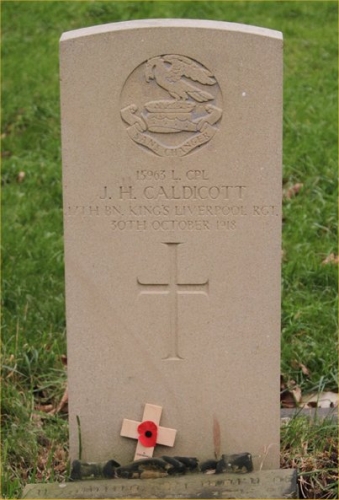
- Age: 25
- From: Wolverhampton
- Regiment: The King's (Liverpool Regiment) 17th Btn
- Died on Wednesday 30th October 1918
- Commemorated at: Christchurch Cy Ellesmere Port
John Henry CALDICOTT(1893-1918) was born in about April 1893 at 98 John Street, Bilston, Staffordshire to William Byers CALDICOTT(1855-1929), an Iron and Steel Worker, and Lucy PARTRIDGE (nee Tredwell) (1856-1922), the elder sister of William Solomon Tredwell (nee PARTRIDGE).
John Henry had one elder sister Esther Ann CALDICOTT(1885-????) and one elder brother William Francis CALDICOTT(1888-1916); a further elder sister Edith Caroline CALDICOTT (1886-1890) died before John Henry was born.
In the 1901 Census, the family are shown living at 9, George Street, Bilston, Staffordshire along with Lucy CALDICOTT’s (nee Partridge) mother Mary Ann TREDWELL (previously PARTRIDGE nee HARRIS, 1832-1907).
In the 1911 Census, the family has moved to 69 Heathfield Road Ellesmere Port and Esther Ann CALDICOTT has married Albert Edward EVANS(1882-????) and is no longer living at home. William Francis and John Henry are both working at the Corrugated Iron Sheet Mill alongside their father.
By the start of the Great War (1914-1918), the family were living at 16 Briarfield Road, Ellesmere Port, Cheshire.
On the 1st September 1914, both of the CALDICOTT brothers William Francis and John Henry signed up for the 17th (Service) Battalion (1st City) of the King’s Liverpool Regiment:
He enlisted on the 1st September 1914 at Liverpool and gave his age as 21 years and 160 days, and his occupation as an engineer. He was five feet eleven and three quarter inches tall, weighed 146 lbs, 37" chest, fresh complexion, hazel coloured eyes and dark brown hair.
29.4.15-4.9.15: Belton Camp, Grantham
5.9.15-6.11.15: : Larkhill Camp, Salisbury
7.11.15: Embarked for France with his battalion.
20.1.17: Appointed unpaid Lance Corporal.
Posted Pte 20th May 1917
Admission Sheet is torn and faded:-
General Hospital, Sheffield - looks like 7/7/1916, this was after trying to save his brother William #15962 17/KLR who later died of wounds on the 10th July 1916 (see newspaper article)
30.5.17: 2nd Western Hospital, Whitworth Street, Kersal, Manchester with an injury from High Explosive shell.
Surname Initials First name Rank Number CALDICOTT W WILLIAM PRIVATE 15962. CALDICOTT JH JOHN PRIVATE 15963
It was on the 9th April 1917 that John Henry CALDICOTT was severely wounded in the right leg and was eventually posted home on 20th May 1917.
John Henry was first sent to the 3rd Northern General Hospital Sheffield. Presumably for preliminary assessment and treatment. On the 30th May 1917, he arrived at the 2nd Western General Hospital Manchester where his right leg was amputated. On 26th October 1917 he was sent to the Temple Road Auxiliary Hospital, Liverpool part of the 1st Western General Hospital, Liverpool to be under specialist Surgeon care. He was moved to K Ward, Fazakerley, 1st Western General Hospital, Liverpool on 28th November 1917 where he had his right stump amputated on 28th February 1918. At about this time he also suffered from a bought of Pneumonia from which he recovered. By the 8th April 1918, he was well enough to go to the Woolton Auxiliary Hospital, Woolton, Liverpool for convalescence and was allowed home on 30th May 1918 pending admission to Roehampton Hospital which was a specialist hospital for limbless men. On 2nd September 1918, he went to stay at Ionic Street, Birkenhead for two weeks before returning home again on 18th September 1918.
On the 19th October 1918, he was admitted to Alder Hey Military Hospital, Liverpool where he was to be fitted with an artificial leg. Sadly, as the next paragraphs tell, this was never to be.
It was on the 30th October 1918 that John Henry CALDICOTT caught the 09:55 am Birkenhead to Hooton railway train – possibly on his way home to 16 Briarfield Road, Ellesmere Port, Cheshire from Alder Hey Hospital. As the train went through Spital Station, John Henry somehow lost his cap out of the train window onto the line. He must then have caught the 10:10 am train from Chester at one of the stations further down the track to return to Spital Station and retrieve his cap.
Consequently, at 10:43 am, John Henry alighted from the front part of the train at Spital Station No.4 Platform and walked on his crutches towards the steps close to the Bridge over the tracks. After the train had departed, John Henry met the Station Master coming towards him. He told the Station Master that he had lost his cap and the Station Master said that he would send a Porter to look for it. When the Station Master asked him where he had lost his cap, John Henry stated that it was somewhere near the Signal Box.
The Station Master duly sent a Porter along the track to look for the missing cap and instructed John Henry to remain where he was until the Porter returned. The Station Master then went off towards the Goods Yard.
For some unexplained reason and despite walking on crutches, John Henry then proceeded down the slope of No.4 Plaform and crossed the tracks to No.3 and No. 2 Platforms stopping at the foot of the slope to No. 2 Platform where he was seen by a Gas Man’s Apprentice who was
working on No.1 Platform. The Apprentice saw John Henry put one crutch on the corner of the Bridge and look across towards the Porters Room.
Just after this happened, the fast Stourbridge goods train went through to Birkenhead on the No.2 line. As the train went through the station, the Apprentice saw John Henry’s body rolling along under the wagons which ran right over him. The body was dragged along the track for some distance before being left in the four foot about 27 yards from the No.2 Platform slope. The Apprentice raised the alarm and the Station Master went immediately to where John Henry was lying between the tracks. He appeared to be badly injured with his left leg being nearly severed and with injuries to the head. A tourniquet was applied and the services of “first-aid men” and a doctor were summoned.
The Apprentice subsequently noticed that both of the deceased’s crutches were standing where he had seen John Henry place the first one. Both were propped up against the Bridge at the foot of No.2 Platform.
The Station Master found a letter signed “Robbie” on the line close to where John Henry was lying. It was later discovered that the writer of the letter was Mr Robinson a newspaper reporter of Chester who was a personal friend of John Henry. The Porter sent to find the cap, found the item some 250 yards past the Signal Box.
John Henry was subsequently moved by an Ambulance from Bromborough to the Borough Hospital, Birkenhead where he was admitted at 12 noon and subsequently died of his injuries at 12:30 pm.
An Inquest was held on 31st October 1918 at which John Henry’s father, William Byers CALDICOTT identified the body of his son. The Inquest was then adjourned while Depositions were collected from Railway Staff, Acquaintances and the Resident Surgeon at Borough Hospital; these are included below. The verdict of the Coroner, Mr Cecil Holden, was as follows:
“The cause of his death was :- Shock and Haemorrhage consequent on compound fracture of the left thigh and other injuries the result of the deceased being accidentally run over by a Great Western Goods Train on the Joint Railway at Spital Station in the county of Chester on the 30th inst.”
CORONERS DEPOSITIONS
BOROUGH OF BIRKENHEAD In the County of Chester
TO WIT
DEPOSITIONS of Witnesses produced, sworn and examined this 31st day of October one thousand nine hundred and eighteen before CECIL HOLDEN, Esquire, Coroner of our Lord the King, for the said Borough, touching the death of John Henry Caldicott now lying dead at Birkenhead aforesaid.
William Caldicott on oath states : - I live at 16 Briarfield Road, Ellesmere Port and am a Corrugated Sheet Iron Worker.
The body today viewed by the Coroner and Inquest Jury at the Mortuary attached to the Borough Hospital is that of my son John Henry Caldicott age 25 years No.15963 Lance Corporal in the 17th Kings Liverpool Regiment in private life was an Iron Sheet Worker.
I saw deceased on Sunday 27th inst. at my house, Ellesmere Port, when he appeared to be quite normal but had been previously depressed.
William Caldicott
Adjourned Inquest
5th November 1918
Mr Kenneth and Mr E Griffithes for the Company
Francis Bowles on oath states :- I am Station Master at Spital Station.
On Wednesday 30th October 1918 the deceased alighted on No.4 Platform from the 10-10 am train from Chester at 10-43 am from the front part of the train, and walked in the direction of the steps close to the Bridge.
I produce a photo of Ledsham Station which is exactly similar to Spital station.
After the departure of the train I also went towards the steps and met the deceased coming towards me. I questioned him as to where he was going and he stated that he had lost his cap.
I enquired where and when and he replied that he had travelled with the last train which went through to Hooton from Birkenhead (no doubt the 9-55 am) and his cap had fallen on to the line. Owing to his having only one leg and having to use crutches I requested him to wait and I would send a porter to search for the cap. I called Porter Jones at the same time asking the deceased where the cap had fallen. He replied “Near the Box”.
Porter Jones then went along the line and I requested the deceased to stop on the platform and we would find his cap.
I then left him near the steps and went to the goods yard. Immediately afterwards a fast goods train went through to Birkenhead on No.2 line. Shortly after it had passed my attention was called by the gas man Jones to the deceased lying in the four foot of the down fast line 27 yards from the crossing. I went to him at once. He appeared to be badly injured his left leg being nearly severed, also injuries to the head. A tourniquet was applied and I obtained the services of “firstaid men” also a doctor and the deceased was afterwards moved by a Bromsborough Motor Ambulance to the Borough Hospital. The deceased after my leaving him would appear to have gone over the crossing and got as far as No.2 platform.
No one would appear to have seen the deceased actually run over.
The letter produced signed “Robbie” was found on the line close to where the deceased was found.
Francis Bowles
Charles Ernest Jones on oath states :- I am Porter at Spital Station. I was on No.4 platform when the deceased alighted there on the 30th inst. The Station Master called me and explained that the deceased had lost a cap on the up fast line and instructed me to go and find it. The witness Bowles told the deceased to stop on the platform and the cap would be found for him. The Stourbridge goods train passed on the way to Birkenhead as I walked in the direction of the box. A moment or so afterwards I looked back as the signalman beckoned to me.
I then saw the deceased lying in the four foot with others in attendance. I did not see the deceased leave the platform.
Subsequently I found the cap about 250 yards away further past the signal box.
Charles Ernest Jones
Robert Herring on oath states :- I am a Gas man’s apprentice in the London North Western Railway employ and on the 30th inst. was engaged working at Spital station on the platform. I saw the porter go up the line to look for the cap and then I saw the deceased walk down the slope on No.4 platform, cross the metals on the crossing and reappear at the foot of No.2 slope. I saw him put one crutch on the corner of the Bridge. After he had done this he stood and looked across towards the Porters Room. That was the last I saw of him before the train passed. My attention was distracted for a moment and the goods train came along and went through on No.2 line. I was standing on No.1 platform. I then saw the deceased’s body rolling under the wagons and the trucks passed right over him.
The body was dragged along and was left behind the train in the four foot about 27 yards from the slope. I raised an alarm and assistance came. I subsequently noticed that both the deceased’s crutches were standing where I had seen him place the one I have spoken of. They were propped up against the Bridge at the foot of No.2.
R Herring
William Thomas Wilson on oath states :-
I am an Engine Driver in the employ of the Great Western Railway.
On Wednesday 30th October 1918 I was in charge of a Goods train which left Stourbridge at 1210 am. About 10-38 am I passed through Spital Station on the down fast line.
On approaching I sounded the whistle before reaching the overbridge which is my usual custom on account of the platform commencing immediately at the other side of the bridge.
I was keeping a good lookout and did not see anyone on the platform or the line.
The line and bridge wall are slightly on the curve and this tends to obscure one’s direct view.
On arrival at Blackpool Street Signal Box at 11-05 am I received information from the signal man through my fireman that my train had run over the deceased. I had no previous knowledge of the happening. I neither saw nor felt anything unusual when passing the place in question that an accident had occurred.
There were no marks or signs on our engine of having struck anything.
William Thomas Wilson
John Owens on oath states :- I am the Fireman of the goods engine (880) in question.
I corroborate my Drivers statement.
On arrival at Blackpool Street we were informed that the deceased had been knocked down at Spital, but I was not aware that anything of the kind had happened.
I did not feel anything on the engine to indicate that we had passed over anything on the line. I was looking out on the left side of the engine going through Spital Station and on the approach thereto I saw nothing unusual.
John Owens
Frederick George Daniel Phipps on oath states :- I am a patient at Alder Hey Hospital. I knew the deceased I was speaking to him at the Hospital on the morning of the 30th inst. He appeared to be quite right and in good spirits.
He was expecting to be fitted with an artificial limb in a day or so and was looking forward to his discharge.
F G D Phipps
William John Moore on oath further states :-
The following is a copy of a statement which Dr Wadia intended giving at this Inquest. Dr Wadia is unable to attend the Inquest owing to an attack of Pleurisy and pneumonia :-
I am House Surgeon at the Borough Hospital, Birkenhead. The deceased John Henry Caldicott was admitted to the Borough Hospital on Wednesday the 30th inst. at 12 noon, with a history of having been run over by a Railway Waggon. On admission he was in a condition of severe shock and collapse. His left thigh (lower part) knee and leg were crushed attached to the remaining portion of the thigh only by a piece of skin and one or two tendons. His right leg was amputated before the accident and was quite healed.
The lower part of his right thigh, and the remaining part of the stump was reduced to a pulpy condition resulting from fracture of the bones.
He had one lacerated wound on the chin, one on left temple, and two scalp wounds on the back of the head. There were abrasions all over his face, and bruises over the shoulders and back and eyelids of the right eye. He died at 12-30 pm the same day.
The cause of death was :- Shock and Haemorrhage.
From enquiries made by me I find that the deceased was wounded on 9th April 1917, he had the right leg amputated. He was operated on last at Fazakerley about the end of last February.
After this he had an attack of Pneumonia while at Fazakerley. He came home from “Woolton Convalescent Home” on 2nd May last.
On about 2nd September he went to Ionic Street (Birkenhead) where he remained for about 16 days returning home (having benefited by the change) where he remained until 2 weeks ago when he went to the Alder Hey Hospital.
I produce the original letter signed “Robbie” found upon the deceased and letter from the Chief Constable of Chester to the Coroner relative thereto. The writer of the former is a Mr Robinson a newspaper reporter of Chester and a personal friend of the deceased.
W J Moore
Copy of the Verdict
The cause of his death was :- Shock and Haemorrhage consequent on compound fracture of the left thigh and other injuries the result of the deceased being accidentally run over by a Great Western Goods Train on the Joint Railway at Spital Station in the county of Chester on the 30th inst.
Liverpool Echo 31st December 1918
SOLDIER'S SAD END.
WOUNDED ON THE SOMME
KILLED ON THE RAILWAY.
An accident, attended by fatal results, occurred to Lance Corporal Jack Caldicott (27), Liverpool Pals, who lived in Beechfield(sic) Road, Ellesmere Port. He went through the Somme battles and sustained an injury to his leg while in the act of saving his brother, who died from wounds. Caldicott had his leg amputated, and had recently gone to a Bromborough Hospital to have an artificial attachment. Yesterday he received an invitation from the Ellesmere Port Discharged Sailors and Soldiers Association to attend a concert given in the Hippodrome. Last night while on his way to Ellesmere Port he was crossing the line at Spital, being on crutches, when an express train from Chester to Birkenhead dashed into him. One of his legs was taken off, but he was conscious when moved to Birkenhead Hospital where he died.
John now rests at Christ Church Churchyard, Ellesmere Port.
There are 26 First World War burials in the Churchyard
Soldiers Effects to his father William and pension to William and his mother Lucy.
John and William are both commemorated on the Christ Church, Ellesmere Port Memorial.
Their mother died in 1922 aged 64 and their father in 1929 aged 74.
Grateful thanks are extended to Mike Royden for permission to use his extensive research in order to tell the full story of John Henry Caldicott visit www.roydenhistory.co.uk
Killed On This Day.
(110 Years this day)Wednesday 19th April 1916.
Pte 15260 William Porter
27 years old
(109 Years this day)
Thursday 19th April 1917.
Pte 57857 James Carter
19 years old
(109 Years this day)
Thursday 19th April 1917.
Pte 57792 Albany Howarth
19 years old
(109 Years this day)
Thursday 19th April 1917.
Pte 48091 William King
38 years old
(108 Years this day)
Friday 19th April 1918.
2nd Lieut Rowland Gill (MC) (MM)
33 years old