
1885 - 1916

CPL David Wallace Crawford
1887 - 1916

Lce-Corpl John Joseph Nickle
1894 - 1916

Pte 17911 Morton Neill
1897 - 1916

Lieut Edward Stanley Ashcroft
1883 - 1918

Pte 22032 Joseph Bunn
- Age: 22
- From: Middlewich
- Regiment: The King's (Liverpool Regiment) 20th Btn
- K.I.A Sunday 30th July 1916
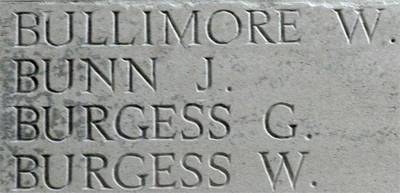
- Commemorated at: Thiepval Memorial
Panel Ref: P&F1D8B &8 C.
Joseph was born on 15th January 1894 in the Newton area of Middlewich. He was the son of Middlewich born, Peter Bunn and his Runcorn born wife Elizabeth (nee Johnson) who married in 1893. He was baptised on 04th February 1894. His father was a canal clerk.
By 1896 the family had moved to Aston-by-Sutton, southeast of Runcorn, and this was where the other four children were born, Thomas in 1896, Ann in 1899, Mary in 1902 and Mabel in 1911.
His father, Peter, aged 32, was still working as a canal check clerk in 1901, mother Elizabeth was aged 26. The family lived at Tunnel End with Joseph, 7, Thomas, 5, and Annie, 2. The address appears to refer to the Preston Brook Tunnel, 1,239 yards long, on the Bridgewater Canal.
The Census of 1911 shows the family address as Aston-By-Sutton, Preston Brook, "via Warrington".
His father is 42, a canal check clerk, his mother is 38. Joseph, aged 17, was working as a grocer’s clerk and was unmarried. Thomas, 15, worked as a clerk for an accountant and estate agent. Annie, 13, and Mary, 9, were at school, and Mabel was 2 months old.
Joseph enlisted in Liverpool on 13th November 1914, joining the 20th Battalion of The King's Liverpool Regiment as Private 22032. He gave his age as 20 years and 10 months, and his occupation as a clerk. He was described as being 5’ 5 and a half inches tall, weighing 126 lbs, 36” chest, with a fresh complexion, grey eyes and dark brown hair. He stated his religion as Church of England and as next of kin his father Peter, at Dutton, Preston Brook, near Warrington.
Formed in November 1914 the 20th Battalion were originally billeted at Tournament Hall, Knotty Ash before on 29th January 1915 they moved to the hutted accommodation purposely built at Lord Derby’s estate at Knowsley Hall. On 30th April 1915 the 19th Battalion alongside the other three Pals battalions left Liverpool via Prescot Station for further training at Belton Park, Grantham. They remained here until September 1915 when they reached Larkhill Camp on Salisbury Plain. He arrived in France on 07th November 1915.
He was sent to a 55th Field Ambulance on 08th April 1916 with pyrexia (fever) and from 22 Field Ambulance rejoined his unit in the field on 15th April 1916.
The 20th Battalion took part in the fateful attack on the village of Guillemont in the Battle of the Somme on 30th July 1916. Joseph was killed in action (missing presumed dead) on 30th July 1916, aged 22, one of nearly 500 Pals who were killed in action on that day.
The 20th King’s Battalion Diary records:
“At 4.45am prompt the attack was launched. Unfortunately, a thick mist prevailed and it was impossible to see more than 10 yards ahead. This continued until about 6 o’clock when it lifted slightly, but it was still too hazy and impossible to see what was happening 100 yards ahead. This being so, it was not surprising to find that the attacking waves were experiencing great difficulty in maintaining connection.”
At 6am, Lt. RE Melly, No.1 Company, reported that his men had taken the German Maltz Horn trench.
At 6.30am, 2/Lt. CP Moore reported that he had 150 men, 4 Stokes Mortars and 2 Lewis Guns, but he was the only officer. He also said that due to the fog, both his “flanks were in the air” i.e. he was not in contact with neighbouring troops.
At 9.10am, Moore was still not in contact at his flanks, and now he had only 75 men, he had sent out 2 patrols and neither not returned. Later Moore established communication with the French on his right.
Around 10.00am, 2/Lt Musker reported that he had just over a company with him, but his left flank was suffering from German machine gun fire. Later he reported that he had over 30 casualties from the machine gun fire. His flanks were also “in the air”. No contact was made with this party until the remnants returned around 9.30pm, all runners sent were killed or missing. The War Diary states that this group had: ”held the ground won all day, and this permitted the consolidation of the ground won on the Maltz Horn ridge with little interference from the enemy”.
Relief for 20/Kings had been planned for 11.00pm, but it was 5.00am on the 31st July before it took place, ending a tragic day for the Liverpool Pals.
Casualties for 20th Battalion were 16 Officers and 357 Other Ranks
When darkness fell on the battlefield the 30th Division held a line from the railway on the eastern side of Trones Wood , southwards and including Arrow Head Copse, to east of Maltz Horn Farm. On this line the division was relieved by the 55th Division during the early hours of the 31st July.
The events of 30th July 1916 were regarded at the time as Liverpool’s blackest day. There follows an extract from The History of the 89th Brigade written by Brigadier General Ferdinand Stanley which gives an indication of the events of the day.
Guillemont
Well the hour to advance came, and of all bad luck in the world it was a thick fog; so thick that you couldn’t see more than about ten yards. It was next to impossible to delay the attack – it was much too big an operation- so forward they had to go. It will give some idea when I say that on one flank we had to go 1,750 yards over big rolling country. Everyone knows what it is like to cross enclosed country which you know really well in a fog and how easy it is to lose your way. Therefore, imagine these rolling hills, with no landmarks and absolutely unknown to anyone. Is it surprising that people lost their way and lost touch with those next to them? As a matter of fact, it was wonderful the way in which many men found their way right to the place we wanted to get to. But as a connected attack it was impossible.
The fog was intense it was practically impossible to keep direction and parties got split up. Owing to the heavy shelling all the Bosches had left their main trenches and were lying out in the open with snipers and machine guns in shell holes, so of course our fellows were the most easy prey.
It is so awfully sad now going about and finding so many splendid fellows gone.
Joseph was initially declared Missing, his name appearing in the list of K.L.R. casualties published in the Liverpool Daily Post on 14th September 1916. His father wrote to Infantry Records on 15th September 1916:
"Dear Sir,
You advised me on the 26th August that my son (Private Joseph Bunn 22032 No.1 Company No.2 Platoon 20th Service Batn K.L.R.) was posted as missing. I have heard from four different soldiers that my son was killed in action on July 30th near Waterlot Farm, + I have received some letters + a photo which were taken from his dead body. I should esteem it a great favour if you could kindly give us any further information, the suspense is very hard to bear.
Enclosed herewith are copies of letters received. Trusting you will do your utmost to enlighten us on this sad affair, thanking you in anticipation,
I remain
Yours humbly
Peter Bunn
P.S. I have 2 more letters from his Pals which give the same information as the enclosed copy."
Copy of letters received:
"Dear Mr. Bunn,
I have the sad duty of writing to you about the death of your son, which took place on Sunday week the 30th ult. He was taking part in an advance when he was hit + it may be some slight comfort to you to know that his end was instantaneous + that he could not have suffered. Your son was in my section from the time we left England + I had therefore ample opportunities of realising what a plucky chap he was + how he stuck to it through some very trying times, he was always cheerful no matter how hard the day.
Please accept, both you + Mrs. Bunn, the deepest sympathy of the platoon commander, his comrades + myself. We feel his loss greatly, but he did his duty bravely to the end.
I am
Yours very truly
R.W. Moulton C.S.M."
(See C.S.M. 22181 Reginald W. Moulton's profile on this site.)
"Dear Mr. Bunn,
I strongly endorse every word of Sgt. Moulton's letter, and beg to offer you my deepest sympathy in your great affliction.
Yours sincerely,
Clive Buttemer, 2nd Lieut."
"14th August 1916
Dear Mr. Bunn,
I am sorry to have to write to you, to say that your son Joe was killed on Sunday morning 30th July, the full particulars of the case I have not yet received, but if I get to know anything I will write and let you know.
The platoon commander is not now with us or he would have written you.
Your loss I fully understand, as he was a fine fellow and one of my best chums, having worked along with him for a couple of years prior to our enlistment together, with Charlie Pearson, who the last I heard of was wounded.
I am enclosing some letters of his which have come to the Battalion and been handed to me.
His chums of the platoon all offer their sincerest sympathy, and deeply regret your loss.
Yours sincerely,
Jack Stringer"
(Pte. 22266 John Stringer was killed in action on 12/10/1916. See profile on this site.)
His father wrote again on 17th September:
"Dear Sir,
I beg to acknowledge receipt of your letter of the 16th inst. and enclose herewith the letter received from C.S.M. Moulton + 2nd Lieut. C. Buttemer, also one from Private J. Stringer of the Liverpool Reg. + one from Private S. Foster Burrows of the 2nd Bedfords, hoping they will be very helpful in your enquiries.
Kindly return letters at your convenience. Thanking you for your kind attention,
I remain
Yours humbly,
Peter Bunn"
(Pte. Samuel Foster Burrows of the 4th Bn. Bedfordshire Regiment was killed in action, aged 29, on 11/01/1917 and is commemorated on the Thiepval Memorial to the Missing of the Somme.)
This correspondence was forwarded by Infantry Records to the War Office, who responded on 11th November 1916 that an enquiry had been made at the Base and enclosed the Deputy Adjutant General's reply:
"Unofficial report of death is not confirmation. Private Burrows was transferred to England, sick, 4.9.16, C.S.M. Moulton was killed in action 20.10.16, 2nd Lieut. Clive Buttemer, 20 King's Liverpool Regiment, was transferred to England (wounded shell-shock) 23.10.16. No further evidence of Pte. Bunn's death is available." His father was notified of this on 1/12/1916 and was assured that further enquiries were being made and the result would be communicated to him as soon as possible.
By 02/01/1917 Army Form B2090 had been furnished (Field Service Report of the Death of a Soldier), and Joseph's death was officially accepted.
The War Office wrote to Infantry Records on 14th January 1917:
"The Officer in Charge of Infantry Records, Preston, is informed that the report of the death of No.22032 Pte. J. Bunn, 20 L'pool Rgt. has been accepted as sufficient evidence for official purposes, and that the date of death has been assumed to be 30.7.16. The next of kin should be notified accordingly and the usual papers prepared, if not already done."
Joseph's personal belongings, 1 cap badge and 1 prayer book, were sent to his father in April 1917.
His body was not recovered or was subsequently lost as his name is recorded on the Thiepval Memorial in France.
The Thiepval Memorial, the Memorial to the Missing of the Somme, bears the names of more than 72,000 officers and men of the United Kingdom and South African forces who died in the Somme sector before 20 March 1918 and have no known grave. Over 90% of those commemorated died between July and November 1916.
On 01st August 1932 the Prince of Wales and the President of France inaugurated the Thiepval Memorial in Picardy. The inscription reads: “Here are recorded the names of officers and men of the British Armies who fell on the Somme battlefields between July 1915 and March 1918 but to whom the fortune of war denied the known and honoured burial given to their comrades in death.”
His fiancee, Annie placed a Memorial notice in the local press:
BUNN - In loving memory of Private Joseph Bunn K.L.R. who fell in action July 30th 1916.
The earth has lost and heaven gained
One of the best the world contained
Fondly remembered by his Fiancee, Annie
He earned his three medals; the 1914-15 Star, the British War Medal and the Victory Medal.
His father received his son's outstanding Army pay and a War Gratuity of £7-10s and was awarded a pension in February 1918 of 3/6d a week backdated to October 1917.
Joseph is commemorated on the following Memorials:
Aston-by-Sutton
St Peter's Church, Aston-by-Sutton
St Michael’s Church in Little Leigh.
His mother appears to have died in 1931 aged 56, and his father in 1933 aged 65.
In 2015 his military paraphernalia were put up for auction:
"WWI 1914-15 Star trio and Memorial Plaque to 22032 Pte J. Bunn L'Pool R. (Joseph Bunn on plaque) very fine [condition] and better. With photo in uniform, copies CWGC, Soldiers Died, Medal Index Card and 6 copied pages of service record, the papers include a letter from his CSM informing Bunn's father of his death. (R) £240"
We currently have no further information on Joseph Bunn, If you have or know someone who may be able to add to the history of this soldier, please contact us.
Killed On This Day.
(110 Years this day)Monday 23rd October 1916.
Pte 37251 James Sanderson
28 years old
(109 Years this day)
Tuesday 23rd October 1917.
2nd Lieut Robert Stephenson Parry
24 years old
(108 Years this day)
Wednesday 23rd October 1918.
Pte 35226 Adam Alexander Russell
22 years old