
1885 - 1916

CPL David Wallace Crawford
1887 - 1916

Lce-Corpl John Joseph Nickle
1894 - 1916

Pte 17911 Morton Neill
1897 - 1916

Lieut Edward Stanley Ashcroft
1883 - 1918

Pte 17798 Colin Vernon Bunting
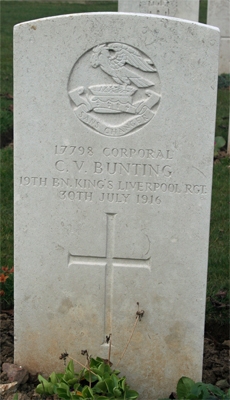
- Age: 35
- From: Loxley, Hallamshire
- Regiment: The King's (Liverpool Regiment) 19th Btn
- D.O.W Sunday 30th July 1916
- Commemorated at: Guillemont Rd Cem
Panel Ref: IV.L.1
Colin Vernon was born in Loxley, Hallamshire, Yorkshire on 27th July 1881, the youngest child and only surviving son of Clement Vernon Bunting and his wife Sarah Ann Green (née Denton). He was baptised on 24th September 1888 at age 7 in Loxley Congregational Church. His parents married in Wortley in 1861, their first born, Sarah, born in 1861 in Loxley, died in infancy. Their subsequent children were born in Wortley, about nine miles to the north. Julia born in 1864 died at age 25 in 1890, Emily Denton 1868 died at age 2, Ada was born in 1870, and Clement Edwin 1875 also died at age 2.
His father was a steel manufacturer, like his father before him, and had been in business with John Denton until the partnership was dissolved by mutual consent in 1874. Many water-powered mills (or wheels) existed in the Loxley Valley. The Dentons had run the Old Wheel at Loxley since 1845.
A likely explanation for the move to Wortley was the collapse of the Dale Dyke Dam in 1864. The reservoir had recently been completed to supply drinking water to the rapidly growing city of Sheffield.
On the night of 11th March 1864 the filling of the reservoir, together with a southwesterly gale, resulted in a breach of the dam and 650 million gallons of water flooding the Loxley Valley. Low Bradfield, Loxley and Hillsborough were among the hamlets situated along the valley some four miles from the dam on the way to Sheffield.
The Great Sheffield Flood of 1864 resulted in the loss of 240 lives, hundreds of buildings destroyed, twenty bridges washed away, and parts of the city of Sheffield devastated. An apprentice at the Old Wheel, 14-year old Joseph Denton, was drowned in the flood.
The claims for damages formed one of the largest insurance claims of the Victorian period.
The family was apparently safe but suffered property damage. Clement Vernon Bunting, steel forgeman, of Old Wheel, Loxley, claimed £48-3s for loss of property (income from work, house rent, tools, books, "viz. Lives of Wellington, Napoleon, Shakespeare, and Burns; Histories of England, France, etc."). His claim was withdrawn and amended, and he was awarded £22 compensation.
The 1891 Census finds the family living at Green Wheel, Ecclesfield, Wortley, Yorkshire. Colin Vernon is 9 years of age and is living with his parents and elder sister. His father Clement Vernon is a steel manufacturer forgeman born in Sheffield in 1841, whilst his mother was born at Bradfield in 1841. His elder sister Ada was born in Ecclesfield in 1871.
His mother died in 1896, aged 56.
The family are still at the same address in 1901. Colin is now 19 and employed as a steel tilter and forgeman like his widowed father, who the census notes has been blind for three years. His father is a widower and his sister Ada is married, her surname now Williams. Her husband George is present in the household, he is described as a photographer. There is a visitor and a servant also present.
Colin married Mary Eveline Silvester at Wortley Registry Office on 24th May 1902. The marriage was reported in the Sheffield Evening Telegraph on 27th May 1902:
"May 24, at Penistone, by license, Colin Vernon, only son of Clement Vernon Bunting, of Green Wheel, Loxley, near Sheffield, to Mary Eveline, eldest daughter of John Silvester, of Cleveden, Bristol."
Going back through the censuses for Mary, on the 1901 Census of England & Wales there is a 21 year old barmaid, Mary E. Sylvester, born India, who was recorded living in one of the households at 25 King Street, Portsmouth. This was the household of her aunt, the married woman Julia Wilson, born Nottinghamshire.
And on the 1881 Census of England & Wales there is a 1 year old Mary Sylvester, born India, recorded aboard the Royal Navy ship “Crocodile”, described on the front page of the return as an Indian Troop Ship, that appears to have been on the highseas off the coast of Oman, at midnight on the night the census was taken, (3rd April 1881). Because of the layout of the census schedule relationships between individuals are not explained but the line above Mary is a married woman, Ellen Sylvester, (aged 19, born India), and the line above that is a married man, Sergeant John Sylvester, Royal Artillery, aged 28 and born Worksop, Nottinghamshire.
His father died in 1906, aged 66, his death was reported in the Sheffield Daily Telegraph on Wednesday 07 November 1906;
FUNERAL OF MR. C. V. BUNTING, LOXLEY.
On Monday a large number people attended the funeral Mr. C. V. Bunting, at Loxley Chapel. The Dead March in “Saul” was feelingly rendered Mr. J. T. Wood, the chapel organist, and an appropriate address was given by the pastor. The deceased gentleman was formerly a member of the Steel and Ironmasters’ Association of Sheffield, and was at one time a member of the Wortley Guardians. In politics he was a staunch Conservative. He was also member the Loxley River Board. Mr. Bunting was 66 years age. .
Cutlery produced by his father was stamped 'C.V. Bunting'; perhaps his intent was to pass the business on to his son of the same initials.
Clement carried on business for many years at the Green Wheel Steel Works, Loxley, but by 1903 was suffering financial difficulties. Horses and stable equipment were auctioned off, a number of insurance policies were sold to settle debts, and his tilt and forge business was sold at auction.
The 1911 Census finds Colin living with his family at 45 Thirlmere Road, Everton. He is employed as a Superintendent at Jones' Sewing Machine company, his wife Mary Eliza was born in Ferozepore, India (Punjab). They have one child Sylvia Ada born on 25th April 1903 in Sheffield.
He enlisted in Liverpool on 12th September 1914 joining the 19th Battalion, The King’s Liverpool Regiment as Private 17798. He gave his age as 33 years and 47 days and his occupation as a manager (another page notes shop manager). He was described as being 5' 6 and a half inches tall, weighed 160lbs with a 39 inch chest. He was of fresh complexion with grey eyes and brown hair and his religion was noted as Church of England. He gave his next of kin as his wife Mary, who by then had moved to Cheshire, at 2 St. Vincent Road, Egremont.
Formed on 07th September 1914 the 19th Battalion trained locally at Sefton Park and remained living at home or in rented accommodation until November 1914. They then moved to the hutted accommodation at Lord Derby’s estate at Knowsley Hall. On 30th April 1915 the 19th Battalion alongside the other three Pals battalions left Liverpool via Prescot Station for further training at Belton Park, Grantham. They remained here until September 1915 when they reached Larkhill Camp on Salisbury Plain. Whilst at Larkhill Camp he was appointed unpaid Lance Corporal on 14th September 1915. He arrived in France on 7th November 1915.
His service record shows Qualification: Machine Gunner.
Colin was treated in a field ambulance for Influenza in February 1916. He was promoted to Corporal on 14th May 1916.
Colin died of wounds sustained in the attack at Guillemont Village on the 30th July 1916, aged 35. He was originally posted as Missing. A letter to his wife Mary, dated 10th October 1916, at 77 Southdale Road, Rock Ferry, Cheshire concerning a pension was annotated that "This form should not be taken as evidence of your husbands death". His sister Ada contacted the International Red Cross in Geneva but was notified on 29th November 1916 that they had no information on Colin.
An entry on his service record dated 23rd August 1917 states, Killed in action or died of wounds on or shortly after 30th July 1916.
The events of 30th July were described in detail in the Battalion diary:
19th Battalion Diary 30th July 1916
MALTZ HORN FARM
BATTLE begun. ZERO hour 4:45 am. The Battalion reached its objective, but suffered heavy losses, and had to evacuate its position owing to no reinforcements.
Everard Wyrall gives details of the attack in his book The History of The King’s Regiment;
"The 2nd Attack on Guillemont- 29th July 1916 the 89th Brigade the 20th King's were to attack on the right and the 19th on the left. During the evening of the 29th the night was dark and foggy when the Battalions moved off and the 19th with Lt Col G Rollo commanding, when passing the South east of the Briqueterie they were heavily shelled first with H E and then with a new kind of asphyxiating Gas shell which had curious results, at first it had no nasty effect but about 8 hrs later men began to fall sick with violent headaches and pains in the stomach. All ranks had to wear gas masks which in the darkness and mist made the going terribly difficult. It was indeed wonderful that they were able to reach their Assembly point at all. But they did and by 2.45 a.m. on the 30th July 1916 the Btn was assembled having suffered about 30 Casualties on the way up ready for the Zero hour at 4.45 a.m.
It is known that the two left Companies of the 19th under Capt. Dodd and Capt. Nicholson advanced in touch with the 2nd Royal Scots Fusiliers on their left although they suffered many casualties from Machine gun Fire did not encounter many Germans and reached their final objective about the time allocated, beginning at once to dig in south of the orchard on the South east corner of Guillemont.
On the left of the 19th the Scots Fusiliers most gallantly forced their way through Guillemont to the eastern side of the village but were soon overwhelmed by the enemy and few returned.
At 8 a.m. finding that the village was not held the two left Companies of the 19th received no word from the rear or either flank believed themselves to be totally isolated so were forced to fall back and dig in, their position being untenable.
At midday the effective fighting strength of the 19th Btn was just 7 Officers and 43 other ranks"
When darkness fell on the battlefield the 30th Division held a line from the railway on the eastern side of Trones Wood , southwards and including Arrow Head Copse, to east of Maltz Horn Farm. On this line the division was relieved by the 55th Division during the early hours of the 31st July.
Casualties in the 19th Battalion were 11 Officers and 435 Other Ranks
The events of 30th July 1916 were regarded at the time as Liverpool’s blackest day. There follows an extract from The History of the 89th Brigade written by Brigadier General Ferdinand Stanley which gives an indication of the events of the day.
Guillemont
Well the hour to advance came, and of all bad luck in the world it was a thick fog; so thick that you couldn’t see more than about ten yards. It was next to impossible to delay the attack – it was much too big an operation- so forward they had to go. It will give some idea when I say that on one flank we had to go 1,750 yards over big rolling country. Everyone knows what it is like to cross enclosed country which you know really well in a fog and how easy it is to lose your way. Therefore, imagine these rolling hills, with no landmarks and absolutely unknown to anyone. Is it surprising that people lost their way and lost touch with those next to them? As a matter of fact, it was wonderful the way in which many men found their way right to the place we wanted to get to. But as a connected attack it was impossible.
The fog was intense it was practically impossible to keep direction and parties got split up. Owing to the heavy shelling all the Bosches had left their main trenches and were lying out in the open with snipers and machine guns in shell holes, so of course our fellows were the most easy prey.
It is so awfully sad now going about and finding so many splendid fellows gone.
Colin was buried close to where he fell and after the war when graves were concentrated, his body was removed and reinterred in Guillemont Road Cemetery.
Guillemont was an important point in the German defences at the beginning of the Battle of the Somme in July 1916. It was taken by the 2nd Royal Scots Fusiliers on 30 July but the battalion was obliged to fall back, and it was again entered for a short time by the 55th (West Lancashire) Division on 8 August. On 18 August, the village was reached by the 2nd Division, and on 3 September (in the Battle of Guillemont) it was captured and cleared by the 20th (Light) and part of the 16th (Irish) Divisions. It was lost in March 1918 during the German advance, but retaken on 29 August by the 18th and 38th (Welsh) Divisions.
The cemetery was begun by fighting units (mainly of the Guards Division) and field ambulances after the Battle of Guillemont, and was closed in March 1917, when it contained 121 burials. It was greatly increased after the Armistice when graves (almost all of July-September 1916) were brought in from the battlefields immediately surrounding the village and certain smaller cemeteries, including:-
HARDECOURT FRENCH MILITARY CEMETERY. The village of Hardecourt-au-Bois was captured by French troops on the 8th July 1916, and again by the 58th (London) and 12th (Eastern) Divisions on 28 August 1918. Five British Artillerymen were buried by their unit in the French Military Cemetery, in the middle of the village, in September 1916; and in 1918 the 12th Division buried in the same cemetery 14 men of the 9th Royal Fusiliers and two of the 7th Royal Sussex.
Guillemont Road Cemetery now contains 2,263 Commonwealth burials and commemorations of the First World War. 1,523 of the burials are unidentified but there are special memorials to eight casualties known or believed to be buried among them.
The cemetery was designed by Sir Herbert Baker.
The pension card, which unusually, does not give a cause of death, shows that his widow Mary, living at 77 Southdale Road, Rock Ferry, was awarded a pension from February 1917. Tragically, she died that same month, at the age of 37.
His outstanding Army pay went to R.S.M. John Sylvestre (sic), and a War Gratuity of £9-10s to his daughter Sylvia Ada including his Memorial Plaque and Scroll. Service records for John Sylvester, born Worksop c1854, show he attested on the 15th October 1914 as Gunner 4225 Royal Garrison Artillery, then resident at Abbey Wood, Kent. He was soon promoted on the 1st December to RSM. Additional records in 1919 are indexed with service number 279225, Royal Garrison Artillery
His daughter Sylvia was 13 years old when Colin died. Colin’s sister Ada, Mrs. Williams, 31 Ainsdale Grove, Gorton Road, Reddish, near Stockport, became her guardian after her mother's death and received a pension of 7/- until Sylvia turned 16. An additional pension of 5/- a week was awarded to Sylvia for six months until she reached the age of 16 and a half.
Probate was granted, only in 1938, in the amount of £191-9s to Sylvia (Colin’s address at the time of his death shown as 2 St. Vincent Road, Egremont.)
In 1939 Sylvia, 36, is living in Stockport, working as a secretary. She never married, and died at age 95 in 1998.
Colin earned his three medals. They and other military paraphernalia went up for auction in 2004: 1914-15 Star, British War and Victory Medals; memorial plaque;
Liverpool Pals silver cap badge with brooch fittings and safety chain; fibre identity disc, the medals and plaque in card boxes of issue, the registered packet addressed to next of kin at Carton (sic) Road, Reddish, Stockport, extremely fine condition, expected to fetch up to £700. Hammer price was £600.
Sadly, Colin has not been found on any memorial.
We currently have no further information on Colin Vernon Bunting, If you have or know someone who may be able to add to the history of this soldier, please contact us.
Killed On This Day.
(110 Years this day)Tuesday 24th October 1916.
Pte 33220 David Brocken
24 years old
(109 Years this day)
Wednesday 24th October 1917.
Pte 17690 Henry Phipps
22 years old
(109 Years this day)
Wednesday 24th October 1917.
Pte 308326 James Speakman
26 years old
(108 Years this day)
Thursday 24th October 1918.
Serjeant 17245 Robert George Evans (MM)
22 years old