
1885 - 1916

CPL David Wallace Crawford
1887 - 1916

Lce-Corpl John Joseph Nickle
1894 - 1916

Pte 17911 Morton Neill
1897 - 1916

Lieut Edward Stanley Ashcroft
1883 - 1918

Lieut Harold Quinan Carver
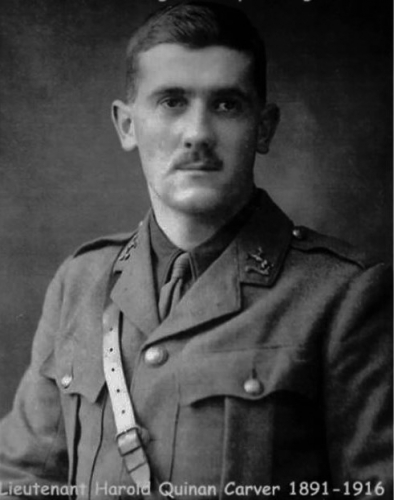
- Age: 25
- From: N.S.W. Australia
- Regiment: The King's (Liverpool Regiment) 19th Btn
- K.I.A Sunday 30th July 1916
- Commemorated at: Guillemont Rd Cem
Panel Ref: V.D.7
Harold Quinan Carver was born in Victoria, Australia, on 14th May 1891 to Walter Aspinall Carver, born in 1857 in Chorlton, Manchester, and Annette Alice (nee Quinan), born in Sale, Victoria. His father had emigrated to Australia in the 1880s. They were married on the 19th Jan 1888 and had six children, all born in Victoria. Harold had an older sister Agnes, and younger siblings Amy, Sybil, Sydney, and Alice.
His father Walter is found on the 1881 census at Holly Bank, Bankfield Rd, West Derby. He is aged 24, a civil engineer, living with his Egyptian merchant brother Charles W. Carver who was born in Gibraltar. Walter was registered in the Institution of Civil Engineers in 1883 and in 1896 was in Rushworth, Victoria.
The family came to England in 1899 and settled in Somerset; Harold was educated at Sexeys school in Somerset from 1901 to 1907 and thereafter at Giggleswick School, a boarding school near Settle, North Yorkshire. After completing his education, Harold moved to Liverpool to work, where he had relatives who worked in the cotton trade.
Name, W A Mrs Carver
Age, 40
Birth Year, abt 1859
Departure Date, Apr 1899
Departure Place, Victoria, Australia
Destination, LONDON VIA PORTS
Ship, OMRAH
Ship's Master, RUTHVEN J F
In 1911 Harold is living with his cousins, Phyllis Carver, 22, and Stella, 17, at 2 Charlesville, Birkenhead. He is 19, single, and employed as a clerk to a cotton merchant. Also in the household is a visitor, as well as a cook and a parlour maid. His parents with four of his siblings are living in eleven rooms in Castle Cary, Somerset. His father is incapacitated, living on his own means, sister Amy is 18, a training student, Sybil 16, Sydney, 14, and Alice, 12, are at school. Also in the household are a boarder, a visitor, and a domestic servant. His family appears to have returned to Australia some time after this and settled in New South Wales. Sister Amy arrives back in Fremantle in December 1913.
Name, Amy Carver
Gender, Female
Nationality, British
Record Type, Arrival
Departure Place, United Kingdom
Arrival Date, 11 Dec 1913
Arrival Place, Fremantle
Vessel Name, Armadale
Before the war, Harold was involved in the cotton trade with Messrs. Carver Bros., 25 & 26 Cotton Exchange building, Edmund St. When war was declared he was in Egypt on business, returned to the U.K. and obtained a commission with the 19th Battalion of The King’s Liverpool Regiment. He was appointed Temp 2nd Lt. as per the London Gazette, of the 13th November 1914. His brother, Sydney, also enlisted, in Prahan, Melbourne.
The medal roll shows that Harold disembarked in France prior to 30th November 1915. In early January the Pals battalions took up position in the south of the Somme line near Carnoy.
According to the battalion War Diary, on 10th February 1916 while in the trenches at Carnoy, Harold was wounded: “About 2.30 a.m. the enemy started a short and sharp bombardment of the village, which lasted 15 minutes, one shell falling within 4 yards of the Commanding Officer’s dugout. 2nd Lieutenant H.Q. Carver was seriously wounded in the mouth.”
After recuperating from his wounds, Harold returned to France in June, in time for the ‘Big Push’. Harold survives the deadly month of July 1916 on the Somme until the 29th, when the 19th battalion takes up position in the Maltz Horn trench for the coming attack on the village of Guillemont.
The Battalion’s objectives on the day were the German trenches on the South Eastern edge of Guillemont, which was a heavily fortified village on top of a gentle slope, with a front of about seven hundred yards. Each end of the front was also defended by Machine-guns, which could give covering and enfilading fire. The line of attack was entirely without cover. The 19th Battalion was on the left flank of the 89th Brigade advance, which began at 04.45 am I a thick and heavy fog.
As the Battalion moved forward in the fog it was heavily shelled with high explosive and gas shells, which added to the confusion and consequent loss of direction. Despite this, the edge of the village was reached, but the 19th unable to link up with the Battalion on its left, the 2nd Royal Scots, and found both its flanks in the air. By this time the fog had lifted to a large extent, but this allowed the German Machine Gunners a clear field of fire, and their numbers augmented by Infantrymen and snipers who had left their trenches to lie in No Man’s Land to shelter from the British Bombardment on their front line trenches. They too were to take a heavy toll of the 19th, who were lying exposed, and by noon the Battalion had been forced to evacuate its position. By the end of the day nine officers and one hundred and eighty four other ranks had been, killed, or died of wounds. Lieutenant Carver was amongst those killed.
The events of 30th July 1916 were regarded at the time as Liverpool’s blackest day. There follows an extract from The History of the 89th Brigade written by Brigadier General Ferdinand Stanley which gives an indication of the events of the day.
Guillemont
Well the hour to advance came, and of all bad luck in the world it was a thick fog; so thick that you couldn’t see more than about ten yards. It was next to impossible to delay the attack – it was much too big an operation- so forward they had to go. It will give some idea when I say that on one flank we had to go 1,750 yards over big rolling country. Everyone knows what it is like to cross enclosed country which you know really well in a fog and how easy it is to lose your way. Therefore, imagine these rolling hills, with no landmarks and absolutely unknown to anyone. Is it surprising that people lost their way and lost touch with those next to them? As a matter of fact, it was wonderful the way in which many men found their way right to the place we wanted to get to. But as a connected attack it was impossible.
The fog was intense it was practically impossible to keep direction and parties got split up. Owing to the heavy shelling all the Bosches had left their main trenches and were lying out in the open with snipers and machine guns in shell holes, so of course our fellows were the most easy prey.
It is so awfully sad now going about and finding so many splendid fellows gone.
His death was reported in the Liverpool Echo on Saturday 19th February 1916;
ROLL OF HONOUR.
CASUALTIES AMONG THE LIVERPOOL "PALS."
Casualties recorded in last night's lists include:
Second-Lieutenant Carver, 19th Battalion (3rd City) Liverpool Regiment, is amongst the wounded officers.
Harold was buried close to where he fell and, after the war when graves were concentrated, his body was removed and he now rests at Guillemont Road Cemetery, Somme which is on the site of the old Battlefield, in Plot V, Row D, Grave 7. His headstone has no private family inscription.
Guillemont was an important point in the German defences at the beginning of the Battle of the Somme in July 1916. It was taken by the 2nd Royal Scots Fusiliers on 30 July but the battalion was obliged to fall back, and it was again entered for a short time by the 55th (West Lancashire) Division on 8 August. On 18 August, the village was reached by the 2nd Division, and on 3 September (in the Battle of Guillemont) it was captured and cleared by the 20th (Light) and part of the 16th (Irish) Divisions. It was lost in March 1918 during the German advance, but retaken on 29 August by the 18th and 38th (Welsh) Divisions.
The cemetery was begun by fighting units (mainly of the Guards Division) and field ambulances after the Battle of Guillemont, and was closed in March 1917, when it contained 121 burials. It was greatly increased after the Armistice when graves (almost all of July-September 1916) were brought in from the battlefields immediately surrounding the village and certain smaller cemeteries, including:-
HARDECOURT FRENCH MILITARY CEMETERY. The village of Hardecourt-au-Bois was captured by French troops on the 8th July 1916, and again by the 58th (London) and 12th (Eastern) Divisions on 28 August 1918. Five British Artillerymen were buried by their unit in the French Military Cemetery, in the middle of the village, in September 1916; and in 1918 the 12th Division buried in the same cemetery 14 men of the 9th Royal Fusiliers and two of the 7th Royal Sussex.
Guillemont Road Cemetery now contains 2,263 Commonwealth burials and commemorations of the First World War. 1,523 of the burials are unidentified but there are special memorials to eight casualties known or believed to be buried among them.
The cemetery was designed by Sir Herbert Baker.
There is some disagreement as to Harold’s age. CWGC shows 26, whilst a family newspaper notice states 25, which agrees with his stated date of birth in May 1891.
The events of 30th July 1916 were regarded at the time as Liverpool’s blackest day. There follows an extract from The History of the 89th Brigade written by Brigadier General Ferdinand Stanley which gives an indication of the events of the day.
His death was reported in the Liverpool Daily Post on 11th August 1916:
“Lieut. H. O. [sic] Carver, who is reported killed in action, was connected with the firm of Messrs. Carver Bros. and Co. Ltd., cotton merchants, of Liverpool. He was the elder son of Mr. and Mrs. W.A. Carver of New South Wales. At the outbreak of war he was in Egypt on business for his firm, but he at once came to England and obtained a commission in the King’s Liverpools. Lieutenant Carver was a very keen and popular officer. He was wounded in February, but was able to again go to the front in June.”
His parents placed a notice in The Argus, Melbourne, 19th August 1916:
“Killed in action in France on July 30, 1916, Lieut. Harold Quinan Carver, aged 25, dearly loved eldest son of Walter and Nettie Carver, of Leeton, New South Wales.”
Sexeys school magazine also reported his death:
"Lieut. Harold Q. Carver was recently reported killed. He entered the school in 1901 and remained until 1907. After a short period at Giggleswick, he then entered the firm of Carver Bros., Cotton Brokers, of Liverpool. During his residence in Liverpool, he was an enthusiastic member of the Territorials. At the outbreak of war, he was holding a position under the same firm in Egypt and came home to join up. Lieut. H.Q. Carver was killed on July 30th, while leading his men. They were almost across No Man’s Land when he turned round to cheer on his men and was shot through the back. He died in about 10 minutes. The major of his regiment writes: “I cannot speak too highly of Lieut. Carver’s conduct. He was a brave and fearless soldier and beloved by all ranks. His loss is one difficult to replace.”
Soldiers Effects of £86 7s 2d to brother Charles William.
Probate, giving Harold’s address as Woodbourne (the address, in Sandfield Park, West Derby, of his uncle Charles in Liverpool), was granted to Charles William Carver, cotton merchant, effects of £785 0s 8d.
His father died on the 27th March 1927 in Balmoral, Sydney, Australia.
Name, Walter Aspinall Carver
Death Date, 27 Mar 1927
Event Type, Probate
Event Date, 27 Apr 1928
Event Place, Balmoral, New South Wales, Australia
The Daily Telegraph, Sydney Thursday the 15 March 1928;
Wanted Body to Turn to "Beneficial Life"
THE estate which Walter Aspinall Carver, of Balmoral, left to his widow and daughters was valued at £1485, and a request in his will was a strange, one. It ran:
“Should I die on the farm" — apparently a property at Leeton — "I request that my remains should be buried under a large pine tree in front of the house, in a light coffin, so that corruption might be changed to beneficial life as soon as possible."
His mother died on the 15th May 1930 in Chatswood, Sydney, but was living in Yenda, NSW.
Name, Annette Alice Carver
Residence Place, Yenda
Death Date, 15 May 1930
Death Place, New South Wales, Australia
Harold is commemorated on the following memorials:
Hall of Remembrance, Liverpool Town Hall, Panel 11 Right.
Australian War Memorial
Liverpool Cotton Association
Giggleswick School, North Yorkshire WW1 Tablet
All Saints Church, Castle Cary, Somerset
Castle Cary, Somerset.
We currently have no further information on Harold Quinan Carver, if you have or know someone who may be able to add to the history of this soldier, please contact us.
Killed On This Day.
(110 Years this day)Tuesday 24th October 1916.
Pte 33220 David Brocken
24 years old
(109 Years this day)
Wednesday 24th October 1917.
Pte 17690 Henry Phipps
22 years old
(109 Years this day)
Wednesday 24th October 1917.
Pte 308326 James Speakman
26 years old
(108 Years this day)
Thursday 24th October 1918.
Serjeant 17245 Robert George Evans (MM)
22 years old