
1885 - 1916

CPL David Wallace Crawford
1887 - 1916

Lce-Corpl John Joseph Nickle
1894 - 1916

Pte 17911 Morton Neill
1897 - 1916

Lieut Edward Stanley Ashcroft
1883 - 1918

Cpl 26558 Frederick Joseph Circuit
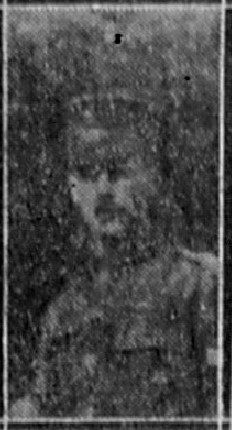
- Age: 26
- From: Leeds
- Regiment: The King's (Liverpool Regiment) 17th Btn
- D.O.W Saturday 5th August 1916
- Commemorated at: Anfield Cemetery
Panel Ref: Sec 17. 1308
Frederick Joseph Circuit was born in the third quarter of 1890 in Leeds, the son of Frederick Joseph Circuit and his wife Elizabeth Ann (née Butcher) who had married on the 27th June 1886 at St Mary’s Church, Edge Hill, Liverpool. Frederick was a 22 year old hairdresser of 29 Gladstone Road, his father, Alfred, was a postman, whilst Elizabeth was aged 28 of Compton Street, her father, Benjamin, a deceased shoemaker. They were originally from Edlesborough, Buckinghamshire. Frederick was baptised on the 14th September 1890 at St Augustine, Church Of England Church, Everton, his father a hairdresser of 30 Welbourne Street.
The 1891 Census shows the family living at Carberry Place, Leeds. His father, Frederick Joseph, is aged 28, born in Buckinghamshire in 1863, his occupation shown as a hairdresser, his mother, Elizabeth Ann, is aged 32 born 1859 also in Buckinghamshire. (Death records show year of birth as 1857) and Frederick born 1891.
The 1901 Census shows the family living at 134 Vine Street, Liverpool. (Name shown as Sircuit). His father, Frederick Joseph is shown as aged 37 and is still a hairdresser and his mother is now shown as 46 with no occupation listed. Frederick J. is aged 10.
His mother Elizabeth Ann, died September 1907, aged 50.
The 1911 Census shows Frederick Joseph is living as one of four boarders in the home of Hannah Jones at 39 Berwick Street, Liverpool. He is aged 20 and employed as a wholesale fancy drapery assistant. His father was still at 32 Shallcross Street.
He married Henrietta Charles on the 16th April 1911 in St Peter’s C. of E. Church, Liverpool. Their marriage certificate shows they were residing in Vine Street, Liverpool. Joseph was 21 years of age and he was employed as a draper. Henrietta was born on the 11th November, 1890, her father, Henry, was a plumber.
His father Frederick Joseph, died, in the December quarter of 1911, aged 47.
Prior to enlisting he was employed by S. & J. Watts, Wholesale Drapers at Clayton Square.
Frederick enlisted in Liverpool joining the 17th Battalion of The King’s Liverpool Regiment as Private 26558.
He had reached the rank of Corporal when he died of wounds on the 05th August 1916, aged 26. The wounds were most likely from the Somme offensive, almost certainly received at Guillemont. He had been admitted to the 31st Ambulance Train on the 04th August with injuries to his right thigh. He died of his wounds onboard the New Zealand hospital ship "Mararma".
17th Battalion Diary
The Battalion was in support to 19 & 20 Battalions K.L.R. 2 Coys. behind 19th & 2 Coys. behind 20th. Very thick mist. The attack was pushed home to the objective in places but in the main was held up by machine gun fire from hidden machine guns.
Fighting continued all day swaying backwards and forwards until by 6pm about 300 yards in depth had been gained & consolidated all along our front.
Casualties in the 17th Battalion were 15 Officers and 281 Other Ranks
Further details are reported in more detailed by Everard Wyrall in his book The History of the King’s Regiment (Liverpool) 1914-1919 Volume II 1916-1917
The 17th King’s had advanced (two companies each behind the 19th and 20th Battalions) in small columns. They too suffered heavily from machine-gun fire and were quickly absorbed into the waves that preceded them. They also shared the gains and losses of that terrible day.
When darkness fell on the battlefield the 30th Division held a line from the railway on the eastern side of Trones Wood , southwards and including Arrow Head Copse, to east of Maltz Horn Farm. On this line the division was relieved by the 55th Division during the early hours of the 31st July.
The events of 30th July 1916 were regarded at the time as Liverpool’s blackest day. There follows an extract from The History of the 89th Brigade written by Brigadier General Ferdinand Stanley which gives an indication of the events of the day.
Guillemont
Well the hour to advance came, and of all bad luck in the world it was a thick fog; so thick that you couldn’t see more than about ten yards. It was next to impossible to delay the attack – it was much too big an operation- so forward they had to go. It will give some idea when I say that on one flank we had to go 1,750 yards over big rolling country. Everyone knows what it is like to cross enclosed country which you know really well in a fog and how easy it is to lose your way. Therefore, imagine these rolling hills, with no landmarks and absolutely unknown to anyone. Is it surprising that people lost their way and lost touch with those next to them? As a matter of fact, it was wonderful the way in which many men found their way right to the place we wanted to get to. But as a connected attack it was impossible.
The fog was intense it was practically impossible to keep direction and parties got split up. Owing to the heavy shelling all the Bosches had left their main trenches and were lying out in the open with snipers and machine guns in shell holes, so of course our fellows were the most easy prey.
It is so awfully sad now going about and finding so many splendid fellows gone.
His death was reported in the Liverpool Express on 28th August 1916:
Corporal John (sic) Circuit K.L.R., 32 Shallcross-street, died of wounds. Was formerly on the staff of the Empire Theatre. Leaves a widow and three children.
His death was also reported in the Liverpool Daily Post on Friday 08th September 1916;
PREVIOUSLY REPORTED WOUNDED,
NOW REPORTED KILLED.
King's (Liverpools) - Circuit, 26558, Corpl. F. J. (Liverpool);
Frederick was originally commemorated on the Hollybrook Memorial in Southampton.
The Hollybrook Memorial commemorates by name almost 1,900 servicemen and women of the Commonwealth land and air forces* whose graves are not known, many of whom were lost in transports or other vessels torpedoed or mined in home waters (*Officers and men of the Commonwealth's navies who have no grave but the sea are commemorated on memorials elsewhere). The memorial also bears the names of those who were lost or buried at sea, or who died at home but whose bodies could not be recovered for burial. Almost one third of the names on the memorial are those of officers and men of the South African Native Labour Corps, who died when the troop transport Mendi sank in the Channel following a collision on 21 February 1917. Other vessels sunk with significant loss of life were: HS Anglia, a hospital ship sunk by mine off Dover on 17 November 1915. SS Citta Di Palermo, an Italian transport carrying Commonwealth troops, sunk by mine off Brindisi on 8 January 1916. In rescuing survivors, two Royal Naval Otranto drifters were themselves mined and blown up. HMTs Donegal and Warilda, ambulance transports torpedoed and sunk between Le Havre and Southampton on 17 April 1917 and 3 August 1918. HS Glenart Castle, a hospital ship torpedoed and sunk off Lundy on 26 February 1918. SS Galway Castle, torpedoed and sunk in the Atlantic on 12 September 1918. RMS Leinster, the Irish mail boat, torpedoed and sunk in the Irish Sea on 10 October 1918. Among those commemorated on the Hollybrook Memorial is Field Marshall Lord Kitchener, Secretary of State for War, who died when the battle cruiser HMS Hampshire was mined and sunk off Scapa Flow on 5 June 1916. (There were 14 members of the Indian Forces commemorated here who are now known to have been cremated at Patcham Down, Sussex, and are now commemorated on a dedicated memorial there). The memorial was designed by T. Newham and unveiled by Sir William Robertson on 10 December 1930.
However it has since been established that Frederick was in fact buried at Anfield Cemetery. (His grave reference is shown as Section 17, Grave 1308.)
There are 996 First World War and Second World War burials in the Cemetery.
Soldiers Effects, Army Pay of £9 11s 9d, £6 War Gratuity and a Pension of 21/- pw went to his widow Henrietta. She remarried to Joseph Hayes, aged 31, in 1921 and on the Census at Shallcross Street they were living with Rena 8, Elsie 7 and Joan Circuit 5, and Joseph Hayes 4.
His widow, Henrietta, died, aged 60, in 1950 and was buried on the 23rd March at Anfield Cemetery, her address at the time of her death was 19 Richmond Terrace.
Frederick is also commemorated on the S. And J. Watts & Co. Memorial, now Britannia Hotel, Portland Street, Manchester.
Grateful thanks are extended to Joe Devereux for permission to use the photograph of Frederick Joseph Circuit now on this site.
We currently have no further information on Frederick Joseph Circuit, If you have or know someone who may be able to add to the history of this soldier, please contact us.
Killed On This Day.
(110 Years this day)Wednesday 25th October 1916.
Pte 29248 James Stanley Williams
21 years old
(109 Years this day)
Thursday 25th October 1917.
Pte 202001 Frank Albert Thomas
21 years old
(108 Years this day)
Friday 25th October 1918.
Pte 10034 Henry Lea
32 years old
(108 Years this day)
Friday 25th October 1918.
Pte 50226 Robert Bradley
33 years old