
1885 - 1916

CPL David Wallace Crawford
1887 - 1916

Lce-Corpl John Joseph Nickle
1894 - 1916

Pte 17911 Morton Neill
1897 - 1916

Lieut Edward Stanley Ashcroft
1883 - 1918

Pte 21746 Thomas Clarke
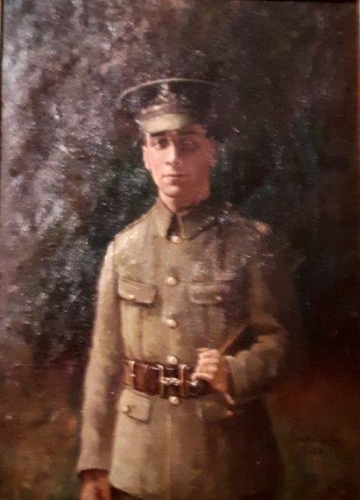
- Age: 29
- From: Liverpool
- Regiment: The King's (Liverpool Regiment) 19th Btn
- K.I.A Sunday 30th July 1916
- Commemorated at: Bernafay Wood Brit Cem
Panel Ref: M.33
Thomas Clarke was born in Liverpool on 20th October 1886 and was baptised 16th January 1887 at St Saviours, Liverpool. At the time of his baptism the family lived at 57 Windermere Street, and his father worked as a clerk. He was the son of William Ashley Clarke and Selina Anne (nee Williams) who were married on 02nd November 1876 at St Chrysostom, Liverpool. William was a book keeper of Breck Rd, father Thomas a gentleman, whilst Selina was also of Breck Rd, father Bernard a whitesmith.They had eleven children; their eldest, William Ashley, died when he was one year old. Thomas had older siblings Selina Annie, Ashley, Ernest, Harry Manifold, and Florence Helen, and younger siblings William Edward, Hanora, Frederick, and Marion.
The 1891 Census finds the family living at 57 Windermere Street, Everton with nine children.
His father is aged 40, a weighing inspector for the Mersey dock board, mother Selina is aged 40. Children Selina 12, Ashley 10, Ernest 8, Harry 7, Florence 5, Thomas, 4, are all at school. William is 3, Hanora 1, baby son 3mths (Frederick).
Sadly, two of the children died within months of each other in 1894, Ashley, at 13, and William, 7.
By the time of the 1901 Census the family have moved to 55 Grey Rock Street, West Derby. His parents are both 50, his father is still employed as a weighing machine inspector. Ernest, 18, is an assistant keeper of weighing machines, Harry 17, is a shipping clerk, Florence is 15, 14-year old Thomas works as an office boy. Hanora, 11, Frederick, 10, and Marion, 8, are at school. Selina is married and lives in Anfield.
The 1911 Census shows that the family are still living at 55 Grey Rock Street. Both parents are now 60 years of age, six of their children are at home. His father is now retired from the dock board. Ernest, 28, is a port sanitary inspector, Florence, 25, has no occupation, Hanora, 21 is a dressmaker, Frederick, 20, is a clerk with the Mersey dock board, Marion, 18, also a clerk, is with the Royal Liver Society, and 24-year old Thomas is a shipping clerk. Harry is now married and lives in Liverpool.
Thomas enlisted on 14th November 1914 at Liverpool, joining the 19th Battalion of The King's Liverpool Regiment as Private 21746. He gave his age as 27 years and occupation as a clerk. He was described as being five feet six and half inches tall, weighed 119lbs, 35” chest, with a sallow complexion, grey eyes and dark brown hair. He stated his religion as a non-conformist (Congregational) and NOK father William Ashley, 55 Grey Rock St. His service record shows qualification: machine gunner.
Formed on 07th September 1914 the 19th Battalion trained locally at Sefton Park and remained living at home or in rented accommodation until November 1914. They then moved to the hutted accommodation at Lord Derby’s estate at Knowsley Hall. On 30th April 1915 the 19th Battalion alongside the other three Pals battalions left Liverpool via Prescot Station for further training at Belton Park, Grantham. They remained here until September 1915 when they reached Larkhill Camp on Salisbury Plain. He arrived in France on 07th November 1915.
He was killed in action on the 30th July 1916, aged 29, at the village of Guillemont, France, during the Somme Offensive.
19th Battalion Diary 30th July 1916
MALTZ HORN FARM
BATTLE begun. ZERO hour 4:45 am. The Battalion reached its objective, but suffered heavy losses, and had to evacuate its position owing to no reinforcements.
Everard Wyrall gives details of the attack in his book The History of The King’s Regiment;
"The 2nd Attack on Guillemont- 29th July 1916 the 89th Brigade the 20th King's were to attack on the right and the 19th on the left. During the evening of the 29th the night was dark and foggy when the Battalions moved off and the 19th with Lt Col G Rollo commanding, when passing the South east of the Briqueterie they were heavily shelled first with H E and then with a new kind of asphyxiating Gas shell which had curious results, at first it had no nasty effect but about 8 hrs later men began to fall sick with violent headaches and pains in the stomach. All ranks had to wear gas masks which in the darkness and mist made the going terribly difficult. It was indeed wonderful that they were able to reach their Assembly point at all. But they did and by 2.45 a.m. on the 30th July 1916 the Btn was assembled having suffered about 30 Casualties on the way up ready for the Zero hour at 4.45 a.m.
It is known that the two left Companies of the 19th under Capt. Dodd and Capt. Nicholson advanced in touch with the 2nd Royal Scots Fusiliers on their left although they suffered many casualties from Machine gun Fire did not encounter many Germans and reached their final objective about the time allocated, beginning at once to dig in south of the orchard on the South east corner of Guillemont.
On the left of the 19th the Scots Fusiliers most gallantly forced their way through Guillemont to the eastern side of the village but were soon overwhelmed by the enemy and few returned.
At 8 a.m. finding that the village was not held the two left Companies of the 19th received no word from the rear or either flank believed themselves to be totally isolated so were forced to fall back and dig in, their position being untenable.
At midday the effective fighting strength of the 19th Btn was just 7 Officers and 43 other ranks"
When darkness fell on the battlefield the 30th Division held a line from the railway on the eastern side of Trones Wood , southwards and including Arrow Head Copse, to east of Maltz Horn Farm. On this line the division was relieved by the 55th Division during the early hours of the 31st July.
Casualties in the 19th Battalion were 11 Officers and 435 Other Ranks
The events of 30th July 1916 were regarded at the time as Liverpool’s blackest day. There follows an extract from The History of the 89th Brigade written by Brigadier General Ferdinand Stanley which gives an indication of the events of the day.
Guillemont
Well the hour to advance came, and of all bad luck in the world it was a thick fog; so thick that you couldn’t see more than about ten yards. It was next to impossible to delay the attack – it was much too big an operation- so forward they had to go. It will give some idea when I say that on one flank we had to go 1,750 yards over big rolling country. Everyone knows what it is like to cross enclosed country which you know really well in a fog and how easy it is to lose your way. Therefore, imagine these rolling hills, with no landmarks and absolutely unknown to anyone. Is it surprising that people lost their way and lost touch with those next to them? As a matter of fact, it was wonderful the way in which many men found their way right to the place we wanted to get to. But as a connected attack it was impossible.
The fog was intense it was practically impossible to keep direction and parties got split up. Owing to the heavy shelling all the Bosches had left their main trenches and were lying out in the open with snipers and machine guns in shell holes, so of course our fellows were the most easy prey.
It is so awfully sad now going about and finding so many splendid fellows gone.
A notice was placed in the local paper on 10th August 1916:
"July 30, killed in action, Private Thomas Clarke (Pals), the dearly-beloved son of Mr. and Mrs. W. A. Clarke, 55, Grey Rock Street, Liverpool. (Deeply mourned by Peggy and Ern [brother Ernest].)"
And on the 11th:
"July 30, killed in action, aged 30 years, Private Thomas Clarke, "Pals", the beloved son of Mr. and Mrs. W. A. Clarke, 55, Grey Rock Street. (Deeply mourned by Family and Gert.)"
"July 30, killed in action, Private Thomas Clarke, "Pals". - In kind remembrance of our late colleague, Tom. (Sadly missed. Better love hath no man.") - Bob and Joe."
Thomas was buried close to where he fell, and after the war when graves were concentrated, his body was removed and reinterred in Bernafay Wood British Cemetery.
The cemetery was begun by a dressing station in August 1916 and used as a front-line cemetery until the following April. It contained at the Armistice 284 burials but was then increased when graves were brought in from Bernafay Wood North Cemetery and from the battlefields immediately east of the wood. Bernafay Wood British Cemetery now contains 945 burials and commemorations of the First World War, 417 of which are unidentified.
His headstone bears the epitaph:
"HE FOUGHT THE GOOD FIGHT HE FINISHED THE COURSE HE KEPT THE FAITH".
Montauban village was taken by the 30th and 18th Divisions on 1 July 1916 and it remained in Commonwealth hands until the end of March 1918. It was retaken on 25 August 1918 by the 7th Buffs and the 11th Royal Fusiliers of the 18th Division. The Bois De Bernafay is a pear-shaped wood close to the east end of Montauban village. It was taken on 3 and 4 July 1916 by the 9th (Scottish) Division. On 25 March 1918, in the retreat to the Ancre, the same Division was driven from the wood but recaptured it for a time. On 27 August 1918 it was finally regained by the 18th Division. The cemetery was begun by a dressing station in August 1916 and used as a front-line cemetery until the following April. It contained at the Armistice 284 burials but was then increased when graves were brought in from Bernafay Wood North Cemetery and from the battlefields immediately east of the wood. BERNAFAY WOOD NORTH CEMETERY was opposite the North edge of the wood, a little East of the Longueval - Maricourt road. It was begun by an Advanced Dressing Station, and used from July to October 1916. It contained the graves of 80 soldiers from the United Kingdom and 1 German prisoner. Bernafay Wood British Cemetery now contains 945 burials and commemorations of the First World War. 417 of the burials are unidentified but there are special memorials to 11 soldiers known or believed to be buried here. Other special memorials commemorate 12 soldiers buried in Bernafay Wood North Cemetery whose graves were destroyed by shell fire. The cemetery was designed by Sir Herbert Baker.
Thomas earned his three medals.
In the Liverpool Echo, on 30th July 1917 under the heading Lost At The Battle of Guillemont his family paid tribute to Tom:
“In fond and loving memory of Thomas Clarke, Machine-gun section, “Pals”, killed in action July 30, 1916. – Deeply mourned by all the family, 55 Grey Rock Street.”
“In loving memory of Tom, 3rd “Pals”, third son of Mr. and Mrs. W.A. Clarke, 55 Grey Rock Street, killed in action 30 July, 1916.
In the bloom of his youth death claimed him,
In the pride of his manhood days,
None knew him but to love him,
None mentioned his name but with praise.
- Ever remembered by Gert and all at 16 Twyford Street.”
“Tam (Our Tim), K.L.R. (Pals), called to Higher Service, 30th July, 1916, killed in action.
Deny him his reward?
Nay – but the vacancy!! - Harry and Gert.
He was also remembered on the second anniversary of his death in 1918:
"In ever-loving memory of Thomas, the fifth son of W. A. and Selina Anne Clarke, killed in action, July 30, 1916. ("Sans changer.") - 55, Grey Rock Street."
"In ever-loving memory of Tom (3rd Pals), killed in action, July 30, 1916. - Ever remembered by Gert, and all at 16, Twyford Street."
His outstanding Army pay and a War Gratuity of £7-10s went to his mother, who was awarded a pension of 6 shillings a week from April 1918. (Documents were not received in the pension office from the Paymaster until 1918, suggesting his parents delayed in applying.)
Both the 1917 and 1918 notices refer to an address at 16 Twyford Street, and a reference to Gert. (John Albert Jones lived at this address in 1914; he had a daughter Gertrude Annie, born in Liverpool in 1892.) Gert is probably Tom's sweetheart.
In 1919 his parents still lived in Grey Rock Street with Hanora, 33, Florence, 30, Frederick 28, and Marion, 26. Selina, 40, Ernest, 36, and Harry, 35, all lived in Liverpool.
His mother died in 1927 age 77, and after her death his father lived with daughters Florence and Marian at 2 Sulby Ave, Tuebrook. He died in 1932 at the age of 82.
Tom is commemorated in the Hall of Remembrance, Liverpool Town Hall, Panels 8 Right and 11 Right.
Grateful thanks are extended to Ben Jackson for providing a copy of the oil painting, portrait of Thomas. Ben advises that the portrait of Thomas was commissioned by two of his sisters. Ben also advises that Thomas was rescued from the battlefield and taken to a Casualty Clearing Station where he succumbed to his wounds on 30th July 1916.
We currently have no further information on Thomas Clarke, if you have or know someone who may be able to add to the history of this soldier, please contact us.
Killed On This Day.
(110 Years this day)Monday 23rd October 1916.
Pte 37251 James Sanderson
28 years old
(109 Years this day)
Tuesday 23rd October 1917.
2nd Lieut Robert Stephenson Parry
24 years old
(108 Years this day)
Wednesday 23rd October 1918.
Pte 35226 Adam Alexander Russell
22 years old