
1885 - 1916

CPL David Wallace Crawford
1887 - 1916

Lce-Corpl John Joseph Nickle
1894 - 1916

Pte 17911 Morton Neill
1897 - 1916

Lieut Edward Stanley Ashcroft
1883 - 1918

Pte 57524 David Clow
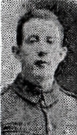
- Age: 23
- From: Dundee
- Regiment: The King's (Liverpool Regiment) 18th Btn
- D.O.W Tuesday 10th April 1917
- Commemorated at: Gouy-en-artois Cc Ext
Panel Ref: A.14
David was born in Dundee around December 1893, the son of Hugh Clow and his wife Euphemia (nee Kiddie).
His father was born in Errol, Perthshire, and his mother in Newburgh, Fifeshire. They married in about 1892. David had a younger sister Robina (known as Ruby) and a younger brother James, who appear on the 1901 census. Unfortunately, the 1911 Scotland census is not available, so details of any further children are not known.
The 1901 census finds the family living at 61 Hill Street, Dundee. His father, 31, is a whinstone sett maker, whilst his mother is 32, David is 7, Robina 6, and James 4. Also in the household is his aunt Annie Clow, 26, a jute weaver. Whinstone is any hard dark-coloured very hard rock, such as basalt or chert, so hard, it was used to make setts – brick-shaped blocks for road paving.
David enlisted in Dundee in the Highland Divisional Cyclist Company. His service number being 825. The amount of the War Gratuity suggests that he enlisted in about November 1915. The Dundee Courier on 29th November 1915 listed David’s name among those of 300 local boys “already doing their bit”. A later record states he worked as a book stall clerk before joining up, and was employed by the local newspaper.
He later transferred to the 18th Battalion of the Kings Liverpool Regiment. He was wounded in action on 09th April 1917 during an attack on the German positions at the Hindenburg Line, during the opening phase of the Battle of Arras, and died of his wounds the next day.
Details of the circumstances the 18th Battalion had to contend with on that day are illustrated below:
The battalion formed the left assaulting battalion of the brigade, the 2nd Wiltshire Regiment being on the right, the 19th Manchester Regiment being in support and 2nd Battalion Yorkshire Regiment furnishing “moppers -up” for the two assaulting battalions. The brigade advance was timed to begin at ---- hour after “Zero”, suited to conform with the movements of 56th Division and other divisions on our left further north (near Arras). This battalion’s objective was the front-line system Lion Lane on the left (exclusive) to Panther Lane on right (exclusive). This sector included the strongpoint known as “The Egg”.
The brigade advanced at prearranged time, i.e., 11.38 a.m, from position of assembly trenches south of Neuville Vitasse to German front line. This necessitated an advance across the open of at least 2,000 yards. This area up to Neuville Vitasse- Henin road was crossed in artillery formation; after this, owing to machine-gun fire and considerable resistance from German posts forward in the sunken roads, it was found necessary to deploy. During the whole movement across the open the advancing columns had been under considerable artillery fire from guns of all calibres. On gaining the position immediately in front of German line it was found that the wire was practically uncut; this wire formed two strong belts in front of German trenches. Two small gaps were eventually discovered and Second-Lieut H.F.Merry gallantly led a bombing party through them, but his three remaining men were killed as they reached the German trenches.
From the moment the battalion was “held up” in front of German wire Capt. R. W. Jones, the senior company commander on the spot, at once began the work of consolidating in front of German wire. The battalion held on in this position for the remainder of the day, until relieved by the 16th Manchester Regiment about 3 a.m. on the 10th of April, all the time under intense machine-gun and rifle fire.
Between 9th-10th April, 1917, the 18th King's lost 2 officers 2nd Lt. F. Ashcroft and 2nd Lt. H.G. Ewing and 59 other ranks killed. 8 other officers were wounded.
David now rests at Gouey en Artois Communal Cemetery Extension where his headstone has the following inscription:
"BELOVED SON OF MR AND MRS HUGH CLOW 20 WELLINGTON STREET DUNDEE"
The extension was made in April 1917 at the time of the Allied advance from Arras. Two further burials took place in June and July 1917, and five in March 1918. Gouy-en-Artois Communal Cemetery Extension contains 44 Commonwealth burials of the First World War. There are also four German war graves. The extension was designed by Charles Holden.
His parents placed a notice on 18th April 1917 in the Dundee Evening Telegraph:
“Died on the 10th inst. of wounds received in action in the 9th inst., Pte. David Clow, King’s Liverpool Reg’t., aged 23 years and 4 months, eldest and dearly loved son of Hugh and Euphemia Clow, 20 Wellington Street, Dundee.”
The Dundee People’s Journal on 21st April reported his death under the heading,
“People’s Journal Employee Killed”:
“Mr. H. Clow, 20 Wellington Street, Dundee, has received official intimation that his son Pte. David Clow, King’s Liverpool Regiment, has died of wounds received in action. Pte. Clow, who was 23 years of age was previous to joining the colours employed in the […] department of the “Dundee Advertiser”. Over a year ago the deceased enlisted in the Highland Cyclist battalion and was transferred to the King’s Liverpool Regiment. He had been at the front for some time. Pte. Clow was of a very likeable disposition and was highly esteemed by his fellow employees and friends. The news of his death has been received with much regret.”
On 21st December 1918 the People’s Journal listed the newspaper’s service and losses:
235 men left the paper’s offices in Bank Street and district offices to join the forces, 146 of them volunteering before conscription was introduced; 19 were killed. David Clow was one of the five killed of the 57 from the dispatch department who served.
His Army effects and a War Gratuity of £5-10s went to his father Hugh. The pension card in the name of his mother Mrs. Euphemia Kiddie Clow, 20 Wellington Street, does not specify the amount awarded.
Probate, giving David’s address as 20 Wellington Street, and his occupation as book stall clerk, (died intestate), confirmation granted to his father Hugh Clow, sett-dresser, of the same address, effects £127-10s.
His father died in 1929 and his mother in 1930.
David is commemorated on the following Memorials:
Scottish National War Memorial
Dundee Roll of Honour.
We currently have no further information on David Clow, If you have or know someone who may be able to add to the history of this soldier, please contact us.
Killed On This Day.
(110 Years this day)Monday 23rd October 1916.
Pte 37251 James Sanderson
28 years old
(109 Years this day)
Tuesday 23rd October 1917.
2nd Lieut Robert Stephenson Parry
24 years old
(108 Years this day)
Wednesday 23rd October 1918.
Pte 35226 Adam Alexander Russell
22 years old