
1885 - 1916

CPL David Wallace Crawford
1887 - 1916

Lce-Corpl John Joseph Nickle
1894 - 1916

Pte 17911 Morton Neill
1897 - 1916

Lieut Edward Stanley Ashcroft
1883 - 1918

Pte 16019 Henry William Howell Collett
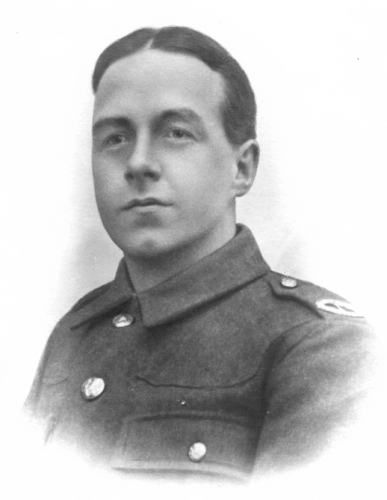
- Age: 26
- From: Sheffield, Yorks
- Regiment: The King's (Liverpool Regiment) 17th Btn
- K.I.A Sunday 30th July 1916
- Commemorated at: Thiepval Memorial
Panel Ref: P&F1D8B &8 C.
Henry William Howell Collett was born in Sheffield on or about 21st August 1890, the son of the Rev. William Collett and his wife Emily (nee Wood) who were married in Nantwich in 1881. William was a Wesleyan Minister who had been born in West Bromwich, and Emily had been born in Macclesfield. Henry had older brothers Harold Harvey and Maurice John (Jack), and a younger brother Charles Edward.
At the time of the 1891 Census, William and Emily were living at Thirland House, Attercliffe in Sheffield with their children – Harold aged 8 who was born in Altrincham, Maurice aged 4, born in Lancaster and Henry who was just 8 months old. The family had a servant, 21 year old Eleanor Catchpole.
The couple had another son, Charles in 1896, and by the time of the 1901 census the family had moved to 35 Greek Street, Stockport where they were living with their four sons; Harold, 18, is a tool maker/fitter, Maurice is 14, Henry 10, and Charles 4. and Annie Webster a domestic servant.
Henry’s brother Harold married in 1907.
He attended Darlington Grammar School in County Durham, then pursued a career in law. He passed his intermediate law examinations in October 1908.
The 1911 Census finds Henry living with his parents and younger brother at 58 Alderley Road, Hoylake. His father, William, is a 59 year old Wesleyan Minister, born in West Bromwich, his mother, Emily is 52 years of age and was born in Macclesfield. They advise that they have been married for 29 years and have had four children. Henry is aged 20 and is a solicitor’s articled clerk, his brother Charles is 14 and is still at school. The family employ a domestic servant, 18 year old Kate Jones born in Gresford.
In 1911 his brother Harold, 28, is living in Sunderland with his family and is employed as a works manager with a gas company. Maurice, 24, single, is an ironmonger boarding in Hull.
Henry was employed as a solicitor for Watson and Atkinson in Liverpool when he enlisted at St George’s Hall on the 02nd September 1914, joining the 17th Battalion as Private 16019. He gave his age as 24 years and 12 days and was described as being 5’ 8½” tall, weighed 163lbs and had a 39” chest with a 4” expansion. He was of brown complexion and had brown hair and brown eyes. He stated his religion as Wesleyan.
He was billeted at Prescot Watch Factory from 14th September 1914, he trained there and also at Knowsley Hall. On 30th April 1915 the 17th Battalion alongside the other three Pals battalions left Liverpool via Prescot Station for further training at Belton Park, Grantham. They remained here until September 1915 when they reached Larkhill Camp on Salisbury Plain.
He was promoted to acting unpaid Lance Corporal on 29th December 1914 but reverted to Private at his own request on 23rd February 1915.
He embarked for France on the 07th November 1915.
He was killed in action on the 30th July 1916, aged 26, at the village of Guillemont, France, during the Somme Offensive.
17th Battalion Diary 30th July 1916
The Battalion was in support to 19 & 20 Battalions K.L.R. 2 Coys. behind 19th & 2 Coys. behind 20th. Very thick mist. The attack was pushed home to the objective in places but in the main was held up by machine gun fire from hidden machine guns.
Fighting continued all day swaying backwards and forwards until by 6pm about 300 yards in depth had been gained & consolidated all along our front.
Casualties in the 17th Battalion were 15 Officers and 281 Other Ranks
Further details are reported in more detailed by Everard Wyrall in his book The History of the King’s Regiment (Liverpool) 1914-1919 Volume II 1916-1917
The 17th King’s had advanced (two companies each behind the 19th and 20th Battalions) in small columns. They too suffered heavily from machine-gun fire and were quickly absorbed into the waves that preceded them. They also shared the gains and losses of that terrible day.
When darkness fell on the battlefield the 30th Division held a line from the railway on the eastern side of Trones Wood , southwards and including Arrow Head Copse, to east of Maltz Horn Farm. On this line the division was relieved by the 55th Division during the early hours of the 31st July.
The events of 30th July 1916 were regarded at the time as Liverpool’s blackest day. There follows an extract from The History of the 89th Brigade written by Brigadier General Ferdinand Stanley which gives an indication of the events of the day.
Guillemont
Well the hour to advance came, and of all bad luck in the world it was a thick fog; so thick that you couldn’t see more than about ten yards. It was next to impossible to delay the attack – it was much too big an operation- so forward they had to go. It will give some idea when I say that on one flank we had to go 1,750 yards over big rolling country. Everyone knows what it is like to cross enclosed country which you know really well in a fog and how easy it is to lose your way. Therefore, imagine these rolling hills, with no landmarks and absolutely unknown to anyone. Is it surprising that people lost their way and lost touch with those next to them? As a matter of fact, it was wonderful the way in which many men found their way right to the place we wanted to get to. But as a connected attack it was impossible.
The fog was intense it was practically impossible to keep direction and parties got split up. Owing to the heavy shelling all the Bosches had left their main trenches and were lying out in the open with snipers and machine guns in shell holes, so of course our fellows were the most easy prey.
It is so awfully sad now going about and finding so many splendid fellows gone.
The circumstances of his death caused his grief stricken father to correspond with the War Office. He had received two letters from the Chaplain of the 17th Battalion concerning his son’s death. The fact that the service records only record his death, (which occurred on 30/07/1916) on 25/09/1916 gives an indication of the disarray caused by the loss of close to 500 men killed on that one day. An illustration of the circumstances of 30/07/1916 is provided by the two letters received by Reverend Collett from the Chaplain to the 17th Battalion.
The first was dated 09th August 1916 sent from
Rev E Skilton Chaplain 17th King’s Liverpools 89th Brigade
Dear Mr Collett,
I have been wanting to write to you about your dear lad for some days, but the movements of my brigade have largely hindered me. I expect you have received the sad news. I shall never forget how he was present at my service about 2 hours before he marched off with the Batt: to take up position for the morning attack. I remember I closed up by quoting Whittier’s lovely verse:
“I know not where His islands left their fronded palms in air, I only know I cannot drift beyond His love and care”.
After the service he came to me and that this verse and the preceding verses were his favourite lines. He gave me your address and asked me to write if he did not get back. I have made very careful inquiries and have found out that he was very seriously wounded, in fact I am afraid he was fatally hurt by the description of the wounds and that he would never have recovered. After his wound had been dressed he was being carried down the Communication Trench when a shell came and killed him and a stretcher bearer.
I know this is a great sorrow to you & I cannot find adequate words to comfort you in your great loss. But I am sure he died with his faith centred in God’s Love and Care. He has faced the Supreme Sacrifice and is numbered among the young heroes who gave their all for the great cause to which we are committed.
Assuring you and yours of my deepest sympathy
I am very sincerely yours
Edward Skilton
The second letter was dated 06th September and concerns Rev Collet’s response to the Chaplain
Dear Mr Collett,
Please excuse me not answering your letter before, but I have been home on leave.
I am sorry to say that as far as I know nothing was recovered that could be sent to you from your dear lad. The conditions on that fateful day made it impossible to attend to anything except the terrible necessities of war.
There is left the very precious memory of a noble lad. I shall never forget that Saturday Evening, that last service and the faces I was never to see again. It was such sorrow to see them march away in platoons to their great and difficult task. Somewhere all the treasure of this young life so richly proud and gathered up.
“Life is ever, Lord of Death, and Love can never lose its own”.
With kindest thoughts
Yours very sincerely
Edward Skilton
P.S. Our Doctor attended Howell until he was sent down the trench. He tells me he was very cheerful when he went off but that his wound would have proved fatal, and that it was merciful he was spared further suffering.
His father's attempts at verifying the death of his son led to much correspondence with the War Office including him having to copy the letters sent to him by Reverend Skilton. In one of his letters the pain of the loss is palpable when he writes:
"I enclose copies of the two letters I have received from the Chaplain, and shall be very glad of the definite confirmation or refutation of them by the War Office, for the constant re-opening of wounds is almost unbearable".
His death was reported in the Liverpool Echo on 16th August 1916:
Private Henry William Howell Collett, solicitor of the firm of the late John Watson and Atkinson of 25 Castle Street, has been killed. He joined the "Pals" on September 3rd 1914 and went to the front in November 1915. He went through the engagements of July 1 and July 9 unscathed but on the 30th of the same month fell wounded. After having his wounds dressed, and whilst being carried down the communication trench a shell came in and killed him and the stretcher bearers who bore him. His life was full of promise. He was the third son of Rev. William Collett, Wesleyan minister, of Chester.
His fiancee placed a notice in the Liverpool Echo on 18th August 1916:
"July 30, killed in action, Henry W. Howell Collett (Pals), of Queen's Park, Chester. (Sadly missed by his Fiancee Ada.)"
The Chester Chronicle reported on the 19th August 1916 under the heading:
"Wesleyan Supt. Loses His Son":
"We regret to have to add to the list of those "killed in action" the name of Hy. Wm. Howell Collett, the third son of the Rev. and Mrs. Wm. Collett, of "Ferney", Queen's Park, Chester. Mr. Collett is the respected superintendent of the Chester Wesleyan Circuit, and not only Methodism but local Nonconformity will be distressed on hearing the news. On Sunday morning Mr. Collett received information that his son was "missing", and a busy day of four services proved a great strain to the anxious father. On Tuesday the chaplain's letter arrived conveying the sad news of young Collett's death. It appears that deceased was in the very fierce fighting with his regiment (the King's Liverpool Regiment) on July 30th, and was very severely wounded. After being treated at the Field Dressing Station he was carried down a communication trench, when a German shell burst, killing the deceased and also one of the stretcher bearers. Mr. Harry Collett was 26 years of age, and was educated at the Darlington Grammar School. He served his articles with Messrs. John Watson and Atkinson, solicitors, of Castle Street, Liverpool. He was one of the youngest solicitors in the country, having passed his final examination before he was 21, i.e., before he was entitled to be entered on the Rolls. He enlisted in the Liverpool Pals as a private on the 3rd September, 1914, and after training at Preston [sic], Grantham and Larkhill (Salisbury Plain) he left for the front in November, 1915. He spent last winter in the trenches, and took part with his regiment in the big offensive, which commenced on the morning of July 1st. He was again in heavy fighting on July 9th, but once more escaped injury. His last letter home was full of courage and bright Christian hope. "If I fall", he wrote, "I know I have done my duty". When his father was superintendent at Hoylake before coming to Chester the deceased was a most enthusiastic church worker, ably filling a number of important official positions. He was the centre and soul of the young life of the church, and greatly beloved by all who knew him. Great sympathy will be extended to the bereaved parents in the heavy blow which has befallen them."
His body was not recovered or was subsequently lost as has no known grave and is commemorated on the Thiepval Memorial in France.
The Thiepval Memorial, the Memorial to the Missing of the Somme, bears the names of more than 72,000 officers and men of the United Kingdom and South African forces who died in the Somme sector before 20 March 1918 and have no known grave. Over 90% of those commemorated died between July and November 1916.
On 01st August 1932 the Prince of Wales and the President of France inaugurated the Thiepval Memorial in Picardy. The inscription reads: “Here are recorded the names of officers and men of the British Armies who fell on the Somme battlefields between July 1915 and March 1918 but to whom the fortune of war denied the known and honoured burial given to their comrades in death.”
His father had written to the Infantry Records Office asking about the whereabouts of his son's grave. They in turn wrote to the Imperial War Graves Commission who on 20th August 1920 advised that the were unable to give information of the location of the grave of H W H Collett.
Henry earned his three medals.
His outstanding Army pay and a War Gratuity of £8-10s went to his father, by then living at "Ferney", Queen's Park, Chester, who also received his son's personal belongings in December 1916: a leather cigarette case and pipe.
No pension card has been found, suggesting that his parents made no claim or that Henry lived independently and had no dependents.
In the Liverpool Echo, on 30th July 1917 under the heading ‘Lost At The Battle of Guillemont’ a touching tribute was paid to three Pals by one of their friends:
“In honoured and treasured memory of my comrades, Corporal Fred Thomas, and Privates Howell Collett and Frank Harper (K.L.R.), killed in action, July 30, 1916. – Nobby”
Henry is commemorated on the following memorials:
St. John Street Methodist Church, Chester
Chester Citizens Memorial, Chester Town Hall
Darlington Grammar School
Liverpool's Hall of Remembrance, Panel 11 Right
Hoylake and West Kirby Memorial
St Luke's Methodist Church, Market Street, Hoylake.
The memorial at St Luke's is a personal memorial from the family in honour of their precious son. It is in the form of a Brass Plaque affixed to the Font in the Church.
"TO THE GLORY OF GOD AND IN LOVING MEMORY OF HENRY WILLIAM HOWELL COLLETT: PRESENTED TO THE TRUSTEES OF THIS CHURCH BY HIS PARENTS AND BROTHERS IN GRATEFUL REMEMBRANCE OF A NOBLE LIFE LAID DOWN IN BATTLE ON JULY 30TH 1916. HIS SIMPLE FAITH IN JESUS CHRIST, HEROISM IN SERVICE, CHEERFULNESS IN FACE OF DANGER, TOGETHER WITH HIS VICARIOUS DEATH ARE A PRECIOUS HERITAGE "HE BEING DEAD YET SPEAKETH" HEBREWS XI.4.V
Probate records show:
COLLETT William Henry Howell of 49 Falkland Road, Egremont, Wallasey, Cheshire, Private 17th (service) battalion the King's Liverpool Regiment died 30 July 1916 in France. Probate London 9 October to William Collett Wesleyan minister. Effects £305.
His father retired a year after Henry's death and in 1919 his parents were at 8 Shelton Road, Wallasey, with Maurice, 32, and Charles, 22. Harold, 36, lived in Leeds.
His father died in 1932 aged 80.
In September 1939 his mother Emily, then 81, was still at 8 Shelton Road in Wallasey. She moved to Prestatyn in North Wales during the war and died in 1942 at the age of 83.
We currently have no further information on Henry William Howell Collett, if you have or know someone who may be able to add to the history of this soldier, please contact us.
Killed On This Day.
(110 Years this day)Tuesday 24th October 1916.
Pte 33220 David Brocken
24 years old
(109 Years this day)
Wednesday 24th October 1917.
Pte 17690 Henry Phipps
22 years old
(109 Years this day)
Wednesday 24th October 1917.
Pte 308326 James Speakman
26 years old
(108 Years this day)
Thursday 24th October 1918.
Serjeant 17245 Robert George Evans (MM)
22 years old