
1885 - 1916

CPL David Wallace Crawford
1887 - 1916

Lce-Corpl John Joseph Nickle
1894 - 1916

Pte 17911 Morton Neill
1897 - 1916

Lieut Edward Stanley Ashcroft
1883 - 1918

Pte 15665 Percy William Collins
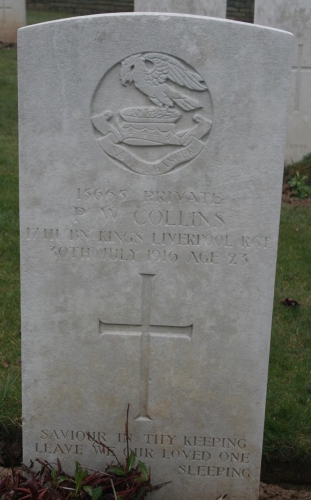
- Age: 23
- From: Liverpool
- Regiment: The King's (Liverpool Regiment) 17th Btn
- K.I.A Sunday 30th July 1916
- Commemorated at: Guillemont Rd Cem
Panel Ref: III.M.1
Percy William Collins was born in Liverpool on 21st November 1892, and was the son of William John Collins and his wife Elizabeth (nee Haines) who married in Liverpool on the 7th June 1890 at St. Michael's Church, Toxteth, William was a 39 year old widower, a compositor of 18 Bowring Street, hisfather John deceased, whilst Elizabeth was aged 33 of 24 Alexandra Terrace, her father William.
William had been married before in 1873 (Warwick) and had two sons and five daughters with his first wife Mary Ann Spires: Louisa Mabel(1874) and George Henry(1875) born in Warwickshire, Alice Mary(1877), William John(1879), twins Hope and Faith (b. and d.1881), and Mabel(1884) born in Liverpool. Mary Ann sadly died, aged 27, in 1886.
On the 1881 Census his father is with his first wife Mary at 71 Lombard Street, West Derby Road. Father William John is aged 30, a printer compositor b.Leamington, mother Mary A. is aged 31 b.Eathorpe, Warwickshire, children Lousia M. 7 a scholar b.Leamington, George Henry 5 a scholar b.Birmingham, Alice M. 3 and William 1 b.Liverpool.
Percy was baptised on 08th January 1893 in St. Paul's Church, Princes Park, his parents living at the time in Rhiwlas Street, and his father's occupation compositor.
He had an elder brother Edmund Haines and a younger sister Robina Elizabeth (Ruby).
At the time of the 1901 census, the family were living at 18 Rhiwlas Street, Princes Park, Liverpool. William was 60 and was working as a printer, he was born in Leamington in Warwickshire. Elizabeth was 45 and was born in Llanfillin, Montgomeryshire. William’s sons were living with them, George was 25 and working as a sugar boiler, and William junior was 21 and a horse driver. William senior and Elizabeth had three children, Edmund aged 10, Percy was 8 and Robina 4. His half-sister Mabel, 16, was living in Leamington with her aunt Louisa Collins, who ran a lodging house.
The family were still at the same address at the 1911 census. Percy, then 18, was working as a clerk in wholesale provisions, his half brother William aged 31,was a carter with the Lancashire & North West Railway, Edmund aged 20 was a draper’s salesman and Robina aged 14 was at school. Their father aged 60 occupation was printer for a wholesale chemist and their mother was aged 55.
Percy enlisted at St. George's Hall, Liverpool on 01st September 1914 joining the 17th Battalion (C Company) of The King’s Liverpool Regiment as Private No 15665. He gave his age as 21 years and 262 days and his occupation as clerk. He was described as being 5' 6 and three-quarter inches tall, and weighing 129 lbs, 36" chest, with good physical development. He stated his religion as C of E.
He was billeted at Prescot Watch Factory from 14th September 1914, he trained there and also at Knowsley Hall. On 30th April 1915 the 17th Battalion alongside the other three Pals battalions left Liverpool via Prescot Station for further training at Belton Park, Grantham. They remained here until September 1915 when they reached Larkhill Camp on Salisbury Plain.
Whilst at Prescot on 24th November 1914 he received 7 days Field Punishment No.2 for laughing and talking in the ranks and for making an improper remark to an N.C.O. On 15th January 1915 he received 5 days Field Punishment No.2 for the same offence of making an improper remark to an N.C.O.
He arrived in France on 7th November 1915.
He suffered a lac(eration?) wound to the finger on 13th January 1916.
He was admitted with a septic foot to 3rd Field Ambulance, then recovered at 30 D.R.S. (Divisional Rest Station) and was discharged to duty on 22nd January and rejoined his unit.
Having been involved in the fighting at Montauban and Trones Wood the Pals next objective was to attack the German stronghold of Guillemont. Percy was killed in action on the 30th July 1916, aged 23, during the disastrous attack on Guillemont, France, during the Somme Offensive.
17th Battalion Diary 30th July 1916
The Battalion was in support to 19 & 20 Battalions K.L.R. 2 Coys. behind 19th & 2 Coys. behind 20th. Very thick mist. The attack was pushed home to the objective in places but in the main was held up by machine gun fire from hidden machine guns.
Fighting continued all day swaying backwards and forwards until by 6pm about 300 yards in depth had been gained & consolidated all along our front.
Casualties in the 17th Battalion were 15 Officers and 281 Other Ranks
Further details are reported in more detailed by Everard Wyrall in his book The History of the King’s Regiment (Liverpool) 1914-1919 Volume II 1916-1917
The 17th King’s had advanced (two companies each behind the 19th and 20th Battalions) in small columns. They too suffered heavily from machine-gun fire and were quickly absorbed into the waves that preceded them. They also shared the gains and losses of that terrible day.
When darkness fell on the battlefield the 30th Division held a line from the railway on the eastern side of Trones Wood , southwards and including Arrow Head Copse, to east of Maltz Horn Farm. On this line the division was relieved by the 55th Division during the early hours of the 31st July.
The events of 30th July 1916 were regarded at the time as Liverpool’s blackest day. There follows an extract from The History of the 89th Brigade written by Brigadier General Ferdinand Stanley which gives an indication of the events of the day.
Guillemont
Well the hour to advance came, and of all bad luck in the world it was a thick fog; so thick that you couldn’t see more than about ten yards. It was next to impossible to delay the attack – it was much too big an operation- so forward they had to go. It will give some idea when I say that on one flank we had to go 1,750 yards over big rolling country. Everyone knows what it is like to cross enclosed country which you know really well in a fog and how easy it is to lose your way. Therefore, imagine these rolling hills, with no landmarks and absolutely unknown to anyone. Is it surprising that people lost their way and lost touch with those next to them? As a matter of fact, it was wonderful the way in which many men found their way right to the place we wanted to get to. But as a connected attack it was impossible.
The fog was intense it was practically impossible to keep direction and parties got split up. Owing to the heavy shelling all the Bosches had left their main trenches and were lying out in the open with snipers and machine guns in shell holes, so of course our fellows were the most easy prey.
It is so awfully sad now going about and finding so many splendid fellows gone.
He was buried close to where he fell and after the war when the graves were concentrated he was reburied and now rests at Guillemont Road Cemetery, France. The inscription on his headstone reads:
SAVIOUR IN THY KEEPING LEAVE WE OUR LOVED ONE SLEEPING
Guillemont was an important point in the German defences at the beginning of the Battle of the Somme in July 1916. It was taken by the 2nd Royal Scots Fusiliers on 30 July but the battalion was obliged to fall back, and it was again entered for a short time by the 55th (West Lancashire) Division on 8 August. On 18 August, the village was reached by the 2nd Division, and on 3 September (in the Battle of Guillemont) it was captured and cleared by the 20th (Light) and part of the 16th (Irish) Divisions. It was lost in March 1918 during the German advance, but retaken on 29 August by the 18th and 38th (Welsh) Divisions.
The cemetery was begun by fighting units (mainly of the Guards Division) and field ambulances after the Battle of Guillemont, and was closed in March 1917, when it contained 121 burials. It was greatly increased after the Armistice when graves (almost all of July-September 1916) were brought in from the battlefields immediately surrounding the village and certain smaller cemeteries.
Guillemont Road Cemetery now contains 2,263 Commonwealth burials and commemorations of the First World War. 1,523 of the burials are unidentified but there are special memorials to eight casualties known or believed to be buried among them.
The cemetery was designed by Sir Herbert Baker.
Percy earned his three medals, which went to his mother after the war. His outstanding Army pay went to his father. The War Gratuity of £8-10s was shared between his mother, brother and sister after his father's death.
His father, William John died on 16th October 1916.
Soldiers Effects notes that £3-15s-6d of the War Gratuity was retained.
His mother was awarded a pension of 5 shillings a week from February 1917, increased to 12 shillings and sixpence in March 1918.
In the Liverpool Echo, on 30th July 1917 under the heading Lost At The Battle of Guillemont, Percy was remembered:
“In loving memory of Private Percy Collins, “Pals”, killed in action July 30, 1916. – Ever remembered by his friend Esther.”
“In loving memory of my dear brother, Percy William Collins, K.L.R. (“Pals”), who was killed in action July 30, 1916; also my dear father William John Collins, who passed away October 16, 1916, at 18 Rhiwlas Street, Princes Park. (Ever remembered by Eddie, in France.)”
“In loving memory of Private Percy W. Collins, 1st Liverpool Pals, killed in action July 30, 1916, aged 23 years, the beloved and youngest son of Elizabeth and the late William I. Collins. – Sadly missed by Mother, Ruby, and Eddy (in France), of 18, Rhiwlas Street, Prince’s Park.”
He was also remembered on the second anniversary of his death in 1918:
"In loving memory of my dear son, Percy (1st Pals), killed in action, July 30, 1916; also my dear husband, William John, died October 16, 1916. Sadly missed. - Mother and Ruby, Rhiwlas Street."
COLLINS— In loving memory of my dear brother PERCY WILLIAM (Pals), killed in action July 30 ,1916, also dear Father, died October 16, 1916 at 18 Rhiwlas Street. Ever remembered by Eddie in Italy.
His brother Edmund served overseas, achieved the rank of Sergeant in the R.A.S.C. and survived the war.
In 1919 his mother was still in Rhiwlas Street with Robina, 22. Edmund, 28, was married and lived in Gilpin Street in the Dingle. Half brother William, 41, lived in Liverpool and Mabel (May), 35, in Leamington. Half brother George is not accounted for.
His mother later lived at 44 Joliffe Street, Princes Park. In 1939, then aged 84, she was living in Hoylake with widowed daughter Robina Rowlands, 43, and her two daughters.
His mother died on 15th November 1940, aged 85.
Percy is commemorated in the Hall of Remembrance in Liverpool Town Hall at Panel 8 Left.
Percy is also remembered on the family headstone in Toxteth Park Cemetery, Liverpool.
In loving memory of Percy W. Collins, (17th K.L.R.) killed in action July 30th 1916, aged 23 years. Interred at Plot 3, Row M. Grave 1. Guillemont Road Cemetery, France. Also William J. Collins, father of the above who died October 16th 1916, aged 66 years. Also Elizabeth, beloved wife of the above, William J. Collins, who died November 15th 1940, aged 85 years. ‘Saviour in Thy gracious keeping. Leave we now our loved ones sleeping.’
We currently have no further information on Percy William Collins, if you have or know someone who may be able to add to the history of this soldier, please contact us.
Killed On This Day.
(110 Years this day)Tuesday 24th October 1916.
Pte 33220 David Brocken
24 years old
(109 Years this day)
Wednesday 24th October 1917.
Pte 17690 Henry Phipps
22 years old
(109 Years this day)
Wednesday 24th October 1917.
Pte 308326 James Speakman
26 years old
(108 Years this day)
Thursday 24th October 1918.
Serjeant 17245 Robert George Evans (MM)
22 years old