
1885 - 1916

CPL David Wallace Crawford
1887 - 1916

Lce-Corpl John Joseph Nickle
1894 - 1916

Pte 17911 Morton Neill
1897 - 1916

Lieut Edward Stanley Ashcroft
1883 - 1918

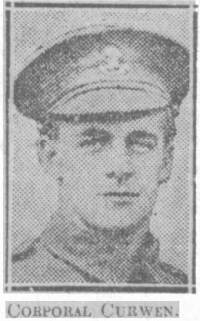
Cpl 17296 Tom Curwen (MM)
- Age: 22
- From: Birkenhead, Cheshire
- Regiment: The King's (Liverpool Regiment) 19th Btn
- K.I.A Sunday 30th July 1916
- Commemorated at: Combles Cc Ext
Panel Ref: II.F.46
Tom Curwen was born on 10th May 1894 in Birkenhead the son of Thomas John Curwen and his wife Margaret (nee Smith) who were married on the 17th Dec 1880 at St Peter, Liverpool. Thomas was a 21 year old brewer of Vauxhall Rd, father James a brewer, whilst Margaret was aged 21 of Everton, father Robert a master mariner. Father Thomas had always been involved in the Licensed Trade, he was a brewer and publican when he married Margaret and when they first had children he was a Licensed Victualler at a hotel in Upper Harrington Street. Tom was baptised in St. Mary's Church, Birkenhead, on 03rd June 1894.
At the time of the 1901 Census, Tom’s father, aged 30 and born in Poulton, Lancashire, was the Licensee of the Spellow House Hotel at 79 Goodison Road where the family lived. Mother Margaret was aged 39 born in St Helens. Tom, aged 6, had two sisters Lily aged 15 and Margaret (known as Daisy) aged 11, and two brothers William Albert aged 17 and Arthur E. aged 3.
Lily married in 1902, William in 1906, and Daisy in 1908.
The family kept the same pub at the 1911 census. Thomas and Margaret were living there with their youngest son Arthur, and their daughter Lily and her husband Harold Close and their three children. Also living there were three barmen and a domestic servant. Tom is not listed in the 1911 census but prior to the outbreak of the war he was employed by Cunard as a steward on board the SS Saxonia, so he is possibly at sea.
Tom was a member of the Walton Swimming Club, and his siblings were also keen sportspeople. Daisy was an English Champion swimmer and record holder, she continued to compete through the war under her maiden name and was a well known figure in Liverpool and the swimming world.
Tom enlisted at St George's Hall, Liverpool on the 1st September 1914, joining the 19th Battalion of The King’s Liverpool Regiment as Private 17296. He gave his age as 20 years and 150 days and his occupation as clerk. His attestation papers describe him as being 5ft 6 inches, weighing 142 lbs, 36” chest, with a sallow complexion, blue eyes and fair hair. His religion was Church of England and NOK was father Thomas John, Spellow Hotel.
Formed on 7th September 1914 the 19th Battalion trained locally at Sefton Park and remained living at home or in rented accommodation until November 1914. They then moved to the hutted accommodation at Lord Derby’s estate at Knowsley Hall. On 30th April 1915 the 19th Battalion alongside the other three Pals battalions left Liverpool via Prescot Station for further training at Belton Park, Grantham. They remained here until September 1915 when they reached Larkhill Camp on Salisbury Plain. He arrived in France on 7th November 1915 and in November 1915 he was appointed unpaid Lance Corporal.
He was promoted to Corporal on 21st April 1916.
He was killed in action on the 30th July 1916, aged 22, at the village of Guillemont, France, during the Somme Offensive. He had been recommended for a Military Medal and had also been considered for a Distinguished Conduct Medal.
19th Battalion Diary 30th July 1916
MALTZ HORN FARM
BATTLE begun. ZERO hour 4:45 am. The Battalion reached its objective, but suffered heavy losses, and had to evacuate its position owing to no reinforcements.
Everard Wyrall gives details of the attack in his book The History of The King’s Regiment;
"The 2nd Attack on Guillemont- 29th July 1916 the 89th Brigade the 20th King's were to attack on the right and the 19th on the left. During the evening of the 29th the night was dark and foggy when the Battalions moved off and the 19th with Lt Col G Rollo
commanding, when passing the South east of the Briqueterie they were heavily shelled first with H E and then with a new kind of asphyxiating Gas shell which had curious results, at first it had no nasty effect but about 8 hrs later men began to fall sick with violent headaches and pains in the stomach. All ranks had to wear gas masks which in the darkness and mist made the going terribly difficult. It was indeed wonderful that they were able to reach their Assembly point at all. But they did and by 2.45 a.m. on the 30th July 1916 the Btn was assembled having suffered about 30 Casualties on the way up ready for the Zero hour at 4.45 a.m.
It is known that the two left Companies of the 19th under Capt. Dodd and Capt. Nicholson advanced in touch with the 2nd Royal Scots Fusiliers on their left although they suffered many casualties from Machine gun Fire did not encounter many Germans and reached their final objective about the time allocated, beginning at once to dig in south of the orchard on the South east corner of Guillemont.
On the left of the 19th the Scots Fusiliers most gallantly forced their way through Guillemont to the eastern side of the village but were soon overwhelmed by the enemy and few returned.
At 8 a.m. finding that the village was not held the two left Companies of the 19th received no word from the rear or either flank believed themselves to be totally isolated so were forced to fall back and dig in, their position being untenable.
At midday the effective fighting strength of the 19th Btn was just 7 Officers and 43 other ranks"
When darkness fell on the battlefield the 30th Division held a line from the railway on the eastern side of Trones Wood , southwards and including Arrow Head Copse, to east of Maltz Horn Farm. On this line the division was relieved by the 55th Division during the early hours of the 31st July.
Casualties in the 19th Battalion were 11 Officers and 435 Other Ranks
The events of 30th July 1916 were regarded at the time as Liverpool’s blackest day. There follows an extract from The History of the 89th Brigade written by Brigadier General Ferdinand Stanley which gives an indication of the events of the day.
Guillemont
Well the hour to advance came, and of all bad luck in the world it was a thick fog; so thick that you couldn’t see more than about ten yards. It was next to impossible to delay the attack – it was much too big an operation- so forward they had to go. It will give some idea when I say that on one flank we had to go 1,750 yards over big rolling country. Everyone knows what it is like to cross enclosed country which you know really well in a fog and how easy it is to lose your way. Therefore, imagine these rolling hills, with no landmarks and absolutely unknown to anyone. Is it surprising that people lost their way and lost touch with those next to them? As a matter of fact, it was wonderful the way in which many men found their way right to the place we wanted to get to. But as a connected attack it was impossible.
The fog was intense it was practically impossible to keep direction and parties got split up. Owing to the heavy shelling all the Bosches had left their main trenches and were lying out in the open with snipers and machine guns in shell holes, so of course our fellows were the most easy prey.
It is so awfully sad now going about and finding so many splendid fellows gone.
His death was reported in the Liverpool Courier on 19th August 1916:
Corporal Tom Curwen (brother of Miss Daisy Curwen, the well known Liverpool swimmer and lady champion of England) of the "Pals" was killed in action on July 30th. He had been recommended for the Distinguished Conduct Medal. He was a well known member of the Walton Swimming Club, of which he is the second member to be killed.
The Adjutant of the Battalion writing to Mrs Curwen said the following:
"When your son played his last brave part on the 30th we lost one of the very best boys in the Battalion. I was not in the same Company as your boy, but knew him with his bright smile and smart soldierly bearing and his readiness to take on any stiff piece of work and carry it through. I am told he was wonderfully brave and plucky to the last on that Sunday morning- and that is only in accordance with his whole character in all our winter trench life and our stiffer work from time to time this last month. I know the depth of your sorrow but I must congratulate you on the proud memory of a hero son who never flinched."
A further tribute from his Captain read:
"I cannot tell you how sorry we all are to lose him. When I say we, I mean not only myself and brother Officers and men of his company but the whole Battalion for everybody liked and admired him. As you probably know his name was sent in some time ago for distinguished work and I am very sorry indeed that he did not live to get his medal. He was one of the best absolutely, always ready to go over the top, cut wire and go on patrol etc. On the day on which he died he was splendid."
Tom was buried close to where he fell but after the war, when graves were concentrated his body was exhumed and he was reburied at Combles Communal Cemetery Extension, France, where his headstone bears the epitaph:
"HIS DUTY NOBLY DONE"
The village of Combles was entered in the early morning of the 26th September 1916, by units of the 56th (London) Division and of the French Army; and it remained in Allied occupation until the 24th March 1918, when the place was captured after a stubborn stand by the South African Brigade at Marrieres Wood. It was retaken on the 29th August 1918, by the 18th Division. The village was later "adopted", with Flers, by the County Borough of Portsmouth.
The cemetery was begun in October 1916 by French troops, but the 94 French graves made in 1916 have been removed to another cemetery. The first British burials took place in December 1916. From March 1917, to the end of May 1918, the Extension was not used. In June, July and August, 194 German soldiers were buried in what was afterwards called Plot I, but these graves, too, have been removed; and in August and September further burials were made by the 18th Division. Plots II, V, VI and VII and most of Plot IV were added after the Armistice by the concentration of 944 graves from the battlefields in the neighbourhood.
There are now over 1,500, First World War casualties commemorated in this site. Of these, over half are unidentified and special memorials are erected to nine soldiers from the United Kingdom and one from South Africa, known or believed to be buried among them. Other special memorials record the names of three soldiers from the United Kingdom, buried in Maurepas and Longtree Dump Military Cemeteries, whose graves were destroyed by shell fire.
The Extension covers an area of 5,356 square metres. It is enclosed by brick walls on the North-East and South-West.
His award of the Military Medal saw an article in the Liverpool Express of 27th March 1917:
"The posthumous honour of the Military Medal has been awarded to the late Corporal Thomas Curwen, of the King's (Liverpool Regiment),who was killed in action on July 30th, 1916. Corporal Curwen was for a long time a steward employed by the Cunard Company, and served on the S.S.Saxonia. The deceased who was 22 years of age, was a son of Mr.Curwen, of the Spellow House Hotel, Goodison-road, and brother of Miss Daisy Curwen (Mrs.O'Brien), the well known lady swimmer of Liverpool. He was also a brother of Mr.William Curwen,who won the Mersey Championship three times, and who is now the superintendent of the swimming department of the largest sports club in Philadelphia. Another brother of the deceased, A.E.Curwen, is now in France, serving with the Liverpool Scottish. Writing to Mrs.Curwen, the adjutant of his battalion states:- When your son played his last brave part on the 30th,we lost one of the very best boys in the whole battalion. I was not in the same company as your boy, but I knew him with his bright smile, his smart soldiery bearing, and his readiness to take on any stiff piece of work and carry it through. I am told that he was wonderfully brave and plucky to the last on that Sunday morning - and that is only in accordance with his whole character in all our winter trench life and our stiffer work from time to time this last month. I know the depth of your sorrow, but I must congratulate you on the proud memory you will always have of a hero son who never flinched. A further tribute to the deceased soldier is paid by his captain :- I cannot tell you how sorry we all are to lose him. When I say we, I mean not only myself and brother officers and men of his company, but the whole battalion, for everybody liked and admired him. As you probably know, his name was sent in some time ago for distinguished work and I am very sorry indeed that he did not live to get his medal. He was absolutely one of the best, always ready to go over the top, cut wire, and go on patrol, etc. On the day on which he died he was splendid".
His belongings were sent back to his father in April 1917, they were: 1 hairbrush, 1 water bottle, 1 pipe bowl, 1 tobacco pouch and 1 bag.
Liverpool Echo - Monday 14 August 1916
KILLED IN ACTION.
CURWEN – Killed in action in his 23rd year, Corporal Tom Curwen (“Pals”), dearly-beloved second son of Thomas John and Margaret Curwen, Spellow House Hotel, Walton. (He never wavered. Duty first.)
Liverpool Echo - Wednesday 28 March 1917 LATE CUNARD STEWARD.
Corporal Curwen, K.L.R., who was killed in action July last, has been awarded the posthumous honour of the Military Medal. Corporal Curwen was for quite a long time a steward employed by the Cunard Company, and served on the S.S. Saxonia. He was twenty-two years of age, was the son Mr. Curwen, of the Spellow House Hotel, Goodison-road, and brother of Miss Daisy Curwen (Mrs. O'Brien), the well-known lady swimmer of Liverpool. He was also a brother of Mr. William Curwen, who won the Mersey championship three times, and who is now superintendent of the swimming department of the largest sports club in Philadelphia.
On the first anniversary of his death in the Liverpool Echo, on 30th July 1917 under the heading Lost At The Battle of Guillemont, his family paid tribute to Tom“In honoured and affectionate memory of Tom Curwen, M.M. corporal 19th King’s (Liverpool Regiment), and Robert D. Rodgers, corporal (acting sergeant) 17th King’s (Liverpool Regiment), killed in action July 30, 1916. – 10 Wasdale Road, Walton.”
“In sad but fond memory of our dear brother, Corporal Tom Curwen, M.M., who fell in action July 30 1916. A brave, great heart. – “Straight and true.” – Daisy and Jim (in India).”
“In ever-loving memory of a very dear son, Tom Curwen, M.M., who was killed in action at the battle of Guillemont on July 30, 1916 fighting gallantly for his King and country. Deeply mourned by his Dad and Mam and his Brother Arthur (in France).”
“In sad but loving memory of my dear nephew, Corporal Tom Curwen (Liverpool Pals), who was killed in action July 30, 1916, aged 22 years. (Never forgotten by all at Shard House, Orrell Lane, Aintree.)”
“In loving memory of my old pal, Corporal Tom Curwen, aged 23 years, killed in action July 30, 1916. - Sadly missed by Cliff; also Mrs. Shierson.” “In memory of Corporal Tommy Curwen, 19th K.L.R. (“Pals”), killed in action, at Guillemont July 30, 1916. Ever remembered as “one of the best” by George and Charlie, B.E.F.”
Tom was also remembered on the second anniversary of his death in 1918:
"In proud and honoured memory of Corpl. Tom Curwen, M.M. (19th K.L.R.), killed in action in France July 30, 1916, the dearly-loved son of Tom and Maggie Curwen. (Deeply mourned by all, and his brother Arthur in Germany.)"
"In memory of Corporal Tom Curwen ("Pals"), killed at Guillemont, July 30, 1916. - Ever remembered by George and Charlie."
"In honoured memory of Tom Curwen, M.M., private 19th KL.R., and Robert D. Rodgers, corporal 17th K.L.R., died in action July 30, 1916. - 16 Wasdale Road, Walton."
Hall of Remembrance, Liverpool Town Hall, Panel 11 Right
St Luke’s Church, Walton
He is also remembered on the family headstone in Flaybrick Cemetery, Birkenhead -
Tom’s brother Arthur served with the 10th (Scottish) Battalion King’s Liverpool Regiment as a stretcher bearer in 'V' Company. He enlisted on the 30th May 1915 to demobilisation in 1919. He was wounded and suffered in a gas attack, then was posted missing in December 1917. He was captured unwounded at Epehy, south of Cambrai, on 30th November 1917. He was found to be a prisoner of war in Germany.
Arthur worked as a tailor for Daisy’s husband James O’Brien before the war. Daisy would need him in their shop in County Road as sadly an article in the Liverpool Daily Post on the 01st March 1918 reads:
Many people on Merseyside who have admired the swimming capabilities of Miss Daisy Curwen, the English champion swimmer and record holder, will extend their sympathy to her in the news that her husband Mr James O’Brien has died in active service in the East. Mr O’Brien was a tailor well known in city circles who was drafted away on foreign service three days after joining up.
James O’Brien was serving with The Army Service Corps number M/305484. He died of Malaria in India on the 23rd February 1918 at the age of 32, he now rests in the Deolali Government Cemetery, 175 kms from Mumbai.
His father died on the 28th May 1925, aged 64.
Liverpool Evening Express - Friday 29 May 1925
CURWEN— May 28 at 154 Kirkdale Road, in his 64th year, THOMAS JOHN, the beloved husband of Margaret Curwen, member Duke of Edinburgh 1182, and 36 years with Threlfall's Co. Funeral 9 a.m. tomorrow (Saturday). (Friends please accept this the intimation.)
His mother lived to the age of 91 and died in 1953.
We currently have no further information on Tom Curwen, if you have or know someone who may be able to add to the history of this soldier, please contact us.
Killed On This Day.
(110 Years this day)Tuesday 24th October 1916.
Pte 33220 David Brocken
24 years old
(109 Years this day)
Wednesday 24th October 1917.
Pte 17690 Henry Phipps
22 years old
(109 Years this day)
Wednesday 24th October 1917.
Pte 308326 James Speakman
26 years old
(108 Years this day)
Thursday 24th October 1918.
Serjeant 17245 Robert George Evans (MM)
22 years old