
1885 - 1916

CPL David Wallace Crawford
1887 - 1916

Lce-Corpl John Joseph Nickle
1894 - 1916

Pte 17911 Morton Neill
1897 - 1916

Lieut Edward Stanley Ashcroft
1883 - 1918

Pte 270033 William Downey
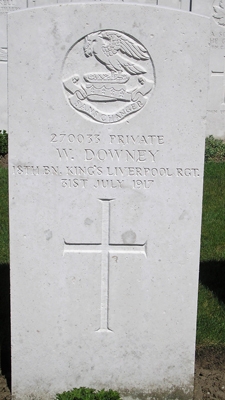
- Age: 22
- From: Liverpool
- Regiment: The King's (Liverpool Regiment) 18th Btn
- K.I.A Tuesday 31st July 1917
- Commemorated at: Hooge Crater Cem, Zillebeke
Panel Ref: XX.G.11
William Downey was born on 07th February 1895 and baptised 12th May 1895 at St Gabriel's Church, Toxteth. He was the son of John Downey and his wife Ann Jane (nee Williams) who were married in Holy Trinity Church, Toxteth Park in September 1877.
In 1901, the family were living at 15 Haylock Street. James is described as a foreman labourer, he’s 48 years old and Ann Jane is 45. Their children are: Emily aged 20 who is working as a kitchen maid, Annie 16, a domestic servant, John 13 a grocers shop boy, Edwin 10, Ada 8, William 6 and 1 year old Lily.
The 1911 census finds the family living at 15 Sefton Drive. The 16 year old William is now working as an iron cutter in a granite works. His siblings living at home are John who is a cotton porter, Edwin a mariner and Lily who is at school. The census records that their parents have been married for 33 years and that Ann Jane has borne 9 children, 2 of whom have sadly died.
William enlisted in Liverpool and was serving in the 18th Battalion, The King’s Liverpool Regiment as Private No 270033 when he was killed in action, aged 22, on the 31st July 1917, the first day of the Third Battle of Ypres, better known as the Battle of Passchendaele.
On this day, before Zero Hour, the 18th Battalion was part of 21st Brigade and was to form up for the attack from trenches from the area of Sanctuary Wood to Observatory Ridge but it was dark and continually falling rain gave very poor visibility. The departure of the 21st Brigade was delayed by heavy shelling.
The 18th King’s began to move forward in the rear of the 2nd Battalion of the Wiltshire Regiment who had been detailed as the left attacking battalion of the 21st Brigade.
No’s 1 and 3 Companies of the King’s led the way followed by No’s 2 and 4. In Sanctuary Wood there was considerable confusion, as a result No.2 and No.4 Companies became separated from the others, and were moved over to the left flank towards positions known as Surbiton Villas and Clapham Junction in the direction of the 90th Brigade.
No.1 and 3 Companies were soon in action with the enemy, and were for a time, held up against an enemy strong point. They pushed forward with their right on a trench known as Jar Row and their left on the tramway south of Stirling Castle. Advance along Jar Row was held up by the Germans who put up a fierce resistance and the party was forced to withdraw.
Another group of men from No.1 and No.3 Companies led by 2nd Lieut. Graham were being held up by another strongpoint which was south of Stirling Castle, which was eventually stormed and taken. Not far away from this action, an attempt, by other men of No.1 and No.3 companies, was made to penetrate a broad belt of uncut wire, but this was covered by Machine-guns which killed almost every man attempting to pass through the two gaps that were discovered.
The situation was similar with No.2 and 4 Companies, who had attacked along the wrong axis. Their advance was met with fierce opposition, and once all the experienced officer’s had been killed or wounded, all cohesion was lost, although some men did reach and cross the Menin Road at Clapham Junction.
By that time, the situation had become extremely confused, and the whereabouts of all four companies being unknown to Battalion Headquarters, urgent attempts were made to discover their locations. Eventually by mid- afternoon, it was established that the bulk of the companies, although all mixed together, were dug in the vicinity of Stirling Castle and by mid evening, the Battalion Headquarters moved forward to meet them.
During its time in the line the 18th Battalion lost 7 officers and 76 men killed or died of wounds and 7 officers and 177 men were wounded. They were relieved on the 2nd August.
William now rests at Hooge Crater Cemetery, Zillebeke, Belgium.
The Liverpool Daily Post of 06th September 1917 carried the following notice:
Downey – July 31st , killed in action aged 22 years, Private William Downey, loved son of John and Jane Downey of 28 Barclay Street, Dingle:
Sleep on dear brother, in a far off grave –
A grave we may never see;
But as long as life and memory last
We will remember Thee
Jack and Dollie
He was reported killed in the Liverpool Daily Post 24th Sept 1917
King's(Liverpool Regt.) - Downey, 270033, W. ;
William now rests at Hooge Crater Cemetery, Zillebeke, Belgium.
Hooge Chateau and its stables were the scene of very fierce fighting throughout the First World War. On 31 October 1914, the staff of the 1st and 2nd Divisions were wiped out when the chateau was shelled; from 24 May to 3 June 1915, the chateau was defended against German attacks and in July 1915, the crater was made by a mine sprung by the 3rd Division. On 30 July, the Germans took the chateau, and on 9 August, it and the crater were regained by the 6th Division. The Germans retook Hooge on 6 June 1916 and on 31 July 1917, the 8th Division advanced 1.6 Kms beyond it. It was lost for the last time in April 1918, but regained by the 9th (Scottish) and 29th Divisions on 28 September.
Hooge Crater Cemetery was begun by the 7th Division Burial Officer early in October 1917. It contained originally 76 graves, in Rows A to D of Plot I, but was greatly increased after the Armistice when graves were brought in from the battlefields of Zillebeke, Zantvoorde and Gheluvelt and other smaller cemeteries.
There are now 5,916 Commonwealth servicemen of the First World War buried or commemorated in this cemetery. 3,570 of the burials are unidentified, but special memorials record the names of a number of casualties either known or believed to be buried among them, or whose graves in other cemeteries were destroyed by shell fire.
The cemetery was designed by Sir Edwin Lutyens.
Soldiers Effects to father John, Pension to mother Ann Jane.
His father, John, died aged 76 in 1928 and his mother, Ann Jane, died aged 78 in 1933
We currently have no further information on William Downey, If you have or know someone who may be able to add to the history of this soldier, please contact us.
Killed On This Day.
(109 Years this day)Friday 20th April 1917.
Pte 57400 Roderick Chisholm
21 years old
(109 Years this day)
Friday 20th April 1917.
Pte 73671 Ellis Marsden
39 years old
(108 Years this day)
Saturday 20th April 1918.
2nd Lieut Harry Crook
44 years old
(108 Years this day)
Saturday 20th April 1918.
Pte 86268 George John Fasham
30 years old
(108 Years this day)
Saturday 20th April 1918.
Pte 20781 John Green
25 years old
(108 Years this day)
Saturday 20th April 1918.
Sgt 57856 Hugh Shotton
24 years old
(108 Years this day)
Saturday 20th April 1918.
Pte 90940 Frederick William Tomlinson
19 years old
(108 Years this day)
Saturday 20th April 1918.
Sgt 23876 Henry Young
22 years old