
1885 - 1916

CPL David Wallace Crawford
1887 - 1916

Lce-Corpl John Joseph Nickle
1894 - 1916

Pte 17911 Morton Neill
1897 - 1916

Lieut Edward Stanley Ashcroft
1883 - 1918

Pte 31794 William Thomas Garrett
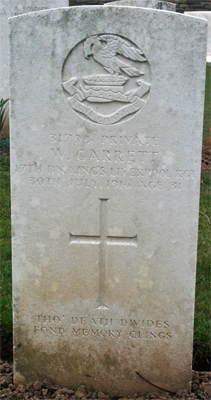
- Age: 31
- From: Laxey, I.O.M
- Regiment: The King's (Liverpool Regiment) 17th Btn
- K.I.A Sunday 30th July 1916
- Commemorated at: Guillemont Rd Cem
Panel Ref: III.M.10
William Thomas Garrett was born on 19th March 1885 in Old Laxey, Lonan, Isle of Man, and baptised on 16th April in Christ Church, Laxey. He was the son of Edward James Garrett and Eleanor Ann Garrett (nee Kewley) who were both born on the Isle of Man. His parents married in 1881, and had 11 children, three of whom died young. Willie had an older brother Arthur Edward, and younger siblings Robert Walter, John Alfred (who died at four months), John Alfred (who lived for 10 days), Daniel, Florence (died at age 4), Joseph, James Kewley, Annie, and Mary Ellen.
Laxey was the centre of a lead- and zinc-mining industry which was once one of the richest and most important in Britain. Lead workings were opened by 1782 and the mine also produced copper, silver, and iron. Manx miners were some of the most respected ‘hard-rock’ miners in the world.
Because the Laxey mine was prone to flooding, pumps were installed to remove water, but flooding remained a danger underground. In 1854 a 6’-wide 72’-high water wheel, considered an engineering marvel of its day, was constructed to power the pumps. By the 20th century yield had declined significantly and the mine was becoming uneconomical. Many miners emigrated to South Africa, Australia or the USA. The mine closed in 1929 but the Great Laxey Wheel still runs and is the largest operating water wheel in the world.
At the time of the 1891 census the family were living on Minorca Hill in Laxey. Edward was working as a general labourer, and the couple have three sons – 8 year old Arthur, William aged 6 and Robert Walter aged 4.
The family were still living at Minorca Hill in the 1901 census. The couple have four more sons. Edward is now working as a lead ore dresser as is 16 year of William (Willie) and 14 year old (Robert) Walter. The other sons living at home were Daniel aged 9, Joseph 4 and James 1.
Willie married Edith Elizabeth Brew on 19th November 1908 (Elizabeth was born in 1881).
In the 1911 census the couple are living at Quarry Road, Minorca Hill. William is 26, a lead miner, Elizabeth is 29. They live with their two small daughters – Florence aged 2 and Christina aged 5 months.
His parents have five children at home, their address simply Ballacollister Road. His father, 49, is a lead miner, his mother is 48. Daniel, 19, is a farm labourer, Joseph, 14, has no occupation, James 12, Annie 10, and Mary 7, are at school. His brother Walter is married and working as a lead miner. He emigrated to the United States in about 1913.
William and Elizabeth had another daughter, Edna May, born on 18th February 1912.
William enlisted at the Recruiting Office, Parrs Bank Chambers, in Douglas and joined the 17th Battalion, The King’s Liverpool Regiment as Private No 31794.
The local newspaper printed the names of new recruits on 15th September 1915: W. Garrett, Laxey, labourer, Liverpool Regiment.
William was killed in action on the 30th July 1916 aged 31 at the village of Guillemont, France, during the Somme Offensive.
17th Battalion Diary 30th July 1916
The Battalion was in support to 19 & 20 Battalions K.L.R. 2 Coys. behind 19th & 2 Coys. behind 20th. Very thick mist. The attack was pushed home to the objective in places but in the main was held up by machine gun fire from hidden machine guns.
Fighting continued all day swaying backwards and forwards until by 6pm about 300 yards in depth had been gained & consolidated all along our front.
Casualties in the 17th Battalion were 15 Officers and 281 Other Ranks
Further details are reported in more detailed by Everard Wyrall in his book The History of the King’s Regiment (Liverpool) 1914-1919 Volume II 1916-1917
The 17th King’s had advanced (two companies each behind the 19th and 20th Battalions) in small columns. They too suffered heavily from machine-gun fire and were quickly absorbed into the waves that preceded them. They also shared the gains and losses of that terrible day.
When darkness fell on the battlefield the 30th Division held a line from the railway on the eastern side of Trones Wood , southwards and including Arrow Head Copse, to east of Maltz Horn Farm. On this line the division was relieved by the 55th Division during the early hours of the 31st July.
The events of 30th July 1916 were regarded at the time as Liverpool’s blackest day. There follows an extract from The History of the 89th Brigade written by Brigadier General Ferdinand Stanley which gives an indication of the events of the day.
Guillemont
Well the hour to advance came, and of all bad luck in the world it was a thick fog; so thick that you couldn’t see more than about ten yards. It was next to impossible to delay the attack – it was much too big an operation- so forward they had to go. It will give some idea when I say that on one flank we had to go 1,750 yards over big rolling country. Everyone knows what it is like to cross enclosed country which you know really well in a fog and how easy it is to lose your way. Therefore, imagine these rolling hills, with no landmarks and absolutely unknown to anyone. Is it surprising that people lost their way and lost touch with those next to them? As a matter of fact, it was wonderful the way in which many men found their way right to the place we wanted to get to. But as a connected attack it was impossible.
The fog was intense it was practically impossible to keep direction and parties got split up. Owing to the heavy shelling all the Bosches had left their main trenches and were lying out in the open with snipers and machine guns in shell holes, so of course our fellows were the most easy prey.
It is so awfully sad now going about and finding so many splendid fellows gone.
William was buried (as “A British Soldier”) close to where he fell and after the war, when graves were concentrated, his body was exhumed and identified and reinterred in Guillemont Road Cemetery, Somme, where he now rests, his headstone bears the epitaph:
"THO DEATH DIVIDES FOND MEMORY CLINGS"
Guillemont was an important point in the German defences at the beginning of the Battle of the Somme in July 1916. It was taken by the 2nd Royal Scots Fusiliers on 30 July but the battalion was obliged to fall back, and it was again entered for a short time by the 55th (West Lancashire) Division on 8 August. On 18 August, the village was reached by the 2nd Division, and on 3 September (in the Battle of Guillemont) it was captured and cleared by the 20th (Light) and part of the 16th (Irish) Divisions. It was lost in March 1918 during the German advance, but retaken on 29 August by the 18th and 38th (Welsh) Divisions.
The cemetery was begun by fighting units (mainly of the Guards Division) and field ambulances after the Battle of Guillemont, and was closed in March 1917, when it contained 121 burials. It was greatly increased after the Armistice when graves (almost all of July-September 1916) were brought in from the battlefields immediately surrounding the village and certain smaller cemeteries, including:-
HARDECOURT FRENCH MILITARY CEMETERY. The village of Hardecourt-au-Bois was captured by French troops on the 8th July 1916, and again by the 58th (London) and 12th (Eastern) Divisions on 28 August 1918. Five British Artillerymen were buried by their unit in the French Military Cemetery, in the middle of the village, in September 1916; and in 1918 the 12th Division buried in the same cemetery 14 men of the 9th Royal Fusiliers and two of the 7th Royal Sussex.
Guillemont Road Cemetery now contains 2,263 Commonwealth burials and commemorations of the First World War. 1,523 of the burials are unidentified but there are special memorials to eight casualties known or believed to be buried among them.
The cemetery was designed by Sir Herbert Baker.
His daughters were 5 and 4 years old when William was killed. Sadly, it appears that Florence had died, as she is not included as a dependent on the pension card, although no burial record has been found.
Elizabeth received his Army pay and a War Gratuity of £3, and was awarded a pension of 18/6d a week from March 1917, increased to 21/- for 13 months “in respect of widow’s age”. The pension card lists multiple addresses for her: Croit e Quill(?); Cronk-e-Callow; Ballacollister; Cliff Cottage, Old Chapel, Laxey; and Douglas.
On the anniversary of his death in 1919 his widow placed a notice in the Isle of Man Examiner:
“In loving memory of Thomas William Garrett, who was killed in action on 30th July, 1916, in France.
Three years have passed since that sad day
When my dear husband was called away;
God took him home, it was His will,
But in our hearts he liveth still.
- Ever remembered by his loving Wife and two little Daughters. Cliff Cottage, Old Chapel, Lonan.”
His elder brother Arthur served as a Driver with the R.A.S.C. and was discharged in 1919 with a partial disability pension due to sickness.
Joseph, a miner, enlisted in November 1914 at the age of 18 and served as a Signaller in the 11th Manchester Regiment. The battalion landed at Suvla Bay on the Gallipoli Peninsula on 06th August 1915. He was severely wounded on 24th August 1915 and evacuated to Floriana Hospital in Malta, where his lower left arm was amputated. He was Court Martialed in Egypt on 27/03/1916 and found guilty of self-inflicted wounds, but the conviction was later overturned on review. He was invalided to the U.K., where he had an operation to remove two bullets and shrapnel from his side and back. He underwent a leg operation in December at Levenshulme Military Hospital in Manchester and was later treated at the 1st Western General Military Hospital in Liverpool. Joseph was discharged with a disability pension and a Silver War Badge in February 1917.
Daniel first enlisted in Preston in December 1911 in the Loyal North Lancs Regiment, but was discharged three months later as not likely to become an efficient soldier (for health reasons). After the outbreak of war he enlisted again with his brother Joseph in November 1914 in the Manchester Regiment (they have consecutive regimental numbers) but was again discharged, two weeks later, for the same reason. He persevered and enlisted for the third time successfully in May 1915. He landed in France in August 1915 with the 7th South Lancs Regiment and served as a machine gunner. He was wounded three times before being severely wounded on 02nd July 1916 during “The Big Push”. The Peel City Guardian reported that he was being treated in Netley Hospital in Southampton for wounds in both legs and the left arm.
Daniel wrote in a letter from the hospital, “though badly wounded, I feel proud and satisfied with my efforts, for the reason that the Island takes a great interest in its wounded soldiers.” Daniel was discharged on 13/04/1917 with a Silver War Badge and a 70% disability pension. He underwent 30 operations in subsequent years for his amputated arm and shattered legs.
The Isle of Man Examiner reported on 21st April 1917 that an In Memoriam Service was held in Lonan Parish Church before a very large congregation, including Mr. and Mrs. Garrett of Ballacollister, having had four sons on active service, one on the Roll of Honour, and two severely wounded and disabled. The names of the dead were read out by the vicar and the “Dead March” was played. The collection was devoted to the fund for disabled Manx soldiers and sailors.
His youngest brother James died suddenly in 1919, at the age of 19.
His daughters both married, Christina in 1932 and Edna in 1941. In 1932 his widow Elizabeth was living at Cronk-e-Callow. It is not known when she died.
His mother died in 1938, aged 75. His father lived to see the outbreak of another world war and died in 1942, aged 80.
William is remembered on the following Memorials:
Glen Road, Laxey, IOM.
Manx National Memorial, St. John’s, Isle of Man.
He is also remembered on his Kewley grandparents’ headstone in All Saints Church in Lonan -
IN LOVING MEMORY OF
WILLIAM T. GARRETT
KILLED IN FRANCE JULY 16th [sic] 1916
We currently have no further information on William Thomas Garrett, If you have or know someone who may be able to add to the history of this soldier, please contact us.
Killed On This Day.
(110 Years this day)Thursday 26th October 1916.
Pte 38230 Bernard McEvoy
26 years old
(108 Years this day)
Saturday 26th October 1918.
Pte R/32424 Alfred Powell
26 years old
(108 Years this day)
Saturday 26th October 1918.
Pte 48449 Thomas Birkett Yarker
34 years old