
1885 - 1916

CPL David Wallace Crawford
1887 - 1916

Lce-Corpl John Joseph Nickle
1894 - 1916

Pte 17911 Morton Neill
1897 - 1916

Lieut Edward Stanley Ashcroft
1883 - 1918

L/Cpl 16190 Henry Laid
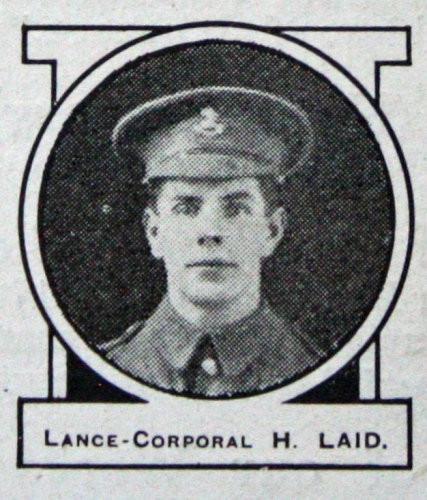
- Age: 24
- From: Hampstead London
- Regiment: The King's (Liverpool Regiment) 18th Btn
- D.O.W Sunday 2nd July 1916
- Commemorated at: Heilly Station Cem, Mericourt
Panel Ref: I.B.16
Henry Laid was born in Hampstead, London on the 17th October 1891, the son of James Hutchings Laid and his wife Harriet (née Exley). Both his parents were born in St. Pancras, London, married at St. Martin's Church, Kentish Town, London on 07th August 1871 and had eight children, four of whom died young. Elizabeth, born in 1872 died at age 2, James, born in 1874 died aged 5, and Harriet, 1877, died aged 2. Their next four children survived: Joseph, born in 1880, Rosa 1884, Albert 1888, and Henry born in 1891. Their youngest, Alfred, born in 1893 died at age 5.
In 1901 the family is living at 32 Wellesley Road, Kentish Town. Henry is 9 years of age and lives with his parents and three siblings. His father is a 52 year old plumber born at St Pancras London, whilst his mother is 51 years of age and was also born at St Pancras. His siblings are shown as; Joseph aged 20 a machine minder (colour mill), Rosa aged 19 an envelope gummer and Albert aged 12.
The 1911 Census finds Henry as one of four boarders in the household of John and Mary Boyles and family, 4 Bromborough Road, Lower Bebington, Henry is 19, employed as an advertising clerk for a soap manufacturer (Lever Brothers in Port Sunlight.). His parents, both 61, with Albert, are living in Tottenham, London, at 16 Etherley Road, West Green. His father describes himself as “unemployable” (he was deaf and suffering from cataracts), his mother works in ladies underclothing, at home, and Albert, 21, is a general printer. His parents have been married for 39 years and four of their eight children have survived.
Henry enlisted at St George's Hall in Liverpool joining the 18th Battalion of The King's Liverpool Regiment as Private 16190. He gave his age as 22 years and 320 days, and his occupation as clerk. He is described as being 5’7 and three-quarter inches tall, weighing 112 lbs, with a fresh complexion, hazel eyes, and light brown hair. He gives his religion as C of E, and as next of kin his father, at 112 Highgate Road, Gospel Oak, London N.W.
From the 23rd September 1914 he was billeted at Hooton Park Race Course and remained there until 03rd December 1914 when they moved into the hutted accommodation at Lord Derby’s estate at Knowsley Hall. On 30th April 1915 the 18th Battalion alongside the other three Pals battalions left Liverpool via Prescot Station for further training at Belton Park, Grantham. They remained here until September 1915 when they reached Larkhill Camp on Salisbury Plain. He arrived in France on 7th November 1915.
On 04th November 1915, just three days before he sailed for France with his Battalion on board the SS Invicta, he was appointed paid Lance-Corporal.
During the attack on the 1st July 1916, he was struck in the head and admitted to 96 Field Ambulance. He died from the effects of his wounds in 36 Casualty Clearing Station the following day.
18th Battalion Diary
At 6.30am the artillery commenced an intensive bombardment of the enemy’s trenches. Zero Hour – 7.30 am – the battalion commenced to leave their trenches and the attack commenced. The attack was pressed with great spirit and determination in spite of heavy shelling and machine gun enfilade fire which caused casualties amounting to 2/3rds of the strength of the Battalion in action. The whole system of German trenches including the Glatz Redoubt was captured without any deviation from the scheduled programme. Consolidated positions and made strong points for defence against possible counter attacks.
Graham Maddocks provides more detail concerning the events of the day:
As the first three waves began to move forward towards the German reserve line, known as Alt Trench and then on to the Glatz Redoubt itself, they suddenly came under enfilading fire from the left. This was from a machine gun which the Germans had sited at a strong point in Alt Trench. The gun itself was protected by a party of snipers and bombers, who, hidden in a rough hedge, were dug into a position in Alt Trench, at its junction with a communication trench known as Alt Alley. These bombers and snipers were themselves protected by rifle fire from another communication trench, Train Alley which snaked back up the high ground and into Montauban itself. The machine gun fire was devastating and it is certain that nearly of the Battalion’s casualties that day were caused by that one gun.
Lieutenant Colonel Edward Henry Trotter wrote in the conclusion of his account of the days action:
I cannot speak to highly of the gallantry of the Officers and men. The men amply repaid the care and kindness of their Company Officers, who have always tried to lead and not to drive. As laid down in my first lecture to the Battalion when formed, in the words of Prince Kraft:
“Men follow their Officers not from fear, but from love of the Regiment where everything had always and at all times gone well with them”.
Joe Devereux in his book A Singular Day on the Somme gives the Casualty Breakdown for the 18th Battalion as Killed in Action 7 Officers and 165 men and of those who died in consequence of the wounds 3 Officers and 19 men a total of 194 out of a total loss for the four Liverpool Pals Battalions of 257.
Henry now rests at Heilly Station Cemetery, Mericourt, L'Abbe, France. He served in No.1 Company.
The 36th Casualty Clearing Station was at Heilly from April 1916. It was joined in May by the 38th, and in July by the 2/2nd London, but these hospitals had all moved on by early June 1917. The cemetery was begun in May 1916 and was used by the three medical units until April 1917. From March to May 1918, it was used by Australian units, and in the early autumn for further hospital burials when the 20th Casualty Clearing Station was there briefly in August and September 1918. The last burial was made in May 1919. There are now 2,890 Commonwealth servicemen of the First World War buried or commemorated in this cemetery. Only 12 of the burials are unidentified and special memorials are erected to 21 casualties whose graves in the cemetery could not be exactly located. The cemetery also contains 83 German graves. The burials in this cemetery were carried out under extreme pressure and many of the graves are either too close together to be marked individually, or they contain multiple burials. Some headstones carry as many as three sets of casualty details, and in these cases, regimental badges have had to be omitted. Instead, these badges, 117 in all, have been carved on a cloister wall on the north side of the cemetery. The cemetery was designed by Sir Edwin Lutyens.
He earned his three medals.
In October 1916 Henry’s personal effects were sent to his father: 1 Bag, 1 Pkt letters & photos, 1 Pouch, 1 Notebook, 1 Vocabulary, 1 Testament, 1 Watch (broken), 1 Fountain pen, 1 Cig case.
Pension to mother Harriet.
Henry is also remembered on the Lever brothers War Memorial, The Causeway, Port Sunlight.
His father died a few months later, in the March quarter of 1917, aged 67, and his brother Joseph, a father of three, shortly afterwards, aged 36. Joseph served initially in the Royal Fusiliers and was transferred as a Lance-Corporal to the Artillery Pay Corps at Woolwich. He died at home on the 28th May 1917 while still serving and now rests in St Pancras Cemetery with a CWGC headstone.
Within a year, his mother lost two sons to war as well as her husband.
His brother Albert served in the Royal Field Artillery and survived the war.
In 1919 his mother provided information on Henry’s living relatives: She was living at 51 Lady Somerset Road, Kentish Town, N.W.5, his sister Rosa, 36, was living in Southbourne, Hants, and his brother Albert, 32, was living in Kentish Town.
His mother, having lost six of her eight children and her husband, died in 1921, aged 71.
We currently have no further information on Henry Laid. If you have or know someone who may be able to add to the history of this soldier, please contact us.
Killed On This Day.
(110 Years this day)Sunday 2nd July 1916.
Pte 16888 William Byrne
21 years old
(110 Years this day)
Sunday 2nd July 1916.
Pte 16119 Hugh Crawford
24 years old
(110 Years this day)
Sunday 2nd July 1916.
Pte 17228 Charles David Jones
20 years old
(110 Years this day)
Sunday 2nd July 1916.
Pte 24976 William Ernest Jones
32 years old
(110 Years this day)
Sunday 2nd July 1916.
L/Cpl 16190 Henry Laid
24 years old
(110 Years this day)
Sunday 2nd July 1916.
Lieut Dudley Holme Scott
38 years old
(110 Years this day)
Sunday 2nd July 1916.
L/Cpl 26024 Samuel Stanley Spencer
26 years old
(110 Years this day)
Sunday 2nd July 1916.
Lieut Basil Withy
30 years old
(109 Years this day)
Monday 2nd July 1917.
Pte 57999 Frederick William Birks
36 years old
(109 Years this day)
Monday 2nd July 1917.
Pte 47163 Edward Cooil
30 years old
(109 Years this day)
Monday 2nd July 1917.
Pte 49091 Percy Leopold Plews Garside
19 years old
(109 Years this day)
Monday 2nd July 1917.
Pte 49573 George Henry Hughes
20 years old
A total of 14 Pals were killed on this day. View All