
1885 - 1916

CPL David Wallace Crawford
1887 - 1916

Lce-Corpl John Joseph Nickle
1894 - 1916

Pte 17911 Morton Neill
1897 - 1916

Lieut Edward Stanley Ashcroft
1883 - 1918

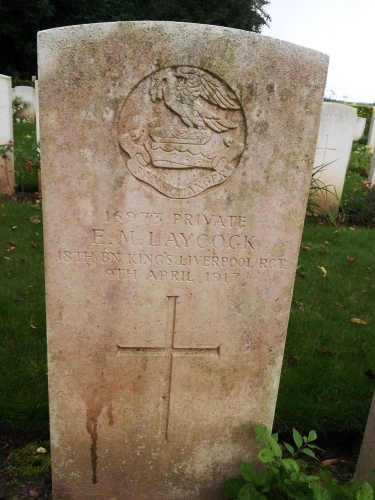
Pte 16973 Ernest Mitchell Laycock
- Age: 35
- From: Tranmere
- Regiment: The King's (Liverpool Regiment) 18th Btn
- K.I.A Monday 9th April 1917
- Commemorated at: Bucquoy Rd Cem Ficheux
Panel Ref: VI.N.13
Ernest Mitchell Laycock was born in 1882 in Tranmere the son of Henry Laycock and his wife Mary Jane (nee Lees) who were married in 1870 in Birkenhead.
On the 1891 census the family are living at 10 Circular Road, Tranmere. His father Henry is aged 47, a house furnisher ,born in Bingley, Yorkshire, his mother Mary J. is 46 born in Meltham, Yorkshire. They have four children in the household: Samuel H. 14 born in Tranmere, Jane L. 10 born in Tranmere, Ernest M. 8 born in Birkenhead, and John 6 born in West Kirby.
Ernest married Jessie Beatrice Jones on 04th September 1914 in Birkenhead just three days after enlisting, according to his service record this was done to ensure Jessie received a separation allowance. .
His service papers survived and show Ernest enlisted on the 01st September 1914 joining the 18th Battalion, The King’s Liverpool Regiment as Private No 16973. He gave his age as 32 years and 297 days and his occupation as a clerk. He was described as being 5’6 ¾ tall and weighed 132lbs with a 37” chest, brown hair and eyes and his religion was C. of E. His wife was living at 38 Courteney Avenue, Waterloo and then subsequently at 44 Church Street, Birkenhead.
Formed on 07th September 1914 the 19th Battalion trained locally at Sefton Park and remained living at home or in rented accommodation until November 1914. They then moved to the hutted accommodation at Lord Derby’s estate at Knowsley Hall. On 30th April 1915 the 19th Battalion alongside the other three Pals battalions left Liverpool via Prescot Station for further training at Belton Park, Grantham. They remained here until September 1915 when they reached Larkhill Camp on Salisbury Plain. He arrived in France on 7th November 1915.
Ernest saw action on the Somme at Montauban, Trones Wood, Guillemont and Le Transloy in 1916.
He was killed in action on Easter Monday, 09th April 1917, aged 35, during the Battle of Arras.
Arras 09th April 1917
Details of the circumstances the18th Battalion had to contend with are illustrated below:
The battalion formed the left assaulting battalion of the brigade, the 2nd Wiltshire Regiment being on the right, the 19th Manchester Regiment being in support and 2nd Battalion Yorkshire Regiment furnishing “moppers -up” for the two assaulting battalions. The brigade advance was timed to begin at ---- hour after “Zero”, suited to conform with the movements of 56th Division and other divisions on our left further north (near Arras). This battalion’s objective was the front-line system Lion Lane on the left (exclusive) to Panther Lane on right (exclusive). This sector included the strongpoint known as “The Egg”.
The brigade advanced at prearranged time, i.e., 11.38 a.m, from position of assembly trenches south of Neuville Vitasse to German front line. This necessitated an advance across the open of at least 2,000 yards. This area up to Neuville Vitasse- Henin road was crossed in artillery formation; after this, owing to machine-gun fire and considerable resistance from German posts forward in the sunken roads, it was found necessary to deploy. During the whole movement across the open the advancing columns had been under considerable artillery fire from guns of all calibres. On gaining the position immediately in front of German line it was found that the wire was practically uncut; this wire formed two strong belts in front of German trenches. Two small gaps were eventually discovered and Second-Lieut H.F.Merry gallantly led a bombing party through them, but his three remaining men were killed as they reached the German trenches.
From the moment the battalion was “held up” in front of German wire Capt. R. W. Jones, the senior company commander on the spot, at once began the work of consolidating in front of German wire. The battalion held on in this position for the remainder of the day, until relieved by the 16th Manchester Regiment about 3 a.m. on the 10th of April, all the time under intense machine-gun and rifle fire.
Between 9th-10th April, 1917, the 18th King's lost 2 officers 2nd Lt. F. Ashcroft and 2nd Lt. H.G. Ewing and 59 other ranks killed. 8 other officers were wounded.
He now rests at Bucquoy Road Cemetery, Ficheux, France.
In November 1916, the village of Ficheux was behind the German front line, but by April 1917, the German withdrawal had taken the line considerably east of the village and in April and May, the VII Corps Main Dressing Station was posted near for the Battles of Arras. It was followed by the 20th and 43rd Casualty Clearing Stations, which remained at Boisleux-au-Mont until March 1918, and continued to use the Bucquoy Road Cemetery begun by the field ambulances. From early April to early August 1918 the cemetery was not used but in September and October, the 22nd, 30th and 33rd Casualty Clearing Stations came to Boisleux-au-Mont and extended it. By the date of the Armistice, it contained 1,166 burials but was greatly increased when graves were brought in from the surrounding battlefields and from small cemeteries in the neighbourhood.
The cemetery now contains 1,901 burials and commemorations of the First World War. 168 of the burials are unidentified but there are special memorials to 23 casualties known or believed to be buried among them. Other special memorials commemorate 21 casualties buried by their comrades in Henin-sur-Cojeul German Cemetery, whose graves could not be found on concentration.
The cemetery was used again in May 1940 for the burial of troops killed during the German advance. There are 136 burials and commemorations of the Second World War; 26 of the burials are unidentified and special memorials commemorate 39 soldiers whose graves in the cemetery could not be specifically located.
The Liverpool Express of 23rd April 1917 reported:
The flag of the Liverpool Cotton Association is flying half-mast in memory of Private E.M.Laycock, K.L.R., killed in action. He was formerly with Messrs. Minoprio and Co.
Ernest is commemorated on the War Memorial at the Liverpool Cotton Association at Walker House, Exchange Flags, Liverpool.
His father died in the March quarter of 1921.
We currently have no further information on Ernest Mitchell Laycock, If you have or know someone who may be able to add to the history of this soldier, please contact us.
Killed On This Day.
(108 Years this day)Tuesday 30th April 1918.
L/Cpl 29203 Valentine Alexander
26 years old
(108 Years this day)
Tuesday 30th April 1918.
Pte 27948 Joseph Atherton
26 years old
(108 Years this day)
Tuesday 30th April 1918.
Pte 51896 Richard Edward Banks
34 years old
(108 Years this day)
Tuesday 30th April 1918.
Pte 46630 Watson Bell
38 years old
(108 Years this day)
Tuesday 30th April 1918.
Lieut Roland Henry Brewerton
27 years old
(108 Years this day)
Tuesday 30th April 1918.
Pte 51708 Charles Norman Dod
21 years old
(108 Years this day)
Tuesday 30th April 1918.
L/Cpl 94246 Frank Emison
24 years old
(108 Years this day)
Tuesday 30th April 1918.
Pte 23056 John William Jones
27 years old
(108 Years this day)
Tuesday 30th April 1918.
Pte 49572 John Henry Leadbeater (MM)
27 years old
(108 Years this day)
Tuesday 30th April 1918.
Sgt 22462 James Lowe (MID)
25 years old
(108 Years this day)
Tuesday 30th April 1918.
Pte 51712 Edgar Domenico Murray
21 years old
(108 Years this day)
Tuesday 30th April 1918.
Pte 269899 Harry Pitts
21 years old
A total of 14 Pals were killed on this day. View All