
1885 - 1916

CPL David Wallace Crawford
1887 - 1916

Lce-Corpl John Joseph Nickle
1894 - 1916

Pte 17911 Morton Neill
1897 - 1916

Lieut Edward Stanley Ashcroft
1883 - 1918

Cpl 16976 Frank Lindon
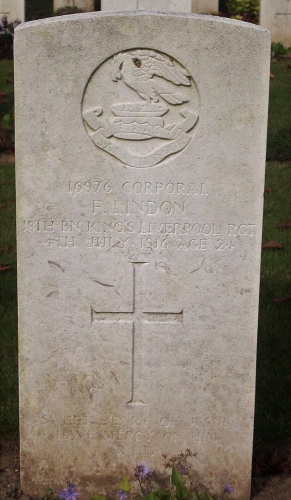
- Age: 26
- From: Liverpool
- Regiment: The King's (Liverpool Regiment) 18th Btn
- D.O.W Tuesday 4th July 1916
- Commemorated at: St Pierre Cem Amiens
Panel Ref: II.D.5
Frank Lindon was born in Liverpool on 05th January 1890, his birth was registered as Frank and he was baptised in the Oratory of St Philip Neri Roman Catholic Church, Mount Pleasant, Liverpool on the 15th January 1890. He was the son of Henry Lindon and his wife Sarah (nee Aitchison).
The 1901 Census shows the family are living at 41 Menzies Street, Toxteth Park, Liverpool. Frank is 11 years of age and lives with his parents and seven siblings. His father is a 44 year old ship's store keeper, born in Liverpool, whilst his mother is 39 years of age and was also born in Liverpool. His siblings are listed as; Christina aged 16, William K. aged 14 and a chartered accountants office boy, John T. 13, Stanley 9, Doris 7, Mabel 5 and Marion 11 months.
By 1911 the family have moved to 99 Errol Street, Aigburth. Frank is now 21 years of age and is a stock clerk, he is living with his parents and seven siblings. His parents have been married for 27 years and eight of their ten children have survived. Those children listed in the household alongside Frank are; Christina aged 26, William Henry a chartered accountant aged 24, John T. a 23 year old baker, Stanley a 19 year old apprentice engineer, Doris aged 17, Mabel 15 and Marion 10.
Frank enlisted at St George's Hall in Liverpool on 31st August 1914, joining the 18th Battalion of The King's Liverpool Regiment as Private 16976. He gave his occupation as a clerk (he was a member of the office staff of R Silcock & Sons, feed cake manufacturers of 5 Stanley Hall, Union Street, Liverpool). He was described as being 5' 5" tall, weighed 115lbs with a fresh complexion, hazel eyes and dark brown hair.
From the 23rd September 1914 he was billeted at Hooton Park Race Course and remained there until 03rd December 1914 when they moved into the hutted accommodation at Lord Derby’s estate at Knowsley Hall. On 30th April 1915 the 18th Battalion alongside the other three Pals battalions left Liverpool via Prescot Station for further training at Belton Park, Grantham. They remained here until September 1915 when they reached Larkhill Camp on Salisbury Plain.
On the 18th September 1915, he was appointed unpaid Lance-Corporal which was converted to paid Lance-Corporal on 01st November 1915. He sailed to France with his Battalion on board the SS Invicta on 07th November 1915.
He was promoted to Corporal on 06th February 1916, it is known that between the 1st and 4th April he was attached to the 2 Battalion Yorkshire Regiment although the reasons for this are unknown.
Frank was struck by shrapnel in the chest and back whilst taking part in the attack on Montauban on the 01st July with No 4 Company. He was admitted to 1/1 South Midland Casualty Clearing Station on 02nd July and died there two days later. He was 26 year of age.
The 18th Battalion Diary gives an insight into the events of the day upon which Francis was wounded:
At 6.30am the artillery commenced an intensive bombardment of the enemy’s trenches. Zero Hour – 7.30 am – the battalion commenced to leave their trenches and the attack commenced. The attack was pressed with great spirit and determination in spite of heavy shelling and machine gun enfilade fire which caused casualties amounting to 2/3rds of the strength of the Battalion in action. The whole system of German trenches including the Glatz Redoubt was captured without any deviation from the scheduled programme. Consolidated positions and made strong points for defence against possible counter attacks.
Graham Maddocks provides more detail concerning the events of the day:
As the first three waves began to move forward towards the German reserve line, known as Alt Trench and then on to the Glatz Redoubt itself, they suddenly came under enfilading fire from the left. This was from a machine gun which the Germans had sited at a strong point in Alt Trench. The gun itself was protected by a party of snipers and bombers, who, hidden in a rough hedge, were dug into a position in Alt Trench, at its junction with a communication trench known as Alt Alley. These bombers and snipers were themselves protected by rifle fire from another communication trench, Train Alley which snaked back up the high ground and into Montauban itself. The machine gun fire was devastating and it is certain that nearly of the Battalion’s casualties that day were caused by that one gun.
Lieutenant Colonel Edward Henry Trotter wrote in the conclusion of his account of the days action:
I cannot speak to highly of the gallantry of the Officers and men. The men amply repaid the care and kindness of their Company Officers, who have always tried to lead and not to drive. As laid down in my first lecture to the Battalion when formed, in the words of Prince Kraft:
“Men follow their Officers not from fear, but from love of the Regiment where everything had always and at all times gone well with them”.
Joe Devereux in his book A Singular Day on the Somme gives the Casualty Breakdown for the 18th Battalion as Killed in Action 7 Officers and 165 men and of those who died in consequence of the wounds 3 Officers and 19 men a total of 194 out of a total loss for the four Liverpool Pals Battalions of 257.
Frank now rests at St Pierre Cemetery, Amiens, France.
During part of August 1914, Amiens was the British Advanced Base. It was captured by the Germans on 31 August, and retaken by the French on the following 13 September. The German offensive which began in March 1918 had Amiens for at least one of its objectives but the Battle of Amiens (8 - 11 August 1918) is the Allied name for the action by which the counter offensive, the Advance to Victory, was begun. The 7th General Hospital was at Amiens in August 1914; the 56th (South Midland) Casualty Clearing Station from April to July 1916; the New Zealand Stationary Hospital from July 1916 to May 1917; the 42nd Stationary Hospital from October 1917 to March 1919; and the 41st Stationary Hospital in March 1918, and again in December 1918 and January 1919. The Commonwealth plot in St. Pierre Cemetery was first used in September 1915 and closed in October 1919, but shortly afterwards 33 graves of 1918 were brought in from positions in or near the city. During the Second World War, Amiens was again a British base, and G.H.Q. reserve was accommodated in the area south-west of the town. There was heavy fighting in and around Amiens when the Germans broke through the Somme line and took the town on 18 May 1940. Much damage was done, but although all the houses to the west of the cathedral were completely destroyed by the bombardment, the cathedral itself and the church of St. Germain l'Ecossais survived. Amiens was retaken by the British Second Army on 31 August 1944. Nos. 25 and 121 General Hospitals were posted there in October 1944, remaining until April 1945. St. Pierre Cemetery contains 676 Commonwealth burials of the First World War and 82 from the Second World War. The Commonwealth plot was designed by Sir Edwin Lutyens.
A requiem mass was held for him at St Charles Roman Catholic Church, Aigburth Road, Liverpool on 13th July 1916.
Soldiers Effects and Pension to mother Sarah.
A family notice appeared in the Liverpool Echo on 04th july 1917 and again in 1918.
As of July 1919 his siblings were noted as; William 32, John 30, Stanley 27, Christiana 33, Doris 25, Mabel 23 and Marion 19.
Frank is also remembered on the following war memorials
St Charles' RC Church, Aigburth Road, Liverpool
St Michael-in-the-Hamlet with St Andrew Parish Church, Church Road, Toxteth, Liverpool.
We currently have no further information on Frank Lindon. If you have or know someone who may be able to add to the history of this soldier, please contact us.
Killed On This Day.
(108 Years this day)Tuesday 30th April 1918.
L/Cpl 29203 Valentine Alexander
26 years old
(108 Years this day)
Tuesday 30th April 1918.
Pte 27948 Joseph Atherton
26 years old
(108 Years this day)
Tuesday 30th April 1918.
Pte 51896 Richard Edward Banks
34 years old
(108 Years this day)
Tuesday 30th April 1918.
Pte 46630 Watson Bell
38 years old
(108 Years this day)
Tuesday 30th April 1918.
Lieut Roland Henry Brewerton
27 years old
(108 Years this day)
Tuesday 30th April 1918.
Pte 51708 Charles Norman Dod
21 years old
(108 Years this day)
Tuesday 30th April 1918.
L/Cpl 94246 Frank Emison
24 years old
(108 Years this day)
Tuesday 30th April 1918.
Pte 23056 John William Jones
27 years old
(108 Years this day)
Tuesday 30th April 1918.
Pte 49572 John Henry Leadbeater (MM)
27 years old
(108 Years this day)
Tuesday 30th April 1918.
Sgt 22462 James Lowe (MID)
25 years old
(108 Years this day)
Tuesday 30th April 1918.
Pte 51712 Edgar Domenico Murray
21 years old
(108 Years this day)
Tuesday 30th April 1918.
Pte 269899 Harry Pitts
21 years old
A total of 14 Pals were killed on this day. View All