
1885 - 1916

CPL David Wallace Crawford
1887 - 1916

Lce-Corpl John Joseph Nickle
1894 - 1916

Pte 17911 Morton Neill
1897 - 1916

Lieut Edward Stanley Ashcroft
1883 - 1918

Pte 15909 Thomas William Maybury
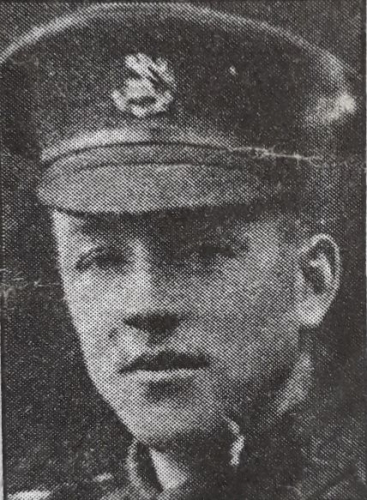
- Age: 24
- From: Worcester
- Regiment: The King's (Liverpool Regiment) 17th Btn
- K.I.A Sunday 30th July 1916
- Commemorated at: Thiepval Memorial
Panel Ref: P&F1D8B &8 C.
Thomas William Maybury was born on 11th July 1892 in Norton Barracks, Norton juxta Kempsey, just southeast of Worcester, the son of Thomas John Maybury and his wife May (née Miskell).
His father had joined up at 16 in 1879 in the 22nd Infantry Brigade. He was made Sergeant in 1890 and served in the U.K. and Ireland for 22 years.
His parents married in 1886 in Portsea, Hampshire and had four children. Their first child, George James, was born in 1889 in Pembroke, South Wales, but died just after his first birthday, by which time his father had been posted to Limerick, Ireland, where their daughter Madeline Mary was born on 07th November 1890. By 1892 when Thomas was born the family was at Norton Barracks near Worcester. His younger brother George John was born at Norton on 18th November 1894.
Unfortunately the 1891 census for Ireland has not survived.
The 1901 census finds the family living in Norton Barracks, his father’s last posting before discharge. Both his parents are aged 37, Madeline is 10, Thomas 9, and George 7.
His father was discharged in October that year, his military record showing his character as exemplary, and intended place of residence 12 Plan Street, Liverpool.
The 1911 Census shows the family living at 19 Maxton Road, Liverpool.
His father, Thomas, is aged 47, born in Worcester in 1864 is an army pensioner, his mother Mary is aged 48, born in Jersey in 1863 with no occupation listed. They have been married for twenty four years and have had four children of which one had died. Their three remaining children are at home; Madeline born in Limerick, Ireland is aged 20, born 1891 and Thomas William aged 18, are both clerks and George aged 16, born 1895 is an apprentice engineer and all are employed at a Tobacco factory (likely to be Ogdens).
Prior to the war Thomas was employed at Imperial Tobacco Limited.
He enlisted on the 01st September 1914 at St George's Hall in Liverpool, joining the 17th Battalion of The King’s Liverpool Regiment as Private No 15909. He gave his age as 22 years and 50 days and his occupation as a clerk. He was described as being five feet six inches tall, weighed 120lbs, fair complexion, greenish blue eyes, brown hair and gave his religion as Roman Catholic. Qualification: Grenadier.
07th November 1915: Embarked for France with his battalion.
He was killed in action on the 30th July 1916, aged 24, at the village of Guillemont, France, during the Somme Offensive.
17th Battalion Diary 30th July 1916
The Battalion was in support to 19 & 20 Battalions K.L.R. 2 Coys. behind 19th & 2 Coys. behind 20th. Very thick mist. The attack was pushed home to the objective in places but in the main was held up by machine gun fire from hidden machine guns.
Fighting continued all day swaying backwards and forwards until by 6pm about 300 yards in depth had been gained & consolidated all along our front.
Casualties in the 17th Battalion were 15 Officers and 281 Other Ranks
Further details are reported in more detailed by Everard Wyrall in his book The History of the King’s Regiment (Liverpool) 1914-1919 Volume II 1916-1917
The 17th King’s had advanced (two companies each behind the 19th and 20th Battalions) in small columns. They too suffered heavily from machine-gun fire and were quickly absorbed into the waves that preceded them. They also shared the gains and losses of that terrible day.
When darkness fell on the battlefield the 30th Division held a line from the railway on the eastern side of Trones Wood , southwards and including Arrow Head Copse, to east of Maltz Horn Farm. On this line the division was relieved by the 55th Division during the early hours of the 31st July.
The events of 30th July 1916 were regarded at the time as Liverpool’s blackest day. There follows an extract from The History of the 89th Brigade written by Brigadier General Ferdinand Stanley which gives an indication of the events of the day.
Guillemont
Well the hour to advance came, and of all bad luck in the world it was a thick fog; so thick that you couldn’t see more than about ten yards. It was next to impossible to delay the attack – it was much too big an operation- so forward they had to go. It will give some idea when I say that on one flank we had to go 1,750 yards over big rolling country. Everyone knows what it is like to cross enclosed country which you know really well in a fog and how easy it is to lose your way. Therefore, imagine these rolling hills, with no landmarks and absolutely unknown to anyone. Is it surprising that people lost their way and lost touch with those next to them? As a matter of fact, it was wonderful the way in which many men found their way right to the place we wanted to get to. But as a connected attack it was impossible.
The fog was intense it was practically impossible to keep direction and parties got split up. Owing to the heavy shelling all the Bosches had left their main trenches and were lying out in the open with snipers and machine guns in shell holes, so of course our fellows were the most easy prey.
It is so awfully sad now going about and finding so many splendid fellows gone.
Thomas was initially declared Missing, his name published in the casualty list in the Liverpool paper on 14th September 1916. After nine months of anguished uncertainty, his parents were notified of his presumed death, reported in the local paper on 09th May 1917:
“Mr. and Mrs. Maybury, 19, Maxton Road, have been officially notified that the Army Council presume that their eldest son, Private Thomas W. Maybury (24), K.L.R., was killed in action on July 30, 1916. He had been reported missing since that date. Before the war he was in the employment of the Imperial Tobacco Company (Ogden Branch).”
Thomas' body was not recovered or was subsequently lost as he has no known grave and is commemorated on the Thiepval Memorial.
The Thiepval Memorial, the Memorial to the Missing of the Somme, bears the names of more than 72,000 officers and men of the United Kingdom and South African forces who died in the Somme sector before 20 March 1918 and have no known grave. Over 90% of those commemorated died between July and November 1916.
On 01st August 1932 the Prince of Wales and the President of France inaugurated the Thiepval Memorial in Picardy. The inscription reads: “Here are recorded the names of officers and men of the British Armies who fell on the Somme battlefields between July 1915 and March 1918 but to whom the fortune of war denied the known and honoured burial given to their comrades in death.”
Thomas is commemorated locally on the William Faulkner Co. and Branches of The Imperial Tobacco Co. Ltd. Memorial in Anfield, Liverpool.
He earned his three medals, which his father signed for.
His Army pay and a War Gratuity of £8-10s went to his father Thomas. His mother Mary was awarded a pension of 9/- a week from May 1917.
In the Liverpool Echo, on 30th July 1917 under the heading ‘Lost At The Battle of Guillemont’ his parents placed a moving tribute to their son as did his sister and brother.
“In loving memory of our dear son, Thomas William, 17th K.L.R. (No.15909, “Pals”), killed in action at Guillemont, July 30, 1916. To his memory. He will never grow old as we who are left grow old; Age shall not weary, nor memory grow dim. At the going down of the sun, and in the morning, We shall remember him. - Sadly missed by his Mother and Father.”
“In loving memory of our dear brother, Thomas William, 17th K.L.R. (“Pals”), killed in action, July 30, 1916. One year has passed Since our great sorrow fell, Still in our hearts we mourn the loss of him we loved so well. - Sadly missed by his Sister and Brother”
His loved ones also placed In Memoriam notices on the second anniversary of his death in the Liverpool Echo:
“In loving memory of Thomas William Maybury (15909), 17th K.L.R. (Pals), reported missing July 30, 1916 at Guillemont, officially presumed killed, the dearly-loved eldest son of Mr. and Mrs. Maybury, 19, Maxton Road, Liverpool. - Never forgotten by his sorrowing Mother and Father.”
“In affectionate remembrance of our dearly-loved brother, Private T. W. Maybury, K.L.R. (1st Pals), presumed killed in action July 30, 1916. (Today recalls sad memories that time can never heal.) - Always remembered by Maddie and George (East Africa).”
"Maybury - In memory of Tommy (Pals), missing since July 30, 1916. - His friend George."
In 1919 his parents were still at 19 Maxton Road with Madeline, 28. George, 24, was at the Malarial Concentration Camp in Shoreham-by-Sea, Sussex.
George had served with the R.A.S.C. in East Africa and was discharged in October 1919 with a 20% disability pension (malaria). In early 1917, the War Office approved a scheme whereby all cases of malaria in the United Kingdom should be concentrated in each Command in special malaria wards under specially qualified medical officers. In July 1919 a Malaria Convalescent Hospital of 1500 beds was established at Shoreham.
Madeline’s future husband Stanley Woodhead also served in the R.A.S.C. in East Africa. Perhaps George’s experience was similar to his record, which still survives. He embarked at Devonport in August 1916 and arrived in October at Dar es Salaam in German East Africa (Tanganyika, now Tanzania). In February 1917 he was hospitalized with malaria, suffered repeated attacks, and was invalided to England. He arrived home in August 1917 and was demobbed in February 1919.
His father wrote to the military authorities in January 1919 and again in October 1921, expressing concern that his son’s Memorial Plaque had been overlooked, as he knew of next of kin of men who had been killed 12 months after Thomas who had received the Plaque. Infantry Records responded that “some considerable time may elapse before delivery of same can be completed owing to the enormous number still required”. The bronze plaque was eventually issued direct from the manufacturers, Royal Ordnance Factories, Woolwich.
His mother died in 1928, aged 65, and his father in 1933, aged 70.
We currently have no further information on Thomas William Maybury, If you have or know someone who may be able to add to the history of this soldier, please contact us.
Killed On This Day.
(108 Years this day)Tuesday 30th April 1918.
L/Cpl 29203 Valentine Alexander
26 years old
(108 Years this day)
Tuesday 30th April 1918.
Pte 27948 Joseph Atherton
26 years old
(108 Years this day)
Tuesday 30th April 1918.
Pte 51896 Richard Edward Banks
34 years old
(108 Years this day)
Tuesday 30th April 1918.
Pte 46630 Watson Bell
38 years old
(108 Years this day)
Tuesday 30th April 1918.
Lieut Roland Henry Brewerton
27 years old
(108 Years this day)
Tuesday 30th April 1918.
Pte 51708 Charles Norman Dod
21 years old
(108 Years this day)
Tuesday 30th April 1918.
L/Cpl 94246 Frank Emison
24 years old
(108 Years this day)
Tuesday 30th April 1918.
Pte 23056 John William Jones
27 years old
(108 Years this day)
Tuesday 30th April 1918.
Pte 49572 John Henry Leadbeater (MM)
27 years old
(108 Years this day)
Tuesday 30th April 1918.
Sgt 22462 James Lowe (MID)
25 years old
(108 Years this day)
Tuesday 30th April 1918.
Pte 51712 Edgar Domenico Murray
21 years old
(108 Years this day)
Tuesday 30th April 1918.
Pte 269899 Harry Pitts
21 years old
A total of 14 Pals were killed on this day. View All