
1885 - 1916

CPL David Wallace Crawford
1887 - 1916

Lce-Corpl John Joseph Nickle
1894 - 1916

Pte 17911 Morton Neill
1897 - 1916

Lieut Edward Stanley Ashcroft
1883 - 1918

Pte 52038 Robert Mayoh
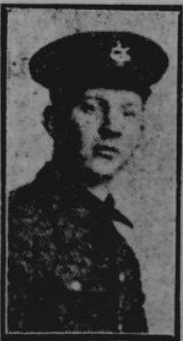
- Age: 19
- From: Bolton, Lancs
- Regiment: The King's (Liverpool Regiment) 19th Btn
- D.O.W Friday 13th October 1916
- Commemorated at: Caterpillar Valley, Longueval
Panel Ref: VIII.H.13
Robert died of wounds in 37th Field Ambulance on the 13th October 1916 during the Battle of the Transloy Ridges which was part of the ongoing Somme Offensive. These wounds were undoubtedly received in action on 12th October 1916.
It had rained incessantly at the beginning of October 1916 and the ground was full of mud. In his book ‘The Liverpool Pals’ Graham Maddocks describes the day of the 12th of October 1916.
It was obvious that the Germans knew an attack was coming and from which direction it would be mounted. On the evening of the 11th the 20th Battalion moved up the line and dug two deep assembly trenches behind the 17th Battalion’s position for the attack the next day. The 19th Battalion also moved into its reserve positions known as Flers Trench. Although the rain has stopped, the ground was like a morass, with all the natural vegetation destroyed, it was difficult to tell exactly where the objectives lay. On the afternoon of the 12th at exactly 2.05pm, the attack began along the whole Corps line, covered by the local batteries of the Royal Field Artillery which still had line of sight. As the whistles blew, the 17th Battalion left its trenches to move forwards, at the same time No.1 and 2 Companies of the 20th Battalion moved forward and occupied the trenches vacated by the 17th. As they too went over the top, No.3 and 4 Companies took their place and waited in their turn to follow. No.2 and 3 Companies of the 19th Battalion moved up to occupy the assembly trenches dug the previous night by the 20th.
As soon as the attacking waves left their trenches the enemy artillery began to register on them and at the same time the defending infantry commenced a murderous rain of fire. Those German regiments were trained and experienced soldiers, well dug in on high ground, and for the most part, looking out on uncut wire. As such it was virtually impossible for them to miss the City Battalion men struggling to advance in the mud towards them.
Brigadier-General F.C.Stanley wrote that the Battalions were also suffering casualties due to the short shooting of the British heavy artillery fire. “I know from practical experience that they were our own guns which were shooting, and which were causing us quite a considerable number of casualties. The fault lay at that time from the fact that the heavy gunners would not send their FOO’s (Forward Observation Officers) far enough forward, but were content to observe us from right back”
Some ground was gained that day, about 150 yards, the 20th Battalion were not relieved until 24 hours later causing the men to endure another day and night in the front line trench.
His death was reported in the Farnworth Chronicle on Friday 03rd November 1916;
Turton Man’s Death.
Pte. R. Mayoh, of the 3/9th(sic) King's Liverpool Regt., who died on October 13th as the result of wounds received in action. His parents reside at the De Rothwell Arms, Cox Green, Turton.
His death was also reported in the Bolton Evening News on Tuesday 07th November 1916;
Mr. and Mrs. J. Mayoh, of De Rothwell Arms, Cox Green, wish to thank all friends for their kind sympathy during their sad bereavement.
Robert now rests at Caterpillar Valley Cemetery, Longueval, France.
Caterpillar Valley was the name given by the army to the long valley which runs West to East, past "Caterpillar Wood", to the high ground at Guillemont. Longueval village is on the Northern crest of this valley and 500 metres West of the village, on the South side of the road to Contalmaison, is Caterpillar Valley Cemetery.
Caterpillar Valley was captured during a successful night assault by the 3rd, 7th and 9th Divisions on Bazentin Ridge on 14 July 1916. It was lost in the German advance of March 1918 and recovered by the 38th (Welsh) Division on 28 August 1918, when a little cemetery was made (now Plot 1 of this cemetery) containing 25 graves of the 38th Division and the 6th Dragoon Guards. After the Armistice, this cemetery was hugely increased when the graves of more than 5,500 officers and men were brought in from other small cemeteries, and the battlefields of the Somme. The great majority of these soldiers died in the autumn of 1916 and almost all the rest in August or September 1918.
Both the cemetery and memorial were designed by Sir Herbert Baker.
Killed On This Day.
(108 Years this day)Tuesday 30th April 1918.
L/Cpl 29203 Valentine Alexander
26 years old
(108 Years this day)
Tuesday 30th April 1918.
Pte 27948 Joseph Atherton
26 years old
(108 Years this day)
Tuesday 30th April 1918.
Pte 51896 Richard Edward Banks
34 years old
(108 Years this day)
Tuesday 30th April 1918.
Pte 46630 Watson Bell
38 years old
(108 Years this day)
Tuesday 30th April 1918.
Lieut Roland Henry Brewerton
27 years old
(108 Years this day)
Tuesday 30th April 1918.
Pte 51708 Charles Norman Dod
21 years old
(108 Years this day)
Tuesday 30th April 1918.
L/Cpl 94246 Frank Emison
24 years old
(108 Years this day)
Tuesday 30th April 1918.
Pte 23056 John William Jones
27 years old
(108 Years this day)
Tuesday 30th April 1918.
Pte 49572 John Henry Leadbeater (MM)
27 years old
(108 Years this day)
Tuesday 30th April 1918.
Sgt 22462 James Lowe (MID)
25 years old
(108 Years this day)
Tuesday 30th April 1918.
Pte 51712 Edgar Domenico Murray
21 years old
(108 Years this day)
Tuesday 30th April 1918.
Pte 269899 Harry Pitts
21 years old
A total of 14 Pals were killed on this day. View All