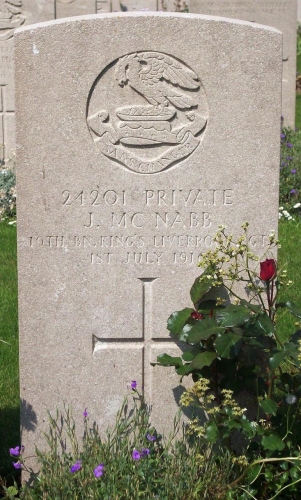
John William McNabb was born in Liverpool on 26th December 1894, the eldest son of John McNabb and Mary Elizabeth (née Stanton or Mack). The school register gives his birthdate as 26th December 1895, but this is apparently in error, as no John McNabb was born in 1895 or 1896, and his birth was registered in the March quarter of 1895. Both his parents were born in Liverpool. There is some uncertainty about his mother’s surname. Mary Elizabeth Stanton was born in Liverpool in 1872 to John and Maria Stanton (names which she passed on to her children), but her maiden name on some of the children’s birth registration is Mack, and the marriage in February 1894 is between John McNabb and Elizabeth Mack (father Samuel, blacksmith, but no census records have been found for this family).
When his parents were married at St John the Baptist, Toxteth Park on the 04th February 1894, his father was a 27 year old labourer of 48 High Park Street, father William, his mother was aged 20 of 71 Morton Street, father Samuel. She signed the certificate with a cross in lieu of her name. They had five children, of which John was the eldest. He had a younger brother Robert Edward, born in Liverpool on 23rd December 1896 (mother’s maiden name Mack) and was baptised Roman Catholic.
The family moved to Barrow-in-Furness where Mary Catherine was born in 1899, followed by two more daughters, Maria in 1901 and Margaret Ann (Annie) in 1904, all born to mother Stanton.
The dramatic growth of Barrow-in-Furness in the late 19th and early 20th Centuries was fuelled by the ready availability of Furness iron ore. Significant investments were made in developing the town to exploit this resource. The various ironworks, steelworks, foundries, shipyards and docks required a huge influx of population to support them. This in turn led to the rapid building of rows of good quality mass-produced terraced housing for the workers. (From lindal-in-furness.co.uk)
At the time of the 1901 census his parents, with three children, are boarding with Walter and Mary Sear and family at 36 Thwaite Street, Barrow in Furness. His father, 38, is a blacksmith/striker, and his mother is 27. John is 6, Robert (now with middle initial M.) is 5, and Mary is 2.
John attended Thwaite Street School and Nelson Street Primary School, the family in 1905 living at 5 Back Nelson Street.
His father died when John was 12, in 1906, aged 41, and was buried in Barrow Cemetery Roman Catholic section. Sadly, the next year his brother Robert (middle name Martin) died, at the age of 10, also buried in the RC section of Barrow Cemetery.
His mother remarried in 1907 to George Henry Nice, and their first son George sadly died in infancy in 1908. Another son William Thomas was born in 1909 (mother’s maiden name also McNabb).
In 1911 the family are at 34 Thwaite Street, Barrow. His stepfather George Nice is 29, a general labourer for a paper manufacturer, his mother is 35. John is 16, a general labourer (rail dept.) for a steel manufacturer, Mary is 11, Maria, 9, and Annie, 7, and his half brother William Nice is 1.
By 1912 they have moved to Liverpool, where James Frederick Nice was born (mother’s maiden name Stanton). James died at 8 months, the family living at 26 Graham Street. Another son, Samuel, was born in 1914 (mother Stanton).
John enlisted in Liverpool on 23rd July 1915 joining the 19th Battalion as Private 24210.
Formed on 07th September 1914 the 19th Battalion trained locally at Sefton Park and remained living at home or in rented accommodation until November 1914. They then moved to the hutted accommodation at Lord Derby’s estate at Knowsley Hall. On 30th April 1915 the 19th Battalion alongside the other three Pals battalions left Liverpool via Prescot Station for further training at Belton Park, Grantham. They remained here until September 1915 when they reached Larkhill Camp on Salisbury Plain.
He embarked for France with his Battalion on 07th November 1915, disembarking at Boulogne.
He was killed in action on 01st July 1916, aged 21, during the attack at Montauban on the opening day of the Battle of the Somme.
19th Battalion Diary
Zero Hour 7.30am . First day of the attack. The Battalion used up entirely in “carrying parties” for the Brigade. Battalion H.Q. in the “Chateau”, Maricourt. Total casualties 01 -04/07/1916: 1 officer wounded, 12 other ranks killed, 53 wounded and 3 missing.
John was one of the other ranks referred to.
His death was announced in the Liverpool Echo on the 13th July 1916:
ANOTHER PAL
“Official news has been received of the death in action of Private John McNabb, of the “Pals.” He was twenty-one years of age, and resided with his mother at 41, Greeta-street, Liverpool.”
He was reported as killed in the Liverpool Echo on the 02nd August 1916:
Killed.
McNabb, 24210, J. W. (Liverpool);
He now rests at Plot I, Row A Grave 2, Peronne Road Military Cemetery, Maricourt, France.
Maricourt was, at the beginning of the Battles of the Somme 1916, the point of junction of the British and French forces, and within a very short distance of the front line; it was lost in the German advance of March 1918, and recaptured at the end of the following August.
The Cemetery, originally known as Maricourt Military Cemetery No.3, was begun by fighting units and Field Ambulances in the Battles of the Somme 1916, and used until August 1917; a few graves were added later in the War, and at the Armistice it consisted of 175 graves which now form almost the whole of Plot I. It was completed after the Armistice by the concentration of graves from the battlefields in the immediate neighbourhood and from certain smaller burial grounds, including:-
TALUS BOISE BRITISH CEMETERY, CARNOY, between Carnoy and Maricourt, at the South end of a long copse. It was used in the latter half of 1916 and (chiefly by the 5th Royal Berks) in August 1918, and it contained the graves of 175 soldiers from the United Kingdom and five from South Africa.
There are now 1348, 1914-18 war casualties commemorated in this site. Of these, 366 are unidentified and special memorials are erected to 26 soldiers from the United Kingdom known or believed to be buried among them. Other special memorials record the names of three soldiers from the United Kingdom, buried in other cemeteries, whose graves could not be found.
The cemetery covers an area of 3,787 square metres and is enclosed on three sides by a low red brick wall.
John earned his three medals. His Army effects, Pension and a War Gratuity of £6-10s went to his mother.
John is commemorated in the Hall of Remembrance, Liverpool Town Hall, Panel 18.
George and Elizabeth Nice are found on electoral rolls at 41 Greta Street from 1918 until 1938.
By 1939 his mother, date of birth 20th October 1874, and stepfather are living at 29 Sandy Lane with her widowed daughter Mary C. Ashcroft and her children.
His mother died around Christmas 1939, aged 65, and was buried on the 28th December at Kirkdale Cemetery, her address Sandy Lane, Walton. His stepfather George Nice died in 1942, aged 60.
We currently have no further information on John William McNabb, if you have or know someone who may be able to add to the history of this soldier, please contact us.