James McQuiggan was born in Southport in the March quarter of 1885, the eldest son of James McQuiggan and his wife Frances (née Aspinall). His father, from Liverpool, and his mother, from Southport, married in 1884 in a Register Office in Ormskirk district. They had seven children after James: Lawrence born in 1886 died in infancy, John 1887 died in infancy, John 1888, Mary 1891, Lawrence 1892, Elizabeth 1893 died in infancy, and Ellen (Nellie) in 1897.
In 1891 the family (listed as McWigan) are living at 159 Bispham Road, Southport. His father, 27, is an iron merchant, his mother is 23, James is 6, John 2, and Mary one month old, also in the household is his uncle Robert Aspinall, 21. After this census was taken, Lawrence and Ellen were born, and his father died in 1899.
His mother Frances remarried to Albert Rimmer in All Saints, Southport, in 1900 and the 1901 census finds James living at 105 High Park Road with his maternal grandmother, Elizabeth Aspinall, 52, and her sons Robert Aspinall 32, and Lawrence Aspinall 22. Grandson James is 16, working as a general labourer. His mother Frances, 32 and stepfather Albert, 24, are living at 26 Devonshire Road, a butcher’s shop, with his siblings John 12, Mary 10, Lawrence 8, and Ellen 4. Albert is a general labourer.
Frances and Albert had seven children, many of whom also died young: Albert in 1901, the next four babies died young (Annie 1902, Elizabeth 1904, Richard 1905, Annie 1906) Alice Maud 1909, and Edith 1911 (died in infancy). Of the 15 children Frances gave birth to, seven survived.
James married Rose Martin on 31st July 1909 in Chorley Register Office. Rose was from the Ormskirk area; it is not known why they married in Chorley. There are no records of children born to the marriage.
The 1911 census find James and Rose living at 18 Heaton Street, Leyland, Lancashire. James gives his age as 27 and Rose as 30 (he was 26, she was 34). He is employed as a clamper in a bleach works. Also in the household is his brother Lawrence, 18, now unemployed, but formerly employed at a bleach works. They also have a visitor, William Berry. His mother and stepfather are living at 90 High Park Road, with Albert, 10, and Alice, 17 months.
James enlisted in Southport on 5th November 1914 as Private 21067, King’s (Liverpool) Regiment (Depot) and was posted to ‘D’ Company, 14th Battalion on the 7th. He gives his age as 29 years and 9 months, and his occupation as a labourer. He is described as being 5’ 7 and 3/4” tall, weighing 142 lbs, with a dark complexion, grey eyes and dark hair. He has a tatoo of hands across a heart on the inside of his right forearm and a 1 and 1/2” scar on his left wrist. He gives his next of kin as his wife, Rose, at 26B High Park Road, Southport and his religion as Roman Catholic.
The battalion trained in Eastbourne and Seaford. Whilst at Seaford on 24/4/1915 James was confined to barracks for two days for insolence to an N.C.O., but the entry is crossed out. His service record survives and shows -
13/5/1915 Appointed unpaid Lance Corporal
6/7/1915 Reverted to Private for irregular conduct
James embarked for France with his battalion on 4th September 1915. They entrained for Marseilles and from there embarked in October for Salonika in the Balkans.
On 23/11/1915, in the field, he was awarded 28 days’ Field Punishment No.1 for insolence to an N.C.O. (This severe punishment was often not carried out when the unit was on the front line.)
24/5/1916 to No.31 Casualty Clearing Station, and admitted to 5th Canadian Hospital in Salonika on the 28th “not yet diagnosed”. He was sent to the Convalescent Depot in Sanonika on 8/6/1916 and rejoined his unit in the field on the 24th.
On 29/7/1916, with fever of unknown origin, he was sent to a Field Ambulance, diagnosed with malaria, and transferred on 9/8/1916, to St. Paul’s Hospital in Malta, after which he was sent to a convalescent camp on the island, and appears to have embarked for the Balkans on 2/2/1917. Unfortunately portions of his Casualty Form are faded and illegible.
The battalion took part in the fighting at Horseshoe Hill and Machukovo in 1916 and at Doiran in 1917.
On 31/5/1917 he was again sent to No.31 C.C.S. and to hospital in Salonika. He spent time at No.1 Convalescent Unit in Corfu from 7/7/1917 until returning to Salonika on 14/12/1917 and rejoined his unit in the field at the end of the month.
The War Office sent a cable on 29/11/1917: “Malaria case - not to be sent to a theatre of war where malaria is prevalent”. James did not leave the Balkans until 31/5/1918, embarking at Itea in Greece and eventually to the UK.
11/6/1918 Posted K.L.R. Depot, “not to return to Salonika”
14/7/1918 Posted to 3rd K.L.R. (home garrison Bn)
The rest of the 14th Battalion were sent to the Western Front in June 1918 and were absorbed by the 18th Battalion, King's Liverpool Regiment in August, becoming the 18th (Lancashire Hussars), The King’s (Liverpool Regiment).
2/8/1918 Classified fit to return to active service “irrespective of malaria”
3/9/1918 Embarked for France
8/9/1918 Posted 18th K.L.R.
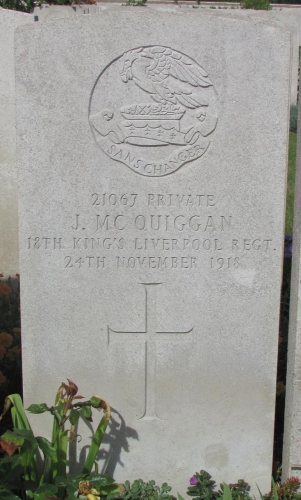
The 100 Days Offensive, the Allied push that would eventually bring the war to an end, begins in August, and by early October the 18th Bn arrives at the Hindenburg Line in the region of Bony. The Allies pursue the retreating German Army and on 8th November 1918, in what would be their last engagement of the war, the 18th Bn attacks the Germans near Marbaix. James was wounded in action on 8th November and died of his wounds at No.6 General Hospital in Rouen on 24th November 1918.
He now rests in St. Sever Cemetery, Rouen.
During the First World War, Commonwealth camps and hospitals were stationed on the southern outskirts of Rouen. A base supply depot and the 3rd Echelon of General Headquarters were also established in the city.
Almost all of the hospitals at Rouen remained there for practically the whole of the war. They included eight general, five stationary, one British Red Cross and one labour hospital, and No. 2 Convalescent Depot. A number of the dead from these hospitals were buried in other cemeteries, but the great majority were taken to the city cemetery of St. Sever. In September 1916, it was found necessary to begin an extension, where the last burial took place in April 1920.
The Cemetery and the Extension adjoin each other but have separate Registers.
During the Second World War, Rouen was again a hospital centre and the extension was used once more for the burial of Commonwealth servicemen, many of whom died as prisoners of war during the German occupation.
The cemetery extension contains 8,348 Commonwealth burials of the First World War (ten of them unidentified) and in Block "S" there are 328 from the Second World War (18 of them unidentified). There are also 8 Foreign National burials here. The adjoining St. Sever Cemetery contains 3,082 Commonwealth burials of the First World War. There is also 1 French burial and 1 non war service burial here.
The extension was designed by Sir Reginald Blomfield.
James earned his three medals.
Rose, then at 71 High Park Road, received his Army effects of £27-13s-6d and a War Gratuity of £23-10s. She received a £5 grant on 3/12/1918, and a pension of 13/9d a week from 2nd June 1919, but a notation dated 28th February 1921 shows Rose ruled ineligible for a pension, reason given, ”Lack of certification of late husband’s pre-war earnings”. The pension card shows 4th King's Liverpool Regiment.
He was reported to have Died of Wounds in the Weekly Casualty List on 14th January 1919.
Rose received his personal effects in March 1919: 1 Identity disc, Rosary, Religious book, Knife, Photographs, Pouch.
His brother Lawrence served in the 11th Bn K.L.R. and won the Military Medal and Bar. He was captured on 22nd March 1918, at the start of the German Spring Offensive, and held at Mannheim POW camp. His name did not appear in the Weekly Casualty List as held by the Germans until1 5/10/18. He was released on 07th January 1919. (International Red Cross records are held under the surname McKniggan.)
In 1919 James’ mother provided information on his living relatives: Albert 17, and Alice 8, were living at home, at 80 High Park Road; his brother John, 30, and married sister Mary, 26, were living a few doors away at number 72, and brother Lawrence at number 56; his sister Nellie was overseas with the QMAAC (Queen Mary’s Army Auxiliary Corps, previously WAAC).
Rose remarried in 1926 when she was about 50 years old. In 1939 she was living with her second husband at 98 High Park Road. Rose died in 1948, age 71. In 1939 his mother and stepfather were at 64 High Park Road. His mother died in 1941 age 74.
James is commemorated on The Monument, Southport.
We currently have no further information on James McQuiggan. If you have or know someone who may be able to add to the history of this soldier, please contact us.