
1885 - 1916

CPL David Wallace Crawford
1887 - 1916

Lce-Corpl John Joseph Nickle
1894 - 1916

Pte 17911 Morton Neill
1897 - 1916

Lieut Edward Stanley Ashcroft
1883 - 1918

2nd Lieut William Munro
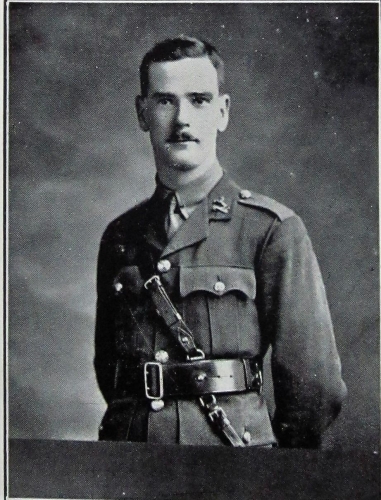
- Age: 24
- From: Liverpool
- Regiment: The King's (Liverpool Regiment) 19th Btn
- K.I.A Monday 29th April 1918
- Commemorated at: Voormezeele Cem Encl No. 3
Panel Ref: XIV.F.16
William was born in Liverpool on 17th February 1894 the son of Andrew Thomas Munro and his wife Eliza (nee Phillips) who married on the 4th March 1891 at St Silas' Church, Toxteth Park. Andrew aged 26 was a joiner of 72 Wellington Road and Eliza is 22 of 29 Foxhill Street.
William was baptised on 13th May 1894 also at St. Silas' Church.
He was educated at Granby Street School enrolling in 1899.
The 1901 Census finds the family living at 2 Fernhill Street, Toxteth Park, Liverpool. William is 7 years of age and is living with his parents and 3 siblings. His father, Andrew, is shown as a joiner born in Liverpool in 1865, whilst his mother Eliza was born in Liverpool in 1869. His siblings, all born in Liverpool are shown as; Miriam b. 1893, Nora b.1896 and Sabina b. 1898.
Sister Frances died in infancy in March 1901.
In 1905 William entered Tiber Street School.
By 1911 the family are still at 2 Fernhill Street. Both parents are still present in the household, they have been married for 20 years and have had seven children, one of whom has sadly died. William is now 17 years of age and is a junior clerk in a shipping office. He now has five sisters living in the household with him. Miriam is now 18 and is a shop assistant in the dyeing trade, Nora is 15 and is an apprentice dressmaker, Sabina is 13 and at school, Ada b.1902 is also at school and Elsie b.1906.
Immediately prior to the war William was employed by Messrs. Rundle and Dale, average adjusters.
William enlisted on 13th December 1915 into the 6th Battalion of The King's Liverpool Regiment. He was quickly identified as a candidate for commission and in July 1916 he was sent to Lichfield for training and was gazetted on 25th October 1916 into the 8th Battalion of the K.L.R. In December 1916 he crossed to France and was attached to the 20th Battalion of the K.L.R.
He served with the Battalion throughout 1917, and during the fighting on the first day of the Battle of Arras on 9th April, was unsuccessful in trying to capture an enemy held mill with 2 sections from ’ A’ Company. This was largely because of the strength of the defenders and enfilading machine-gun fire.
He was wounded at Passchendaele in July 1917 and upon recovery was again back on duty with the 20th Battalion. Upon the disbandment of the 20th Battalion in February 1918 he transferred to the 19th Battalion K.L.R.
He was killed in action on 29th April 1918, aged 24. He was reportedly killed by a sniper's bullet.
William now rests at Voormezelee Cem Enc No3, Belgium in Plot 14, Row F, Grave 16. The inscription on his headstone reads:
"WE THANK GOD FOR ALL OUR REMEMBRANCES OF THEE OUR ONLY SON"
The Voormizeele Enclosures (at one time there were a total of four, but now reduced to three) were originally regimental groups of graves, begun very early in the First World War and gradually increased until the village and the cemeteries were captured by the Germans after very heavy fighting on 29 April 1918.
Voormezeele Enclosure No.3, the largest of these burial grounds, was begun by the Princess Patricia's Canadian Light Infantry in February 1915. Their graves are in Plot III, the other Plots from I to IX are the work of other units, or pairs of units, and include a few graves of October 1918. Plots X and XII are of a more general character. Plots XIII to XVI were made after the Armistice when graves were brought in from isolated sites and smaller cemeteries to replace the French graves (of April and September 1918) that were removed to a French cemetery. These concentrated graves cover the months from January 1915 to October 1918, and they include those of many men of the 15th Hampshires and other units who recaptured this ground early in September 1918.
There are now 1,611 Commonwealth servicemen of the First World War buried or commemorated in Voormezeele Enclosure No.3. 609 of the burials are unidentified but there are special memorials to 15 casualties known or believed to be buried among them. Other special memorials record the names of five casualties whose graves in PHEASANT WOOD CEMETERY could not be found on concentration.
The cemetery was designed by Sir Edwin Lutyens.
The Battalion Commander, Lieutenant – Colonel G. Rollo wrote of him:
“He was a tremendous asset to my men, who beat off the Germans and inflicted many Casualties upon them. His loss to me is a great one, as he was a promising and clever officer, with, whom I feel sure, a brilliant career in front of him. “
His death was reported in the Liverpool Echo on 13th May 1918:
MUNRO - April 29, killed in action, aged 24 years, Sec-Lieut WILLIAM MUNRO, K.L.R., the dearly beloved only son of Andrew Thomas and Eliza Munro, 103 Coltart Road. Deeply mourned by father, mother, and sisters.
Also in the Liverpool Echo on the 25th May 1918;
OFFICER KILLED BY A SNIPER
News has been received of the death in action of Second Lieutenant William Monro, 103 Coltart Road, who was killed by a sniper on April 29. He was gazetted to the K.L.R. in October 1915, and went to France in December, being attached to the Pals. He was previously in the employ of Messrs. Rundle and Dale, average adjusters.
Probate records show the following:
MUNRO - William of 103 Coltart Road, Liverpool. Second Lieutenant 8th Battalion (attached 19th Bn) King's Liverpool Regiment died 29th April 1918 in Belgium. Probate, Liverpool, 07th August to Andrew Thomas Munro, joiner. Effects £117, 5s and 2d.
His mother Eliza died in March 1927 aged 58.
His father Andrew Thomas, aged 76, of 99 Coltart Street, died on the 25th Feb 1941. Probate Liverpool 28th Apr to Miriam Munro and Nora Munro. Effects £372 15s 5d.
William is commemorated on the following Memorials:
Hall of Remembrance, Liverpool Town Hall, Panel 23
Granby Street School
Tiber Street Primary School
Below is an extract taken from the Liverpool Scroll of Fame.
The individual resourcefulness of the subalterns of the British Army was an important factor in the winning of the Great War. Brain as well as muscle, savoir faire as well as bravery, were dedicated to the great cause. The story of 2nd Lieut. William Munro, of the King's (Liverpool Regiment), is an illustration of this. Called from the desk of a city office, he quickly developed from a quiet retiring youth into a first class officer, keen, alert, ingenious, exceptionally strong in will power, and most useful when British grit was required to match German brute force. For a year and a half he bore a man's share of the conflict, and at the age of twenty four years met the death of a brave soldier while extricating his men from an untenable position.
Lieutenant Munro was the son Mr. and Mrs. Andrew Thomas Munro, of 103, Coltart Road, Liverpool. He received his education at the Granby Street Council School, and afterwards entered the service of the Great Northern Railway Company. Later he became a member of staff of Messrs. Langstaffe, Forwarding Agents, and subsequently transferred his services to Messrs. Rundle and Dale, average adjusters, with whom he was making good headway when the country's call became insistent, and the pen had to be laid aside in favour of the sword.
It was on the 13th December, 1915, that he enlisted. Joining the 6th King's (Liverpool Regiment) as a private, he was, in a few months time, picked out for commissioned rank. In July, 1916, he was sent to Lichfield for training, and on 25th October of the same year was gazetted to the 8th K.L.R. In December he crossed to France, being attached to the 20th K.L.R. He got into a very hot corner of the line in the region of Arras, and on the last day of July 1917, he was wounded near Ypres. He, however, made a good recovery, and was soon back again at the post of duty and of danger. In the early part of 1917 he did some remarkably fine patrol work on the right of Arras, and gained the confidence of both officers and men by his good work around in the advance around that town in March of that year.
After his recovery from his injury he was, during the latter part of the year, acting captain in charge of B Company in the famous Menin Road. In February, 1918, on the disbandment of the 20th Battalion, Lieut. Munro was transferred to the 19th, and from the German attack of March 21st to his death on April 29th he was almost continuously in the line with that Battalion. During his time at the front he established a reputation as a patrol leader, and he was frequently chosen for tasks requiring unusual discretion and powers of initiative. His willingness and cheerfulness were almost proverbial in the Battalion, and he never lacked eager volunteers to share his adventures.
While the Germans attack, which commenced on 21st March, was in progress 2nd Lieut. Munro was sent up the line with a composite Battalion, and proved himself as ever a worthy soldier in many tight places. It was a terrible time of forlorn hopes and rearguard actions, but as second in command of his company--he had just been promoted to a full Lieutenant --he never lost his head, but carried on with wonderful coolness and cleverness. Following a heavy bombardment the enemy came over in great hordes in the early morning of April 29th, with the result that his company became practically surrounded in a slit trench in advance of the first line. He at once ordered a withdrawal. He had got through the barbed wire, and was only ten or twelve yards from the shelter of a trench when a sniper's bullet struck him in the head. Death was instantaneous. His body was brought in after dark, and was buried behind the trench.
Lieut.Munro's fall was felt keenly as a great personal loss, and a loss to the Battalion as a fighting unit.
"His example" wrote Lieut.-Colonel Rollo, "was a tremendous asset to my men, who beat off the Germans and inflicted many casualties upon them. His loss to me is a very great one, as he was a most promising and clever officer, with, I feel sure, a brilliant career in front of him."
His batman wrote:- " I have been in several battles with him during the last six weeks, and he was always noted for his bravery and coolness under trying conditions."
Expressions of deep sorrow and sympathy reached the bereaved parents from their son's employers, from the father of a missing boy, who had been befriended by Lieut. Munro at the front, from the headmaster of Granby Street Council School, and from the Rev. A. T. Guttery, of the Primitive Methodist Church, Princes Avenue. "Such boys as William Munro" wrote the headmaster, "are the best type of our young manhood -- difficult to beat, and yet more difficult to replace."
Grateful thanks to Dom and Chris Hirst for additional information on William. Chris who is Dom's father advises that: I am Elsie Munro’s son. She was the youngest sister of Will, and she was born in 1906. Needless to say with only one son and five sisters, Will would have been very well loved, especially in those days.
We currently have no further information on William Munro, If you have or know someone who may be able to add to the history of this soldier, please contact us.
Killed On This Day.
(108 Years this day)Tuesday 30th April 1918.
L/Cpl 29203 Valentine Alexander
26 years old
(108 Years this day)
Tuesday 30th April 1918.
Pte 27948 Joseph Atherton
26 years old
(108 Years this day)
Tuesday 30th April 1918.
Pte 51896 Richard Edward Banks
34 years old
(108 Years this day)
Tuesday 30th April 1918.
Pte 46630 Watson Bell
38 years old
(108 Years this day)
Tuesday 30th April 1918.
Lieut Roland Henry Brewerton
27 years old
(108 Years this day)
Tuesday 30th April 1918.
Pte 51708 Charles Norman Dod
21 years old
(108 Years this day)
Tuesday 30th April 1918.
L/Cpl 94246 Frank Emison
24 years old
(108 Years this day)
Tuesday 30th April 1918.
Pte 23056 John William Jones
27 years old
(108 Years this day)
Tuesday 30th April 1918.
Pte 49572 John Henry Leadbeater (MM)
27 years old
(108 Years this day)
Tuesday 30th April 1918.
Sgt 22462 James Lowe (MID)
25 years old
(108 Years this day)
Tuesday 30th April 1918.
Pte 51712 Edgar Domenico Murray
21 years old
(108 Years this day)
Tuesday 30th April 1918.
Pte 269899 Harry Pitts
21 years old
A total of 14 Pals were killed on this day. View All