
1885 - 1916

CPL David Wallace Crawford
1887 - 1916

Lce-Corpl John Joseph Nickle
1894 - 1916

Pte 17911 Morton Neill
1897 - 1916

Lieut Edward Stanley Ashcroft
1883 - 1918

L/Cpl 22189 Arthur Sidney Newall
- Age: 25
- From: Cuddington, Cheshire
- Regiment: The King's (Liverpool Regiment) 20th Btn
- K.I.A Sunday 30th July 1916
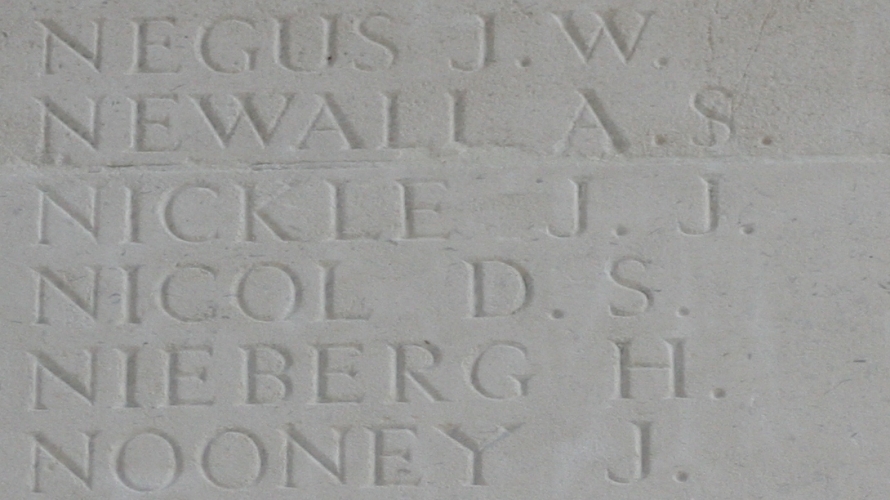
- Commemorated at: Thiepval Memorial
Panel Ref: P&F1D8B &8 C.
Arthur Sydney Newall was born on 10th November 1890 at Cuddington, Cheshire, the son of Frederick Newall and his wife Laura (née Horner) who were married on the 12th November 1887 at Christ Church, Salford. Frederick was a 29 year old blacksmith of Weaverham, father Joseph a blacksmith, whilst Laura was aged 23 of 4 Park Place, father William a cheese factor. He was baptised on 15th July 1891 in Weaverham. Their first child, Beatrice, was born in Broughton Park, after which his parents moved to Cuddington in Cheshire, where Nancy May, Arthur, and Dorothy were born.
At the time of the 1891 Census they are living in one of the Cottages in Tarporley Road, Cuddington, with three children. His father is a blacksmith aged 33, his mother is 27, Beatrice 3, Nancy 1, and Arthur 4 months old. They also have a servant Nancy Ragan aged 17.
The 1901 Census shows the family living at Coopers Hollow, Cuddington, Northwich, Cheshire. His father, Frederick, is aged 43, born in Cuddington, Northwich in 1858 occupation shown as a blacksmith, his mother, Laura, is aged 37, born in Liverpool in 1864 with no occupation listed. They had four children listed as living in the household; Beatrice Ruby aged 13, born 1888 in Manchester, Nancy May aged 11, born 1890, Arthur Sydney aged 10, and Dorothy aged 8, born 1893 were all born in Cuddington.
The 1911 census shows that Arthur, now 19, has moved to Liverpool and is boarding at 44 Royston Street, Edge Hill, employed as a grocer’s assistant. His parents and sisters live in Chester Road, Sandiway, Northwich. His father, 53, is now retired, his mother, 47, works as a dressmaker. They advised that they had been married for 24 years, and had 4 children. Three of their children are in the household; 23-year old Beatrice has no occupation, and Nancy, 21, and Dorothy, 18, are assistant dressmakers.
He enlisted in Liverpool on 15th November 1914 as Private 22189, joining the 20th Battalion of The King’s Liverpool Regiment. His age is recorded as 25 years and 4 days (in fact he had just turned 24), and he gives his occupation as grocer. He was described as being 5’ 3 and three quarter inches tall, weighing 130 lbs, 35” chest, with a sallow complexion, brown hair and blue eyes. He stated his religion as C of E and and next of kin his father Frederick, Lomond, Sandiway. He also stated that he had lived out of his father’s house for at least three years.
Formed in November 1914 the 20th Battalion were originally billeted at Tournament Hall, Knotty Ash before on 29th January 1915 they moved to the hutted accommodation purposely built at Lord Derby’s estate at Knowsley Hall. On 30th April 1915 the 20th Battalion alongside the other three Pals battalions left Liverpool via Prescot Station for further training at Belton Park, Grantham. They remained here until September 1915 when they reached Larkhill Camp on Salisbury Plain.
His service record exists and shows -
07/11/1915 arrived in France
09/05/1916 wounded in the left hand
02/07/1916 appointed paid Lance Corporal
The Liverpool Daily Post on Friday 02 June 1916 listed him amongst the wounded:
Wounded.
King’s (Liverpools) - Newall, 22188, A. S. (Cheshire);
He was killed in action on the 30th July 1916, aged 25, at the village of Guillemont, France, during the Somme Offensive.
The 20th King’s Battalion Diary records:
“At 4.45am prompt the attack was launched. Unfortunately, a thick mist prevailed and it was impossible to see more than 10 yards ahead. This continued until about 6 o’clock when it lifted slightly, but it was still too hazy and impossible to see what was happening 100 yards ahead. This being so, it was not surprising to find that the attacking waves were experiencing great difficulty in maintaining connection.”
At 6am, Lt. RE Melly, No.1 Company, reported that his men had taken the German Maltz Horn trench.
At 6.30am, 2/Lt. CP Moore reported that he had 150 men, 4 Stokes Mortars and 2 Lewis Guns, but he was the only officer. He also said that due to the fog, both his “flanks were in the air” i.e. he was not in contact with neighbouring troops.
At 9.10am, Moore was still not in contact at his flanks, and now he had only 75 men, he had sent out 2 patrols and neither not returned. Later Moore established communication with the French on his right.
Around 10.00am, 2/Lt Musker reported that he had just over a company with him, but his left flank was suffering from German machine gun fire. Later he reported that he had over 30 casualties from the machine gun fire. His flanks were also “in the air”. No contact was made with this party until the remnants returned around 9.30pm, all runners sent were killed or missing. The War Diary states that this group had: ”held the ground won all day, and this permitted the consolidation of the ground won on the Maltz Horn ridge with little interference from the enemy”.
Relief for 20/Kings had been planned for 11.00pm, but it was 5.00am on the 31st July before it took place, ending a tragic day for the Liverpool Pals.
Casualties for 20th Battalion were 16 Officers and 357 Other Ranks
When darkness fell on the battlefield the 30th Division held a line from the railway on the eastern side of Trones Wood , southwards and including Arrow Head Copse, to east of Maltz Horn Farm. On this line the division was relieved by the 55th Division during the early hours of the 31st July.
The events of 30th July 1916 were regarded at the time as Liverpool’s blackest day. There follows an extract from The History of the 89th Brigade written by Brigadier General Ferdinand Stanley which gives an indication of the events of the day.
Guillemont
Well the hour to advance came, and of all bad luck in the world it was a thick fog; so thick that you couldn’t see more than about ten yards. It was next to impossible to delay the attack – it was much too big an operation- so forward they had to go. It will give some idea when I say that on one flank we had to go 1,750 yards over big rolling country. Everyone knows what it is like to cross enclosed country which you know really well in a fog and how easy it is to lose your way. Therefore, imagine these rolling hills, with no landmarks and absolutely unknown to anyone. Is it surprising that people lost their way and lost touch with those next to them? As a matter of fact, it was wonderful the way in which many men found their way right to the place we wanted to get to. But as a connected attack it was impossible.
The fog was intense it was practically impossible to keep direction and parties got split up. Owing to the heavy shelling all the Bosches had left their main trenches and were lying out in the open with snipers and machine guns in shell holes, so of course our fellows were the most easy prey.
It is so awfully sad now going about and finding so many splendid fellows gone.
Arthur was initially declared Missing. Part of a letter his mother wrote to Infantry Records in November 1916, enclosing a letter from an officer, survives -
“[…] If you could send me any particulars I should be grateful, if my son’s body was found and where buried if found. […] of Lieut. J. H. Worsley […] write me but as you see he gave no particulars, I trust you will be able to do so. He was my only son and gave up a good [position?] to join at the beginning of the war.”
(James Harrison Worsley from Birkdale enlisted on 01st September 1914 in the 17th Battalion K.L.R.. He was discharged to commission on 30th July 1915 and arrived in France as a 2nd Lieutenant with the 20th Bn. on the fateful day of 01/07/1916.)
Her appeal was forwarded to the War Office, who replied in December 1916:
“It is regretted that further enquiries cannot be made as the [circumstance?] of death contained in the letter forwarded […] is based only on hearsay, […] therefore not sufficiently definite. Lance Corporal Newall must for the present remain on the official list of Missing.”
One year later, in July 1917, his death was officially accepted as having occurred on or since 30th July 1916.
Arthur's body was not recovered or was subsequently lost as he has no known grave and is commemorated on the Thiepval Memorial.
The Thiepval Memorial, the Memorial to the Missing of the Somme, bears the names of more than 72,000 officers and men of the United Kingdom and South African forces who died in the Somme sector before 20 March 1918 and have no known grave. Over 90% of those commemorated died between July and November 1916.
On 01st August 1932 the Prince of Wales and the President of France inaugurated the Thiepval Memorial in Picardy. The inscription reads: “Here are recorded the names of officers and men of the British Armies who fell on the Somme battlefields between July 1915 and March 1918 but to whom the fortune of war denied the known and honoured burial given to their comrades in death.”
Arthur is also commemorated on the Weaverham War Memorial.
He earned his three medals.
His Army effects of £3 9s 2d and a War Gratuity of £7-10s went to his father. No pension card has been found, as Arthur was living independently, and/or his parents did not apply for a pension.
Probate, showing Arthur’s address as “Lomond”, Chester Road, Sandiway, was granted to his father in the amount of £96-3s-7d.
In 1919 his parents with Nancy and Dorothy are still at “Lomond”, and Beatrice, who is married, lives in Station Road, Weaverham.
In 1919 his parents with Nancy and Dorothy are still at “Lomond”, and Beatrice, who is married, lives in Station Road, Weaverham.
His mother died on the 16th April 1933, aged 69.
Probate:-
NEWALL Laura of Lomond, Chester Road, Sandiway, near Northwich Cheshire (wife of Frederick Newall) died 16 April 1933 Administration Chester 5 September to Beatrice Ruby Forster (wife of David Forster) and Nancy May Newall spinster. Effects £195 10s 9d.
On the 1939 register his father, now 82, lives at “Lomond” with daughter Nancy, 50.
His father died in 1950, at the age of 92.
We currently have no further information on Arthur Sydney Newall, If you have or know someone who may be able to add to the history of this soldier, please contact us.
Killed On This Day.
(108 Years this day)Tuesday 30th April 1918.
L/Cpl 29203 Valentine Alexander
26 years old
(108 Years this day)
Tuesday 30th April 1918.
Pte 27948 Joseph Atherton
26 years old
(108 Years this day)
Tuesday 30th April 1918.
Pte 51896 Richard Edward Banks
34 years old
(108 Years this day)
Tuesday 30th April 1918.
Pte 46630 Watson Bell
38 years old
(108 Years this day)
Tuesday 30th April 1918.
Lieut Roland Henry Brewerton
27 years old
(108 Years this day)
Tuesday 30th April 1918.
Pte 51708 Charles Norman Dod
21 years old
(108 Years this day)
Tuesday 30th April 1918.
L/Cpl 94246 Frank Emison
24 years old
(108 Years this day)
Tuesday 30th April 1918.
Pte 23056 John William Jones
27 years old
(108 Years this day)
Tuesday 30th April 1918.
Pte 49572 John Henry Leadbeater (MM)
27 years old
(108 Years this day)
Tuesday 30th April 1918.
Sgt 22462 James Lowe (MID)
25 years old
(108 Years this day)
Tuesday 30th April 1918.
Pte 51712 Edgar Domenico Murray
21 years old
(108 Years this day)
Tuesday 30th April 1918.
Pte 269899 Harry Pitts
21 years old
A total of 14 Pals were killed on this day. View All