
1885 - 1916

CPL David Wallace Crawford
1887 - 1916

Lce-Corpl John Joseph Nickle
1894 - 1916

Pte 17911 Morton Neill
1897 - 1916

Lieut Edward Stanley Ashcroft
1883 - 1918

2nd Lieut Norman Leopold Taylor
- Age: 26
- From: Glenmore, County Mayo
- Regiment: The King's (Liverpool Regiment) 19th Btn
- D.O.W Monday 18th September 1916
- Commemorated at: Bethune Town Cem
Panel Ref: III.K.41
Norman Leopold Taylor was born on 02nd July, 1890 in Glenmore, Ballina, County Mayo, the only child of Samuel Taylor and his wife Ann (nee Woodcock). His father was born in Antrim, Ireland, and his mother in Rotherham in Yorkshire. His parents married at Sheepscar, Leeds on 10th June 1889.
At the time of the 1901 census Norman, aged 10, is found in Gledhow Terrace, Leeds, with his maternal aunt Amy and her husband John Moore. His parents are living in Kilcolmen, King’s County, his father employed as a gamekeeper. Both parents are listed as Church of Ireland (Protestant).
Norman joined the Royal Irish Constabulary, as Constable 65181, appointment date 01st February 1910, and served in Bookeen station. His record shows that he joined from Leitrim. He is described as being 5’ 9 and a quarter inches tall
In 1911 “Con. N.L.T.”, age 20, born in Mayo, is found in the R.I.C. barracks at Bookeen, Kilconierin, Galway, occupation before enlistment shown as gamekeeper, like his father. His parents have moved to Rockville, Aughrim East, in County Roscommon. His father, 42, is still working as a gamekeeper, his mother is 44.
Con. N. L. Taylor appears as witness or complainant in a number of cases in Athenry, (5 miles north of Kilconierin) in 1913 and 1914.
At a recruiting rally held in Dublin in 1914 a call was made for 200 members of the R.I.C. to join the Irish Guards.
Norman’s name appeared in the list published in various Irish newspapers on 02nd January 1915 of 200 Constables of the R.I.C. selected as volunteers with the Irish Guards.
His R.I.C. record shows that his service ended on 30th December 1914, and he was Commissioned in the 16th (Reserve) Bn King’s Liverpool Regiment. His Medal Index Card gives his date of Commission as 06th August 1915. The 16th Bn. was formed in Hoylake in December 1914 as a Service battalion, part of Kitchener’s Fourth New Army, and became a Reserve battalion in April 1915.
The Dublin Daily Express reported on 04th November 1915:
“Recruits for Irish Guards - R.I.C. and D.M.P. Volunteers Leave Dublin: Eighty men of the Royal Irish Constabulary who have recently volunteered for service with the Irish Guards left the Depot, Phoenix Park, last night. Previous to their departure the men were paraded on the Barrack Square and inspected by Sir Neville Chamberlain [Inspector General of the R.I.C., who resigned in 1916 in the aftermath of the Easter Rising] who cordially shook hands with each man and wished him a safe return. Addressing the men subsequently, Sir Neville Chamberlain said that five hundred men of the R.I.C. had joined the Irish Guards up to the present and their careers had been very successful. […] Constable Norman Taylor, of Galway E.R. [East Riding], had received a commission and no less than 97 percent of the R.I.C. men who had joined the Irish Guards had been promoted non-commissioned officers. […] The Constabulary men, who were accompanied by several volunteers from the Dublin Metropolitan Police, marched via the northern quays to the North Wall, accompanied by the bands of the R.I.C., D.M.P., and 10th Cavalry Reserve Regiment. They were heartily cheered at different points along the route.”
Norman served previously with the Irish Guards as Corporal 6305 and joined as Second Lieutenant in the 19th Battalion, The King’s Liverpool Regiment. He was fatally wounded on 13th September 1916.
During that period the Battalion was stationed in billets at Le Hamel, on the Givenchy Sector, Northern France. As the billets were just behind the front line, the troops were being used for fatiques and work party details. On the night of 12/13th September, a raiding party was sent out to try and identify the German unit holding the line opposite. During the course of this raid, the party was discovered, and a engagement took place. Although casualties were inflicted on the enemy, the purpose of the raid was not accomplished and the raiding party also suffered casualties. One officer and two other ranks were also killed, and Second-Lieutenant N L Taylor and three other ranks were also wounded.
Norman was evacuated to Bethune, but his wounds were too severe for him to be saved and he died five days later, on 18th September 1916. He was aged twenty six.
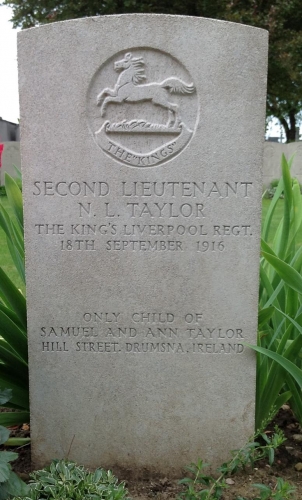
He now rests at Bethune Town Cemetery, Pas De Calais, France in Plot 3, Row K, Grave 41 where his headstone bears the epitaph:
“ONLY CHILD OF SAMUEL AND ANN TAYLOR, HILL STREET, DRUMSNA, IRELAND”
For much of the First World War, Bethune was comparatively free from bombardment and remained an important railway and hospital centre, as well as a corps and divisional headquarters. The 33rd Casualty Clearing Station was in the town until December 1917. Early in 1918, Bethune began to suffer from constant shell fire and in April 1918, German forces reached Locon, five kilometres to the north. The bombardment of 21 May did great damage to the town and it was not till October that pressure from the Germans was relaxed.
Bethune Town Cemetery contains 3,004 Commonwealth burials of the First World War,11 being unidentified. This includes 26 men of the 1/8th Manchester Regiment who were killed by a bomb on 22 December 1917 while marching to rest billets. Second World War burials number 19, 2 being unidentified. There are also 122 French and 87 German war graves, 38 of the German burials are unidentified.
The Commonwealth section of the cemetery was designed by Sir Edwin Lutyens.
His headstone does not bear the Eagle and Child of the Pals Battalions, but the White Horse of Hanover worn by the Regular and some Territorial Battalions of the King’s Liverpool Regiment Unusually the stone does not bear a Christian cross either.
His death was reported in the Irish Times;
In Memoriam. Taylor-
In sad and loving memory of Second Lieutenant Norman L Taylor, King's (Liverpool) Regiment, who died of wounds received in action September 18th, 1916, only child of Mr and Mrs Taylor, Hill Street, Drumsna, County Roscommon.
'I will hear his voice in the Lamb's new song. His steps in the courts of gold. And the same sweet smile of his glorified face. Will speak of my boy of old.'
Probate, giving Norman’s address as “late of Toomore, Hillstreet”, to father Samuel Taylor, farmer, in the amount of £275-18s-7d.
After the war, his mother was awarded a City Battalions Comfort Fund gold badge comprising the crest of the Earl of Derby, the eagle and child, motto on ribbon below "Sans Changer", with four clasps above, reading upwards and dating respectively, 1918, 1917, 1916 and 1915, with its original top brooch suspender bearing the legend "City Battalions Comforts Fund", reverse of badge hallmarked for 9 carat gold.
The City Battalions Comforts Fund was formed in November 1915, its president being Alice, Lady Derby, and its chairman, Alexandra Stanley, the wife of Brigadier General Stanley, commanding officer of the 89th Brigade. Brigadier General Stanley, in his History of the 89th Brigade, was full of praise for the work carried out during the war by the Comforts Fund committee, providing an extensive, itemised list of the vast number of items supplied by the committee to the men of the City Battalions. Amounting to over 250,000 individual items, these included over 29,000 pairs of socks, 6,444 pair of mittens, 10,800 Tommy's Cookers, cases of candles to the weight of some 29,616 pounds, 52,044 newspapers and magazines, 1,683 pounds of cake, 1,860 mouth organs and whistles, etc. Brigadier General Stanley also records the decision taken at Christmas 1917 to give "each of the members of the Committee a little reproduction of our badge in gold, with bars for each year of service in which they have been connected with the City Battalions Comforts Fund".
The badge came in a black velvet white silk-lined case, (Lord Derby’s racing colors), interior of lid with printed inscription "From the Officers, N.C.O.'S and Men of The Four City Battalions King's Liverpool Regt., in grateful recognition of the work she has done for their welfare, January 1918", the exterior of the lid impressed with the name of the recipient, "Mrs A. Taylor", in gilt. (Information from military-medals-online.com)
The badge was found for sale online for £1,850, together with photocopies of various family records (marriage, censuses, etc.).
Norman Leopold Taylor is commemorated on the following Memorials:
Royal Irish Constabulary
Dublin Metropolitan Constabulary
Ireland's National Roll of Honour.
We currently have no further information on Norman Leopold Taylor, If you have or know someone who may be able to add to the history of this soldier, please contact us.
Killed On This Day.
(108 Years this day)Sunday 16th June 1918.
Pte 57615 Fred William Preddy
23 years old
(105 Years this day)
Thursday 16th June 1921.
Captain Leonard George Duncan
43 years old