
1885 - 1916

CPL David Wallace Crawford
1887 - 1916

Lce-Corpl John Joseph Nickle
1894 - 1916

Pte 17911 Morton Neill
1897 - 1916

Lieut Edward Stanley Ashcroft
1883 - 1918

Pte 21634 Frederick Thorp
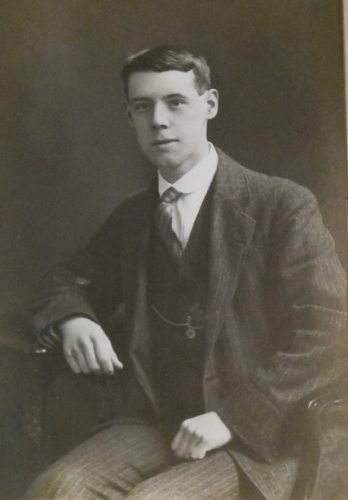
- Age: 31
- From: Southport, Lancs
- Regiment: The King's (Liverpool Regiment) 19th Btn
- K.I.A Sunday 30th July 1916
- Commemorated at: Thiepval Memorial
Panel Ref: P&F1D8B &8 C.
Frederick was born in Southport on the 29th March 1885 the only son of Edward Thorp and his wife Elizabeth Ann (nee Blundell). His parents married in 1882 presumably at the Methodist Church, and Frederick was their only child. He was baptised on the 17th May 1885 at the Wesley Methodist Church, Southbank Road, Southport.
At the time of the 1891 census the family is found at 87 Southbank Road, where they remain all their lives. The house is semi-detached, next door to the church the family attended, the Southbank Road Wesleyan Methodist. His father, 44, is a confectioner and restaurant keeper, his mother is 37, Frederick is 6 years old.
His father was a well known Magistrate in Southport. A biography of Edward Thorp in the local newspaper in 1906 on the occasion of his being appointed Magistrate detailed his family’s business history. His mother started Thorp’s restaurant in 1861 in Nevill Street, off the Promenade. The restaurant was famous for generations and in 1892, at that time owned by his father and uncle John, Thorp’s became a limited company, when the brothers retired. (The premises were more recently occupied by Leo’s Bar.)
The 1901 Census shows the family are living at 87 Southbank Road, Southport. His father, Edward, is the head of the household, born at Almondbury, near Huddersfield, Yorkshire in 1847 he is a retired confectioner, whilst his mother was born in Southport in 1854. Frederick is 16 years of age.
The family are at the same address at the time of the 1911 Census. Both parents are resident in the household, his father is 64, a retired confectioner and restaurant keeper, his mother is 57. They advise that they have been married for 28 years and have had 1 child. Frederick now aged 26 is an architectural draughtsman.
Frederick was educated at Bickerton House School, Birkdale and at Liverpool University where he took his BA degree in 1905 and his MA in 1908 specialising in Architecture and Mathematics. He was an Architect by profession and on the staff of the Borough Engineer, Mr A E Jackson and had previously been with the West Derby Union, Mr Edmund Rathbone of Liverpool and Mr Goodwin S Packer of Southport. He held the Diploma of Royal Institute of British Architects for competitive work, and he had passed all but the final examination for his A. R. I. B. A.
He was an official of Southbank Road Wesleyan Church, and a prominent member of the Wesley Guild. He was also well known in local Esperantists circles as well as Debating Societies and was keen on boating, swimming and football.
He enlisted at St George's Hall, in Liverpool on 04th September 1914 joining the 19th Battalion, (No 4 Company), The King’s Liverpool Regiment as Private No 21634. He gave his age as 29 years and 160 days and his occupation as an architect. He was described as being nearly five feet eight inches tall, weighed 130 lbs, with a 35” chest, a sallow complexion, hazel eyes and brown hair. He stated his religion as Wesleyan. His next of kin was his father Edward, 65 Southbank Road.
Formed on 07th September 1914 the 19th Battalion trained locally at Sefton Park and remained living at home or in rented accommodation until November 1914. They then moved to the hutted accommodation at Lord Derby’s estate at Knowsley Hall. On 30th April 1915 the 19th Battalion alongside the other three Pals battalions left Liverpool via Prescot Station for further training at Belton Park, Grantham. They remained here until September 1915 when they reached Larkhill Camp on Salisbury Plain. He arrived in France on 7th November 1915.
His service record shows:
06.2.16 - Sick, to 98 F.A.
08.2.16 - Bron. Cat, admitted to 3 Amb. Flotilla (barges located along the Somme at Chipilly).
17.2.16 - discharged to unit.
21.2.16 - Influenza, to 98 F.A.
22.2.16 - Influenza, to 21 C.C.S.
25.2.16 - Myalgia(muscle pain), to 1 Gen. Hosp, Étretat.
02.3.16 - Transferred to Convalescent D. Home, Havre.
08.3.16 - Discharged to 30 I.B.D., Etaples.
27.3.16 - Proceeded to unit.
Frederick was killed in action on the 30th July 1916, aged 31, at the village of Guillemont, France, during the Somme Offensive.
19th Battalion Diary 30th July 1916
MALTZ HORN FARM
BATTLE begun. ZERO hour 4:45 am. The Battalion reached its objective, but suffered heavy losses, and had to evacuate its position owing to no reinforcements.
Everard Wyrall gives details of the attack in his book The History of The King’s Regiment;
"The 2nd Attack on Guillemont- 29th July 1916 the 89th Brigade the 20th King's were to attack on the right and the 19th on the left. During the evening of the 29th the night was dark and foggy when the Battalions moved off and the 19th with Lt Col G Rollo commanding, when passing the South east of the Briqueterie they were heavily shelled first with H E and then with a new kind of asphyxiating Gas shell which had curious results, at first it had no nasty effect but about 8 hrs later men began to fall sick with violent headaches and pains in the stomach. All ranks had to wear gas masks which in the darkness and mist made the going terribly difficult. It was indeed wonderful that they were able to reach their Assembly point at all. But they did and by 2.45 a.m. on the 30th July 1916 the Btn was assembled having suffered about 30 Casualties on the way up ready for the Zero hour at 4.45 a.m.
It is known that the two left Companies of the 19th under Capt. Dodd and Capt. Nicholson advanced in touch with the 2nd Royal Scots Fusiliers on their left although they suffered many casualties from Machine gun Fire did not encounter many Germans and reached their final objective about the time allocated, beginning at once to dig in south of the orchard on the South east corner of Guillemont.
On the left of the 19th the Scots Fusiliers most gallantly forced their way through Guillemont to the eastern side of the village but were soon overwhelmed by the enemy and few returned.
At 8 a.m. finding that the village was not held the two left Companies of the 19th received no word from the rear or either flank believed themselves to be totally isolated so were forced to fall back and dig in, their position being untenable.
At midday the effective fighting strength of the 19th Btn was just 7 Officers and 43 other ranks"
When darkness fell on the battlefield the 30th Division held a line from the railway on the eastern side of Trones Wood , southwards and including Arrow Head Copse, to east of Maltz Horn Farm. On this line the division was relieved by the 55th Division during the early hours of the 31st July.
Casualties in the 19th Battalion were 11 Officers and 435 Other Ranks
The events of 30th July 1916 were regarded at the time as Liverpool’s blackest day. There follows an extract from The History of the 89th Brigade written by Brigadier General Ferdinand Stanley which gives an indication of the events of the day.
Guillemont
Well the hour to advance came, and of all bad luck in the world it was a thick fog; so thick that you couldn’t see more than about ten yards. It was next to impossible to delay the attack – it was much too big an operation- so forward they had to go. It will give some idea when I say that on one flank we had to go 1,750 yards over big rolling country. Everyone knows what it is like to cross enclosed country which you know really well in a fog and how easy it is to lose your way. Therefore, imagine these rolling hills, with no landmarks and absolutely unknown to anyone. Is it surprising that people lost their way and lost touch with those next to them? As a matter of fact, it was wonderful the way in which many men found their way right to the place we wanted to get to. But as a connected attack it was impossible.
The fog was intense it was practically impossible to keep direction and parties got split up. Owing to the heavy shelling all the Bosches had left their main trenches and were lying out in the open with snipers and machine guns in shell holes, so of course our fellows were the most easy prey.
It is so awfully sad now going about and finding so many splendid fellows gone.
Originally posted as Missing, his parents placed an appeal for information in the Liverpool Echo on 04th September 1916:
"Mr. and Mrs. Edward Thorp, Southport, have been officially informed that Private Frederick Thorp, their only son, was posted as missing after the action of July 30. Private Thorp joined The King's (Liverpool Regiment) in September, 1914, and had been ten months in France. He had seen much heavy fighting, having been in the British advance from July 1. By profession an architect, he had been for some years on the staff the Southport borough engineer (Mr. A. E. Jackson, A.M.I.C.E.). Any information regarding Private Frederick Thorp will gratefully received by his parents 87, Southbank-road, Southport."
His father contacted the International Red Cross in Geneva in hopes that Frederick had been taken prisoner, but was informed in a reply dated 21st September 1916 that they held no information on Frederick.
His father wrote to the Record Office, Rouen on the 19th October 1916:-
21864 Pte Frederick Thorp, 8 Detachment, MG Section, 4 Coy, 19/KLR
Gentleman, the above named soldier, our only son, has been officially reported as “missing” after the action of July 30 1916. Since receiving this report we have heard nothing, and being aware you have special facilities for tracing these sad cases, we now venture to ask you to help us in this direction assuring you that we shall be deeply grateful if you can obtain any information as to our son’s fate, and especially as to whether he has been taken prisoner by the Germans. A comrade states that he was wounded, and that he was seen lying in a shell hole within 20 yards of a German trench, and was apparently alive. The Germans remained in possession of the ground for many days afterwards, and when it was eventually taken by the British, it does not appear that the slightest trace of our son was found. I enclose photograph of our missing boy, and need hardly say that anything that you can do to relieve our anxiety will be keenly appreciated.
Very faithfully yours,
Edward Thorp J.P.
Another enquiry was made by a Miss Acton (relationship unknown), writing from the Hôtel Monney in Montreux, Switzerland, and received the same response dated 28th October 1916.
A subsequent enquiry by his father, giving as contact his home address, 87 Southbank Road or Paleis Kneuterdyk 20, Haag, also received a negative response on 03rd November 1916. Kneuterdyk (Kneuterdijk) is name of the royal palace in The Hague. Kneuterdijk Palace was used as a Red Cross office during the war. An entry on this POW card notes, “Written to prisoner in [illeg.] camp 23-4-17”, but it is not certain what this refers to. It is possible his father obtained the name of a fellow POW, from a notice placed in the newspaper -
In the Liverpool Echo on 14th November 1916:
“Will relatives of any men of the K.L.R. posted as missing since July 1, and now known to be prisoners of war in Germany, communicate with Mr. Thorp, 87 Southbank Road, Southport, who is striving to trace his son.”
Frederick's death was subsequently reported in the local press:
"Pte Thorp was a member of the Machine Gun Section, was posted as missing after a engagement near Guillemont on the Somme on 30th July 1916. He was a machine Gunner, and in the action of the 30th was wounded during an attack on the German second line trenches, after his Battalion had captured the first line trenches in a brilliant dash, and he fell almost on top of the German parapet, as he was somewhat in advance of his own gun team. From that point nothing is known as to his fate, as he was never seen again, and his body was never found. He joined the Liverpool Pals in September 1914 and had been at the front about ten months. He had taken part in much heavy fighting, having been in the British advance since 1st July 1916".
Frederick's body was not recovered from the battlefield or was subsequently lost as he has no known grave and is commemorated on the Thiepval Memorial.
The Thiepval Memorial, the Memorial to the Missing of the Somme, bears the names of more than 72,000 officers and men of the United Kingdom and South African forces who died in the Somme sector before 20 March 1918 and have no known grave. Over 90% of those commemorated died between July and November 1916.
On 01st August 1932 the Prince of Wales and the President of France inaugurated the Thiepval Memorial in Picardy. The inscription reads: “Here are recorded the names of officers and men of the British Armies who fell on the Somme battlefields between July 1915 and March 1918 but to whom the fortune of war denied the known and honoured burial given to their comrades in death.”
Probate 1919:-
THORP Frederick of 87 Southbank Road, Southport Lancashire architect master of arts private 19th battalion King’s Liverpool regiment died 30 July 1916 in France Probate Liverpool 9 April to Osborne Moorhouse Thorp architect and Henry Horsfall Lord stationer. Effects £674 2s.
His father received his pair of field glasses on the 23rd May 1919, his 15 Star on the 31st May 1919, and the War and Victory on 04th November 1921.
Frederick is commemorated on the following Memorials;
Liverpool University
The Monument, Southport
Hightown Club WW1 Roll of Honour
Liverpool’s Hall of Remembrance, Panel 38 Right
Southport Town Hall, NALGO i and ii (National and Local Government Officers' Association)
Southbank Road Wesleyan Methodist … where a framed photograph of Frederick stands in the window, with the inscription,
“FREDERICK THORP. M.A. attached to this Church and Sunday School through life. He died in action for King and Country, in France, during the Great War.”
His father died a wealthy man on the 14th May 1936, aged 89.
Probate 1936:-
THORP Edward of 87 Southbank Road, Southport Lancashire died 14 May 1936 at 128 Manchester Road, Southport Probate Liverpool 24 June to Norman Douglas Thorp methodist minister and Ernest Thorp pharmaceutical chemist. Effects £11,654 5s 11d.
His death was reported in the Liverpool Evening Express on Friday 15 May 1936:
SOUTHPORT’S OLDEST MAGISTRATE
DEATH OF MR EDWARD THORP
Southport’s oldest magistrate, Mr Edward Thorp, of Southbank-road, died in a local nursing home today. Mr Thorp was 89 years of age. He was a Liberal member of the Southport town council from 1898 to 1907, and in 1903 acted as deputy-Mayor. He was a member of the Executive and vice-president of the Southport Liberal Association for many years. In his early days he was engaged in the woollen cloth manufacturing business, but on coming to Southport was partner of a catering firm. He was made a magistrate in 1906. In December, 1932, he celebrated his golden wedding and is survived by wife. Mr Thorp was a prominent Methodist and belonged to the Southbank-road Church. His only son was killed in the war.
In 1939 his mother is still living at 87 Southbank Road. She is 86, living on private means, and has a housekeeper.
She died on the 18th November 1943, at the age of 90.
The family grave at Duke Street Cemetery reads:-
In Loving Remembrance Of
EDWARD THORP J.P.
Who passed away on May 14th 1936,
In his 90th year.
A friend of all, he was fearless in defending the right,
And a true and humble follower of his Lord.
“There everlasting spring abides and never withering ring flowers.”
Also Of His Beloved Wife
ELIZABETH ANN,
Died 18th November 1943,
Aged 90 Years.
We currently have no further information on Frederick Thorp, If you have or know someone who may be able to add to the history of this soldier, please contact us.
Killed On This Day.
(111 Years this day)Friday 6th August 1915.
2nd Lieutenant Thomas Leslie McGeorge
26 years old
(110 Years this day)
Sunday 6th August 1916.
Pte 34960 Joseph Furness
21 years old
(110 Years this day)
Sunday 6th August 1916.
Pte 36640 John Faultus Jones
29 years old
(110 Years this day)
Sunday 6th August 1916.
Pte 24664 Harry Lloyd
28 years old
(110 Years this day)
Sunday 6th August 1916.
Pte 26153 William Duncalf
41 years old