
1885 - 1916

CPL David Wallace Crawford
1887 - 1916

Lce-Corpl John Joseph Nickle
1894 - 1916

Pte 17911 Morton Neill
1897 - 1916

Lieut Edward Stanley Ashcroft
1883 - 1918

Pte 16848 William James Truby
- Age: 22
- From: Liverpool
- Regiment: The King's (Liverpool Regiment) 18th Btn
- D.O.W Thursday 13th July 1916
- Commemorated at: Heilly Station Cem, Mericourt
Panel Ref: II.B.23
William James Truby was born on the 23rd October 1893 at 7 Wainwright Street, Liverpool, the son of Thomas Charles and his wife Ellen Elizabeth (née Jones) who were married on the 04th September 1890 at St Nathaniel's Church, Edge Hill. Thomas was a 28 year old greengrocer of 199 Chatsworth Street, his father, Henry, was a grocer, whilst Ellen was aged 24 of 238 Smithdown Lane, her father, John, was a watchmaker. He was baptised on the 10th December 1893 in St Catherine's Church, Edge-Hill, Liverpool.
The 1901 Census shows the family living at 20 Wainwright Street, Liverpool. William is 7 years of age and is living with his parents, five siblings, his maternal grandfather and his aunt and uncle. His father, is a 38 year old oil and colour man born in Bicester, Oxfordshire, whilst his mother is aged 34 and was born in Liverpool. His siblings are listed as: Bertha E., isaged 9, Thomas C., is aged 8, Robert A., is aged 6, Eliza G. is aged 3, and George, is aged 1. His grandfather is John Jones a 61 year old widower shown as a labourer. His aunt and uncle are Eliza Jones a 21 year old fruiterer's assistant and George Jones a 23 year old carter.
By 1911 the family are still resident at 20 Wainwright Street, William is now 17 years of age and is employed as a clerk for an ink manufacturer. Both parents are resident as are 6 siblings and his uncle George. His father, is aged 48, a dock watchman, his mother, Helen, is aged 44, and they advise that they have been married for 20 years and seven of their eight children have survived. William's siblings listed at the property are; Bertha Esther aged 19, Thomas Charles, is aged 18, and is a clerk for an oil cake manufacturer, Robert Arthur , is aged16, and is a book binder's messenger, Dora Elizabeth, is aged 13, George Percival, is aged 11 and Lilian Helen, is aged 6.
William enlisted at St George's Hall in Liverpool on the 02nd September 1914, joining the 18th Battalion of The King's Liverpool Regiment as Private 16848. His enlistment papers show his age as 20 years and 313 days and his occupation as a clerk. He was described as being five feet six inches tall, weighing 113lbs, with a 34” chest, with a fresh complexion, grey eyes and brown hair and stated his religion as Presbyterian and as his next of kin, was his father, Thomas, of 166 Tunnel Road.
From the 23rd September 1914 he was billeted at Hooton Park Race Course and remained there until 03rd December 1914 when they moved into the hutted accommodation at Lord Derby’s estate at Knowsley Hall. On 30th April 1915 the 18th Battalion alongside the other three Pals battalions left Liverpool via Prescot Station for further training at Belton Park, Grantham. They remained here until September 1915 when they reached Larkhill Camp on Salisbury Plain.
He specialised in training as a bomber and crossed to France with his Battalion on board the SS Invicta, on the 07th November 1915. He was attached to 30 Division Grenade School between 18th and 30th April 1916 and was granted leave to the UK between 8th and 18th June.
In the attack at Montauban on the 01st July 1916, William who was a member of 12 Platoon, 3 Company was hit in the head by shrapnel and admitted to 21 Field Ambulance. He was subsequently transferred to 36 Casualty Clearing Station (Heilly) where too ill to be moved to a Base Hospital, he died of his wounds on the 13th July.
18th Battalion Diary for the attack at Montauban during which William was wounded:
At 6.30am the artillery commenced an intensive bombardment of the enemy’s trenches. Zero Hour – 7.30 am – the battalion commenced to leave their trenches and the attack commenced. The attack was pressed with great spirit and determination in spite of heavy shelling and machine gun enfilade fire which caused casualties amounting to 2/3rds of the strength of the Battalion in action. The whole system of German trenches including the Glatz Redoubt was captured without any deviation from the scheduled programme. Consolidated positions and made strong points for defence against possible counter attacks.
Graham Maddocks provides more detail concerning the events of the day:
As the first three waves began to move forward towards the German reserve line, known as Alt Trench and then on to the Glatz Redoubt itself, they suddenly came under enfilading fire from the left. This was from a machine gun which the Germans had sited at a strong point in Alt Trench. The gun itself was protected by a party of snipers and bombers, who, hidden in a rough hedge, were dug into a position in Alt Trench, at its junction with a communication trench known as Alt Alley. These bombers and snipers were themselves protected by rifle fire from another communication trench, Train Alley which snaked back up the high ground and into Montauban itself. The machine gun fire was devastating and it is certain that nearly of the Battalion’s casualties that day were caused by that one gun.
Lieutenant Colonel Edward Henry Trotter wrote in the conclusion of his account of the days action:
I cannot speak to highly of the gallantry of the Officers and men. The men amply repaid the care and kindness of their Company Officers, who have always tried to lead and not to drive. As laid down in my first lecture to the Battalion when formed, in the words of Prince Kraft:
“Men follow their Officers not from fear, but from love of the Regiment where everything had always and at all times gone well with them”.
Joe Devereux in his book A Singular Day on the Somme gives the Casualty Breakdown for the 18th Battalion as Killed in Action 7 Officers and 165 men and of those who died in consequence of the wounds 3 Officers and 19 men a total of 194 out of a total loss for the four Liverpool Pals Battalions of 257.
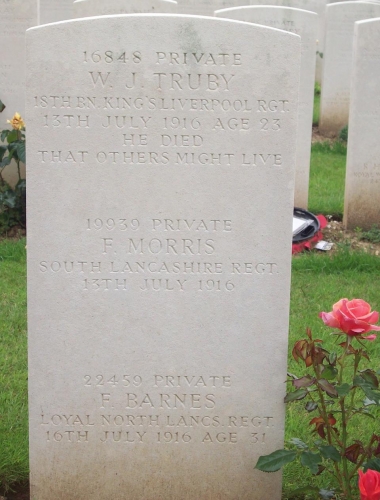
William now rests at Heilly Station, Cemetery, Mericourt, L'Abbe, France, where his headstone bears the epitaph:
"HE DIED THAT OTHERS MIGHT LIVE"
The 36th Casualty Clearing Station was at Heilly from April 1916. It was joined in May by the 38th, and in July by the 2/2nd London, but these hospitals had all moved on by early June 1917. The cemetery was begun in May 1916 and was used by the three medical units until April 1917. From March to May 1918, it was used by Australian units, and in the early autumn for further hospital burials when the 20th Casualty Clearing Station was there briefly in August and September 1918. The last burial was made in May 1919. There are now 2,890 Commonwealth servicemen of the First World War buried or commemorated in this cemetery. Only 12 of the burials are unidentified and special memorials are erected to 21 casualties whose graves in the cemetery could not be exactly located. The cemetery also contains 83 German graves. The burials in this cemetery were carried out under extreme pressure and many of the graves are either too close together to be marked individually, or they contain multiple burials. Some headstones carry as many as three sets of casualty details, and in these cases, regimental badges have had to be omitted. Instead, these badges, 117 in all, have been carved on a cloister wall on the north side of the cemetery. The cemetery was designed by Sir Edwin Lutyens.
On July 14th 1916 his father wrote a letter asking for confirmation of his son's death as his mother, being in bad health was very anxious and troubled. (another letter sent again on 23rd July).
William was reported wounded in Liverpool Daily Post on 01st August 1916.
His death was reported in the Liverpool Echo on the 16th August 1916
FAVOURITE WITH THE PLATOON
Private William Truby, 22, of the "Pals", second son of Mr and Mrs Truby, 166 Tunnel Road, Liverpool, died of wounds. He was in the employ of T. Webster and Co, Tariff Street. A comrade writes:- "He was admired by the whole Platoon, both for his generosity and sportsmanship."
Soldiers Effects to his father Thomas Charles and pension to his mother Ellen Elizabeth.
On the first anniversary of his death, in the Liverpool Daily Post on Friday 13th July 1917;
TRUBY - In memory of my old pal, Will Truby, King's (Liverpool Regiment), who died of wounds received in action. Ever remembered by W. Hilton, 72nd Canadian Highlanders. (In cherished memory of other days.)
TRUBY - In affectionate remembrance of our dear nephew Willie (Pals), who died of wounds July 13, 1916. (Fondly remembered by Aunt Bertha, Uncle, and Cousin Gwen, Harrow.)
TRUBY - In loving memory of our dear son Willie (Pals), who died of wounds July 13, 1916, aged 22 years.
Peaceful as a bed of roses
Is the grave of him who falls;
Blest in death his soul reposes
Who dies where honour calls.
(Sadly missed by his Mother, Father, Sisters, and Brothers.)
TRUBY - In loving memory of our dear brother Willie (Pals), who died of wounds July 13. 1916. (One of the best.) Sadly missed by Bertha, Charlie, and Robert (in France).
William is also commemorated on the war memorial in Earle Road United Reform Church, Earle Road, Liverpool.
His brother Robert Arthur Truby served as a Private (No 5673/356947) with the 10th [Territorial] Battalion King's (Liverpool) Regiment [Liverpool Scottish] during the war.
He earned his three medals.
Soldiers Effects, Army Pay of £3, 2s, 1d and £8 10s War Gratuity went to his father Thomas Charles, and pension to his mother Ellen Elizabeth.
On the 1921 Census at Tunnel Road, his father, is aged 58, an oil colourman, his mother, Ellen, is aged 55, with Bertha, aged 30, Thomas, aged 28, Robert, aged 26, Dora, aged 23, George, aged 21, Lillian, aged 16, and Ellen’s brother George Owen Jones, aged 44.
His father died in hospital, aged 73, in 1933.
His death was reported in the Liverpool Daily Post on Tuesday 12th December 1933;
TRUBY – December 8, in hospital, CHARLES. beloved husband of Ellen Truby, 166, Tunnel-road. Interment at Allerton Cemetery, to-day (Tuesday), at 3.30 p.m.
His mother died, aged 75, in 1941.
Her death was reported in the Liverpool Daily Post on Saturday 15th November 1941;
TRUBY - Nov. 12, aged 75 years, ELLEN ELIZABETH, 166 Tunnel Road, dearly-loved wife of the late Thomas Charles Truby and a beloved mother and sister. Service at Earle Road Presbyterian Church, to-day (Saturday), at 11 a.m.; interment following at Allerton Cemetery.
We currently have no further information on William James Truby, If you have or know someone who may be able to add to the history of this soldier, please contact us.
Killed On This Day.
(110 Years this day)Saturday 5th August 1916.
2nd Lieut Richard Norman Butcher
26 years old
(110 Years this day)
Saturday 5th August 1916.
Cpl 26558 Frederick Joseph Circuit
26 years old
(110 Years this day)
Saturday 5th August 1916.
Pte 16042 Albert Jones Holliday
20 years old
(110 Years this day)
Saturday 5th August 1916.
Pte 22845 Herbert John Smith
23 years old
(109 Years this day)
Sunday 5th August 1917.
Pte 57787 Henry Ferguson Garnham
19 years old
(109 Years this day)
Sunday 5th August 1917.
Pte 204777 George Johnston
27 years old
(109 Years this day)
Sunday 5th August 1917.
Pte 202865 Robert Swift
31 years old
(109 Years this day)
Sunday 5th August 1917.
Pte 50174 John Wilkinson
39 years old