
1885 - 1916

CPL David Wallace Crawford
1887 - 1916

Lce-Corpl John Joseph Nickle
1894 - 1916

Pte 17911 Morton Neill
1897 - 1916

Lieut Edward Stanley Ashcroft
1883 - 1918

Pte 15412 Percival Joseph Tucker
- Age: 30
- From: Liverpool
- Regiment: The King's (Liverpool Regiment) 17th Btn
- K.I.A Saturday 1st July 1916
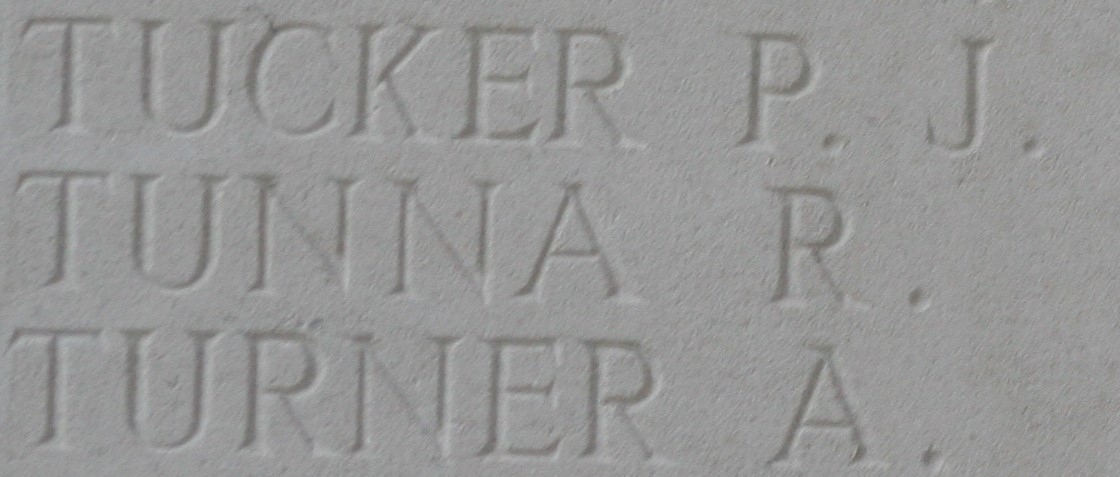
- Commemorated at: Thiepval Memorial
Panel Ref: P&F1D8B &8 C.
Percival "Percy" Joseph Tucker was born at 2 Agnes Road, Liverpool on 15th December 1885, the son of John Burrows Tucker and his wife Elizabeth Mary (nee Siddorn). He was baptised in St Silas Church on 17th February 1886. This was the church where his parents, John Tucker and Elizabeth Siddorn, had been married on the 21st March 1876 also at St Silas, Pembroke Place, they both lived on Moon St. The Siddorns were a Liverpool family, but John Tucker was a sailor who originally came from Cornwall who worked as a boatswain for the Cunard Steamship Company.
Percy was the fifth of their six children, and Elizabeth often had to look after them single-handed when her husband was away at sea. Percy’s siblings were Edith, Henry, Ralph and Emily who were all older than him, and George who was his younger brother. The family moved around a good deal.
The 1881 census shows the family living in Everton.
Ten years later they were living at 21 Thomson Road, Litherland. Percival is 5 years of age and is living with both of his parents and five siblings. His father is now 42 years of age and is a mariner, born at Chyandour, Cornwall, whilst his mother is 38. His siblings are listed as: Edith M. aged 12, Henry E. aged 10, Ralph S. aged 7, Emily M. aged 6 and George W. S. aged 3.
His father, John, died aged 48, in 1896 and was buried on the 20th February at Anfield Cemetery.
By the time of the 1901 census the family were living at 30 Dyson Street in Walton.
Percy is 15 years of age and described as a ship brokers clerk. His mother is recorded as being 49 years of age and a widow living with four of her children. Percy's three siblings listed as living at home are; Edith M. a 22 year old seamstress, Ralph J. a 17 year old music salesman and Emily M. a 16 years old drapers book keeper.
Percy’s connection with Walton Church probably began when he moved to the property at Dyson Street. By the time of the census he was contributing to the family budget by working as a shipping clerk.
The family are still resident at 30 Dyson Street in the 1911 Census.
Percy is now 25 and a shipping clerk. His widowed mother now aged 59 is still in the household along with Percy's two older sisters, Edith Maud aged 32 and a seamstress and Emily Margueritte aged 26 and a book keeper in a general merchant's office. His widowed mother, Elizabeth, is recorded as being married for 35 years and having borne eight children with two of those sadly dying in infancy.
One further move came in 1913, since the address given for him in the parish magazine as secretary of the Guild of Communicants changes to Knocklaid Road in Clubmoor.
He was employed by Messrs. Gracie, Beazley and Company, ship and insurance brokers and forwarding agents of Water Street, Liverpool.
Percy enlisted at St George's Hall in Liverpool on the 01st September 1914 joining the 17th Battalion of The King's Liverpool Regiment as Private 15142. At the time of his enlistment he was living at "Holwen", Knoclaid Road, Clubmoor, Liverpool.
He was billeted at Prescot Watch Factory from 14th September 1914, he trained there and also at Knowsley Hall. On 30th April 1915 the 17th Battalion alongside the other three Pals battalions left Liverpool via Prescot Station for further training at Belton Park, Grantham. They remained here until September 1915 when they reached Larkhill Camp on Salisbury Plain.
Percy crossed to France with B Company of his Battalion on the 07th November 1915.
He was killed in action during the attack at Montauban on 01st July 1916. As with many men of the 17th Battalion who were killed on the 01st July 1916, he is officially listed as having died between 01-02/07/1916. He was 30 years of age.
The diary of the 17th Battalion on the day of the 1st July 1916 records:
3.30 am the Battalion in position in assembly trenches -Battalion frontage from Maricourt – Briqueterie Rd to 100 yards west of Maricourt – Montauban Rd – 1st wave, 2 platoons of A Company on the right and 2 platoons of B company on the left. 2nd wave remaining platoons of these companies. 3rd wave C Company and 4th wave D Company in parallel trenches at about 100 yards distance. 3rd Battalion 153rd French Infantry on our right and 20 KLR on our left. The Battalion’s objective was Dublin Trench from Dublin Redoubt exclusive to a point 400 yards west.
7.30 am – “Zero Hour”. The assault commenced, some shelling but very slight infantry resistance and little machine gun fire encountered, the work of our artillery having been very effective on the German trenches.
8.30 am – the objective was taken at 08.30 am the French on our right gaining their’s at the same hour. Lieutenant-Colonel B C Fairfax and Commandant Le Petit commanding 3rd Battalion 153rd Regiment arrived together in Dublin Trench. A and B Companies dug in almost 100 yards south of Dublin Trench which the Germans shelled intermittently all day hardly touching the new trench. Casualties up to 12 noon, Captain E C Torrey commanding C Company, Lt D H Scott commanding A Company and 2nd Lieutenant P L Wright wounded 100 other ranks. Later in the day the 90th Brigade took Montauban and the 20th KLR captured the Briqueterie. Lt Scott died of wounds in a French hospital at Cerisy where Captain Mirascou commanding the left Company of the French also lay wounded. Perfect liaison existed between the French and ourselves the above two officers commanding respectively our right Company and the French left Company being in constant touch. Shortly after the attack commenced the Battalion Headquarters moved to a German dugout in Favieres Support under Briqueterie Road where Commandant Le Petit also established his H.Q. During the remainder of the day there was intermittent bombardment of Dublin and Casement and Favieres Support trenches. Rations were brought up safely at night. Disposition of the Battalion – 2 Companies in Dublin and 2 in Casement.
Percy has no known grave and is commemorated on the Thiepval Memorial to the Missing of the Somme.
The Thiepval Memorial, the Memorial to the Missing of the Somme, bears the names of more than 72,000 officers and men of the United Kingdom and South African forces who died in the Somme sector before 20 March 1918 and have no known grave. Over 90% of those commemorated died between July and November 1916.
On 01st August 1932 the Prince of Wales and the President of France inaugurated the Thiepval Memorial in Picardy. The inscription reads: “Here are recorded the names of officers and men of the British Armies who fell on the Somme battlefields between July 1915 and March 1918 but to whom the fortune of war denied the known and honoured burial given to their comrades in death.”
His death was reported in the Liverpool Courier on 28th July 1916:
"Private Percival J.Tucker, Liverpool Pals, fourth son of the late John B. Tucker, of Clubmoor. He was formerly an official at Walton Parish Church"
His death was also reported in the Liverpool Daily Post on Friday 28th July 1916:
Private Percival J. Tucker (Percy), fourth son of the late Mr. John B. Tucker and of Mrs. Tucker, Clubmoor, has been killed in action. He joined the “Pals’ on their formation, and went to France in November last. For many years he was associated with Messrs. Gracie, Beazley, and Co., Water-street. He was an official at Walton Parish Church and conductor of Young Men's Bible Class, and at a memorial service on Sunday evening the Archdeacon of Liverpool bore testimony to his devoted labours. His chaplain at the Front wrote: “His coolness and steadiness under fire, and his cheerfulness commended his religion to all. A comrade wrote: “His moral support under shell fire was tremendous.”
His loss was deeply felt in the parish, as tributes in the parish magazine for August 1916 clearly show;
The death in Action of Percy J. Tucker is one of the bitterest blows the parish has recently sustained. As a layman he worked indefatigably and achieved the most encouraging results, and his striking personality will be sorely missed. Perhaps his influence is most traceable in the Young Men’s Bible Class, which he personally conducted with the greatest success for many years. With the late members of that Class he wielded a tremendous influence. Who of us who attended his addresses on those Sunday afternoons can ever forget his stirring eloquence and keen enthusiasm? The nobility of his nature and his deep spirituality were an example to us all. His willing sympathy, ready help and advice completely won the hearts of all who came in contact with him. He was one of the pioneers who did much to raise the parish to a higher standard of Churchmanship, and as Conductor of the Bible Class and Hon. Secretary of the Communicants’ Guild he greatly helped increase the number of regular communicants.
The author of this first tribute cannot be identified.
The second was written by the Rev. W. Dinsdale Young, who was the curate responsible for St Aidan’s Mission Church:
I write these notes under a sense of heavy loss. The one thought uppermost in our minds at this time is the passing of Percy Tucker. To some of us the news seems almost incredible. There must have been few in our parish who did not know him. To know him was to love him. It would take a good deal of space to write of all the work he did in this parish. His activities were indeed manifold. To my mind he represented the best type of Christian layman and Church worker. Let me say something of what St Aidan’s owes to Percy Tucker. The Children’s Service on Sunday mornings will always be associated with his name. It was he who founded and conducted it. He loved the children and the children loved him. The way he gathered them to the service was a striking testimony to his influence and attractiveness. As is well known, a Tea is given at St Aidan’s every New Year to some hundreds of poor children. This, too, owes its origins to Percy Tucker. His was a singularly winning character. He possessed that sure mark of a Christian – the sense of humour. His laugh was infectious. I seem to hear it as I write. I received a letter from him on June 25th. In it are the following words which have a pathetic interest now – “I saw your note in the Magazine re myself and enjoyed the same. When I do get home I hope you will let me come to S. Aidan’s on the first Sunday evening to tell the folks of our boys.” Alas! That will never be. But, “he, being dead, yet speaketh.” His life and work will be an abiding inspiration.
These two memorial notices give the best indication of Percy Tucker’s personality, and why he merits a lasting memorial in St Mary's Church, Walton on the Hill.
The magazines say nothing of his involvement at St Aidan’s, but we do learn that from May 1912 to April 1914 he was a sidesman at the Parish Church. In those days this not only involved the duties carried out by sidesmen at services today, but also carried with it membership of the Church Council. (Parochial Church Councils as we know them now were only established in every parish in the 1920s.) 1912, indeed, seems to be the year when he really came to the fore in parish life. He subscribed five shillings to the fund for a new altar frontal. (this was the second largest individual donation and would have represented a large part of a clerk’s pay.) From October he was secretary of the Guild of Communicants and by the end of the year he had become one of the secretaries of the Young Men’s Bible Class. From November 1913 he was also the treasurer of the Communicants’ Guild. In addition he was playing a leading role in the Walton Church Literary and Debating Society. In February the Society held a meeting where the speaker talked about the proposal to disestablish the Anglican Church in Wales that was currently before Parliament. A month later the Rector presided at “a mass meeting to protest against Welsh Disestablishment.” Percy was one of the joint secretaries for this meeting. Perhaps less controversially he read a paper entitled Recollections to the Literary Society in September 1913.
The last direct reference to anything done by Percy in the parish was a report of the Literary and Debating Society’s meeting on 6 November 1914, when a farewell presentation was made to the Rev. C. Wright who was getting married and moving to Formby. The notices for the Young Men’s Bible Class during December, however, report “the absence of Mr Percy Tucker in connection with his regiment – King’s Liverpool”.
In the magazine for May 1916 the Rev. Dinsdale Young quoted a letter he had received from Percy who claimed he “was never better” and talked about his experiences on the front line: “We occupied the trenches during January and February in fearful weather and had a terrible time. However we all – the Walton crush – stuck it well and came out all right.” This was what Percy was referring to when he asked Dinsdale Young to let him speak at St Aidan’s when he came home on leave.
Percy earned his three medals.
His army pay of £2 4s 4d and pension went to his mother Elizabeth, war gratuity of £8 10s went to his sister Emily Musker. A note on the pension states brother George W. was serving as Sgt 2479 6th (Inniskilling) Dragoons.
Percy was commemorated on the war memorial in St Athanasius' Church, Kirkdale until the building as destroyed by the Luftwaffe in WW2.
Percy’s mother, died aged 68, in 1919 and was buried on 12th March at Anfield Cemetery, her address at the time of her death was 80 Knocklaid Road.
Her death was reported in the Liverpool Daily Post on the 08th March 1919;
TUCKER - March 6, after a brief illness, at “Holwen”, Knocklaid Road, Clubmoor ELIZABETH MARY, widow of the late John B. Tucker of Walton and Cornwall, and beloved mother of the late Private Percy Tucker (Reunited). interment at Anfield Cemetery on Wednesday next at 11:00 a.m.
His brother, Ralph, married in Toronto in 1912 at the age of 29. According to his marriage certificate he had been living there since 1906.
His sister Emily married in October 1917 only weeks before her new husband Second Lieutenant John Musker of the Cheshire Regiment was killed in action. He is commemorated on the Tyne Cot Memorial.
Percy's brother Henry worked on the Cunard Line ships for many years.
Grateful thanks are extended to Peter Bull for allowing us permission to utilise the Parish records in order to fully illustrate Percy's character.
We currently have no further information on Percival Joseph Tucker, if you have or know someone who may be able to add to the history of this soldier, please contact us.
Killed On This Day.
(108 Years this day)Sunday 16th June 1918.
Pte 57615 Fred William Preddy
23 years old
(105 Years this day)
Thursday 16th June 1921.
Captain Leonard George Duncan
43 years old