
1885 - 1916

CPL David Wallace Crawford
1887 - 1916

Lce-Corpl John Joseph Nickle
1894 - 1916

Pte 17911 Morton Neill
1897 - 1916

Lieut Edward Stanley Ashcroft
1883 - 1918

A/Sgt 15977 Wilfred Edward Udall
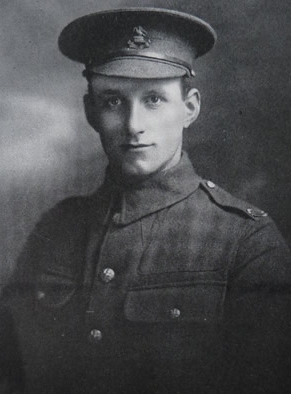
- Age: 28
- From: Stoke on Trent
- Regiment: The King's (Liverpool Regiment) 17th Btn
- K.I.A Sunday 30th July 1916
- Commemorated at: Thiepval Memorial
Panel Ref: P&F1D8B &8 C.
Wilfred Edward Udall was born in in the December quarter of 1887 in Stoke on Trent, the son of William Udall and his wife Maria (née Williams) who married on the 04th August 1885 at St. Aloysius' Roman Catholic Church, Ardwick. His father appears to have attended St. Mary’s College, Oscott, Warwickshire, a Roman Catholic seminary (age 20, student, on the 1881 census). He became a chemist and later a schoolteacher.
His parents had seven children. Agnes Walburga, born in 1886, and Wilfred were born in Stoke on Trent. The family then moved to Ardwick, Manchester, where Cuthbert Joseph 1889, and William Stanislaus 1890 (who died in infancy) were born, then to Burnley where Francis Stanislaus 1892 and Mary Winifred 1894 were born. Their youngest child, Phillip James, was born in 1899 in the Manchester area, after which the family moved to Liverpool.
In 1891 his mother, 37, with Agnes 4, Wilfred 3, and Cuthbert 2, is living with her sister Eliza Williams at 33 Green Street, Ardwick, Manchester. His father is found with his parents in Stoke on Trent. He is 30 years old, married, occupation chemist (in college).
By 1901 the family is in Liverpool, at 19 Helsby Road, Walton, with his five siblings. His father, 40, is a schoolteacher in chemistry, his mother is 47. Wilfred, 13, is a boarding student at Stonyhurst (Jesuit) College near Blackburn.
He was educated at St Francis Xavier and Stonyhurst College. Wilfred was an enthusiastic cricketer and he was secretary for several years at Stanley Cricket Club. He was a secretary to a firm of manufacturing Chemists in Liverpool before he enlisted.
The 1911 Census shows the family living at 46 Eastbourne St, Everton, Liverpool. His father, William, is aged 50, born 1861 occupation assistant master in a secondary school, whilst his mother Maria is aged 57, born 1854 with no occupation listed. They have been married for twenty seven years and have had seven children of which one died. Those living at home are declared as; Agnes Walburg aged 24, born 1887 occupation certified school mistress and Wilfred Edward aged 23, born 1888 a cashier for a pharmaceutical chemist were both born in Stoke on Trent, Mary Winifred aged 16, born 1895 in Burnley is at school and Phillip James aged 11, born 1900 in Manchester is also still at school.
His brother Cuthbert died not long after the 1911 census at the age of 22.
He enlisted at St George's Hall in Liverpool on the 02nd September 1914 joining the 17th Battalion as Private 15977. He gave his age as twenty six years and 333 days, occupation was a clerk and had lived for three years in North Africa. He was described as being five feet eight inches tall, weighed 150lbs, with a 39" chest, a fresh complexion, hazel coloured eyes and light brown hair. He stated his religion as Roman Catholic and named his father William, of 46 Eastbourne Street, Liverpool, as his next of kin.
He was billeted at Prescot Watch Factory from 14th September 1914, he trained there and also at Knowsley Hall. On 30th April 1915 the 17th Battalion alongside the other three Pals battalions left Liverpool via Prescot Station for further training at Belton Park, Grantham. They remained here until September 1915 when they reached Larkhill Camp on Salisbury Plain.
His mother died in November 1914, aged 51, and was buried on the 13th Nov 1914 at Yew Tree Roman Catholic Cemetery.
Wilfred's service papers show:
19.05.15: Appointed unpaid Lance-Corporal.
16.09.15: Appointed paid Lance-Corporal.
7.11.15: Embarked for France with his battalion.
18.06.16: Sick to Field Ambulance with Influenza.
21.06.16: Rejoined unit.
15.7.16: Appointed acting Sergeant to complete establishment.
Wilfred was killed in action on the 30th July 1916 aged 28 at the village of Guillemont, France, during the Somme Offensive.
17th Battalion Diary 30th July 1916
The Battalion was in support to 19 & 20 Battalions K.L.R. 2 Coys. behind 19th & 2 Coys. behind 20th. Very thick mist. The attack was pushed home to the objective in places but in the main was held up by machine gun fire from hidden machine guns.
Fighting continued all day swaying backwards and forwards until by 6pm about 300 yards in depth had been gained & consolidated all along our front.
Casualties in the 17th Battalion were 15 Officers and 281 Other Ranks
Further details are reported in more detailed by Everard Wyrall in his book The History of the King’s Regiment (Liverpool) 1914-1919 Volume II 1916-1917
The 17th King’s had advanced (two companies each behind the 19th and 20th Battalions) in small columns. They too suffered heavily from machine-gun fire and were quickly absorbed into the waves that preceded them. They also shared the gains and losses of that terrible day.
When darkness fell on the battlefield the 30th Division held a line from the railway on the eastern side of Trones Wood , southwards and including Arrow Head Copse, to east of Maltz Horn Farm. On this line the division was relieved by the 55th Division during the early hours of the 31st July.
The events of 30th July 1916 were regarded at the time as Liverpool’s blackest day. There follows an extract from The History of the 89th Brigade written by Brigadier General Ferdinand Stanley which gives an indication of the events of the day.
Guillemont
Well the hour to advance came, and of all bad luck in the world it was a thick fog; so thick that you couldn’t see more than about ten yards. It was next to impossible to delay the attack – it was much too big an operation- so forward they had to go. It will give some idea when I say that on one flank we had to go 1,750 yards over big rolling country. Everyone knows what it is like to cross enclosed country which you know really well in a fog and how easy it is to lose your way. Therefore, imagine these rolling hills, with no landmarks and absolutely unknown to anyone. Is it surprising that people lost their way and lost touch with those next to them? As a matter of fact, it was wonderful the way in which many men found their way right to the place we wanted to get to. But as a connected attack it was impossible.
The fog was intense it was practically impossible to keep direction and parties got split up. Owing to the heavy shelling all the Bosches had left their main trenches and were lying out in the open with snipers and machine guns in shell holes, so of course our fellows were the most easy prey.
It is so awfully sad now going about and finding so many splendid fellows gone.
His death was reported in the Liverpool Echo on 21st August 1916:
“A young man of such promise, in the person of Sergeant W. E. Udall, is among the “Pals” who have fallen. Sergeant Udall, whose age was 28, was one of the very first to join the “Pals” in the early days of the war. He was killed on the 30th ult., by shrapnel whilst leading his platoon into action, death being instantaneous. A comrade, writing to his relatives, said of him, “He was a most conscientious soldier and did everything he had to do well. He was a general favorite.” Sergeant Udall was the elder of the two surviving sons of Mr. William Udall of Prospect Vale, Fairfield, and an esteemed member of the professional staff of St. Francis Xavier’s College. He was educated at that college and at Stonyhurst. In civilian life Sergeant Udall was secretary for Messrs. Thompson and Capper, manufacturing chemists. A lover of cricket, he was for many years secretary of the Stanley Cricket Club. His younger brother is now serving in France with the Canadians.”
Wilfred's body was not recovered from the battlefield or was subsequently lost as he has no known grave and is commemorated on the Thiepval Memorial.
The Thiepval Memorial, the Memorial to the Missing of the Somme, bears the names of more than 72,000 officers and men of the United Kingdom and South African forces who died in the Somme sector before 20 March 1918 and have no known grave. Over 90% of those commemorated died between July and November 1916.
On 01st August 1932 the Prince of Wales and the President of France inaugurated the Thiepval Memorial in Picardy. The inscription reads: “Here are recorded the names of officers and men of the British Armies who fell on the Somme battlefields between July 1915 and March 1918 but to whom the fortune of war denied the known and honoured burial given to their comrades in death.”
There is some confusion regarding his brothers. His older brother Francis had emigrated to Canada in 1910. He enlisted as Gunner 85799, in the Canadian Expeditionary Force Field Artillery on 27th November 1914, served on the Western Front, and survived the war. By 1918 he was suffering serious mental issues and returned to Warrington with delusional insanity and invalided back to Canada on the 29th December 1918. He made a full recovery and died 1974.
His younger brother Phillip, born in 1899, evidently enlisted late in the war, served overseas with the 1/8th Lancashire Fusiliers, and was discharged on 11/11/1919 with a partial disability pension (trench feet).
Wilfred earned his three medals.
His Army pay and a War Gratuity of £11-10s went to his father. No pension card has been found, indicating that Wilfred lived independently, having been overseas for some time.
In 1919 Agnes, 32, and Mary, 24, were living at home with their father at 27 Prospect Vale; Phillip, 20, was in military camp in Ashton in Makerfield, and Francis, 26, was in Canada, address unknown.
His father died in 1929, aged 68.
He is also remembered on the following Memorials:
Stonyhurst College, Stonyhurst, Ribble Valley, Lancs
Liverpool’s Hall of Remembrance, Panel 35
St Francis Xavier College, Woolton, Liverpool
St Francis Xavier Church, Liverpool
And on the family gravestone in Yew Tree Cemetery, Liverpool -
Jesus give rest to the soul
of
ALSO WILFRED E. UDALL, 1ST LIVERPOOL PALS
KILLED IN ACTION IN FRANCE 30TH JULY, 1916
AGED 28 YEARS
We currently have no further information on Wilfred Edward Udall, If you have or know someone who may be able to add to the history of this soldier, please contact us.
Killed On This Day.
(108 Years this day)Sunday 16th June 1918.
Pte 57615 Fred William Preddy
23 years old
(105 Years this day)
Thursday 16th June 1921.
Captain Leonard George Duncan
43 years old