
1885 - 1916

CPL David Wallace Crawford
1887 - 1916

Lce-Corpl John Joseph Nickle
1894 - 1916

Pte 17911 Morton Neill
1897 - 1916

Lieut Edward Stanley Ashcroft
1883 - 1918

Pte 21930 James Walters Noel Unsworth
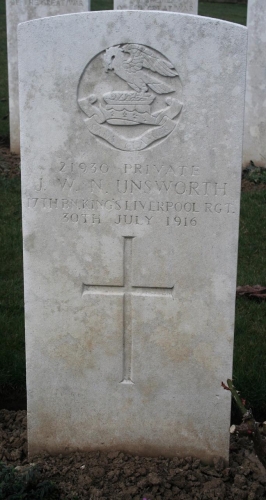
- Age: 20
- From: Liverpool
- Regiment: The King's (Liverpool Regiment) 17th Btn
- K.I.A Sunday 30th July 1916
- Commemorated at: Guillemont Rd Cem
Panel Ref: IV.M.9
James Walters Noel Unsworth was born on 26th December 1895 at Liverpool, the son of Arthur Unsworth and his wife Theresa Charlotte (nee Cross). Her father, Pierre Jean Baptiste Hippolite Auguste Cros, was a French merchant who married and settled in Liverpool. James was baptised on 16th February 1896 at St John the Divine, C. of E. Church, Fairfield, Liverpool, his parents’ residence given as 20 Prescot Drive, and his father’s occupation metal merchant. His birth was registered as James Walters, and he was baptised James Walters Noel. His parents married on the 06th December 1893 at St James' Church, West Derby. Arthur was a 33 year old merchant of 70 Moscow Drive, father James deceased , whilst Theresa was aged 25 of 29 Derby Lane, father Auguste Cros deceased. They had seven children, one of whom, Marjorie Sarah, born in 1899, died in infancy. James had an elder sister Dorothy Charlotte, and younger siblings Harold Auguste, Margery, Arthur, and Gwyneth Mary.
The 1901 Census shows the family living at 20, Prescot Drive, Liverpool. His father, Arthur, is aged 40, occupation employer commission foreign merchant and his mother, Theresa, is aged 32 with no occupation listed. They have four children living at home at the time of the Census; Dorothy aged 6,James W.N. aged 5, Harold aged 3, and Margery born 1901. Also at the address are Harriet Cross sister in law aged 42 and living by private means. They have three servants, Jane Dalveso a widow aged 47, born in Scotland 1854 and she is a domestic cook, Annie Jones aged 22, born 1879 a domestic nurse, born in Liverpool and Eleanor Gilligan aged 17, born 1884 a domestic housemaid, born in Pontefract, Yorkshire.
He enrolled in Abergele school in September 1907, his family’s address at the time Bedford Cottage, Water Street, Abergele. The record shows his previous school as Liverpool College, Fairfield. He passed his Junior Certificate in 1910, and his Senior Certificate in 1911, and the Oxford Senior Exams in 1912. On leaving school in the summer of 1914 he earned the London Inter B.Sc.
The 1911 Census shows the family living at Glanheulog , Sea Road, Abergele. His father, Arthur, is now aged 50, born in West Derby, Liverpool in 1861 occupation import and export general merchant, whilst his mother, Theresa, is aged 43, born in Walton, Liverpool in 1868 has no occupation listed. They have been married for seventeen years and have had seven children of which one died. Those children declared on the Census are; Dorothy aged 16, born 1895, Noel aged 15, Harold aged 13, born 1898, Margery aged 10, born 1901 are at school and Arthur aged 7, born 1904 were all born in West Derby, Liverpool, Gwyneth born 1911 in Abergele. Also at the address are Harriet Cross sister in law aged 53, born 1858 in Walton, Liverpool and living by private means. They have two servants both born in Abergele Jenny Jones aged 17, born 1894 a domestic cook and Mary Davies aged 18, born 1893 a domestic housemaid.
His mother died, aged 45, in early 1914. Her obituary was in the North Wales press on 23rd January 1914:
The wife of Councillor Arthur Unsworth, Garswood, Abergele.
She took ill walking home after work, luckily Arthur was able to see her before she died a few hours later.
Noel enlisted on the 11th November 1914 at Prescot, joining the 17th Battalion of The King's Liverpool Regiment as Private 21930. He gave his age as nineteen years and had no occupation as he had just left school. He was described as being five feet six and three quarter inches tall, weighed 140lbs, 36" chest with a fresh complexion, blue eyes and brown hair. He stated his religion as Church of England, and as next of kin, his father, at Garswood, Abergele.
The local press published the names of local men who were serving in the 1st Liverpool Pals on 19th November 1914: C.P. Jones, Metropole; Rowland Jones, Park Vilas; Noel Unsworth, Garswood; T. R. Mills, Marine Villas (Pte. 16038 Thomas Reginald Mills, suffered wounds to the face and jaw on 30th July 1916, and was discharged with a Silver War Badge on 15/04/18.)
He was billeted at Prescot Watch Factory, he trained there and also at Knowsley Hall. On 30th April 1915 the 17th Battalion alongside the other three Pals battalions left Liverpool via Prescot Station for further training at Belton Park, Grantham. They remained here until September 1915 when they reached Larkhill Camp on Salisbury Plain. He arrived in France on 07th November 1915.
He was killed in action on the 30th July 1916, aged 20, at the village of Guillemont, France, during the Somme Offensive.
17th Battalion Diary 30th July 1916
The Battalion was in support to 19 & 20 Battalions K.L.R. 2 Coys. behind 19th & 2 Coys. behind 20th. Very thick mist. The attack was pushed home to the objective in places but in the main was held up by machine gun fire from hidden machine guns.
Fighting continued all day swaying backwards and forwards until by 6pm about 300 yards in depth had been gained & consolidated all along our front.
Casualties in the 17th Battalion were 15 Officers and 281 Other Ranks
Further details are reported in more detailed by Everard Wyrall in his book The History of the King’s Regiment (Liverpool) 1914-1919 Volume II 1916-1917
The 17th King’s had advanced (two companies each behind the 19th and 20th Battalions) in small columns. They too suffered heavily from machine-gun fire and were quickly absorbed into the waves that preceded them. They also shared the gains and losses of that terrible day.
When darkness fell on the battlefield the 30th Division held a line from the railway on the eastern side of Trones Wood , southwards and including Arrow Head Copse, to east of Maltz Horn Farm. On this line the division was relieved by the 55th Division during the early hours of the 31st July.
The events of 30th July 1916 were regarded at the time as Liverpool’s blackest day. There follows an extract from The History of the 89th Brigade written by Brigadier General Ferdinand Stanley which gives an indication of the events of the day.
Guillemont
Well the hour to advance came, and of all bad luck in the world it was a thick fog; so thick that you couldn’t see more than about ten yards. It was next to impossible to delay the attack – it was much too big an operation- so forward they had to go. It will give some idea when I say that on one flank we had to go 1,750 yards over big rolling country. Everyone knows what it is like to cross enclosed country which you know really well in a fog and how easy it is to lose your way. Therefore, imagine these rolling hills, with no landmarks and absolutely unknown to anyone. Is it surprising that people lost their way and lost touch with those next to them? As a matter of fact, it was wonderful the way in which many men found their way right to the place we wanted to get to. But as a connected attack it was impossible.
The fog was intense it was practically impossible to keep direction and parties got split up. Owing to the heavy shelling all the Bosches had left their main trenches and were lying out in the open with snipers and machine guns in shell holes, so of course our fellows were the most easy prey.
It is so awfully sad now going about and finding so many splendid fellows gone.
He was initially declared Missing on 30th July 1916.
He was buried close to where he fell and after the war, when graves were concentrated, his body was removed and reinterred in Guillemont Road Cemetery. CWGC shows exhumation and reburial completed by December 1919.
Guillemont was an important point in the German defences at the beginning of the Battle of the Somme in July 1916. It was taken by the 2nd Royal Scots Fusiliers on 30 July but the battalion was obliged to fall back, and it was again entered for a short time by the 55th (West Lancashire) Division on 8 August. On 18 August, the village was reached by the 2nd Division, and on 3 September (in the Battle of Guillemont) it was captured and cleared by the 20th (Light) and part of the 16th (Irish) Divisions. It was lost in March 1918 during the German advance, but retaken on 29 August by the 18th and 38th (Welsh) Divisions.
The cemetery was begun by fighting units (mainly of the Guards Division) and field ambulances after the Battle of Guillemont, and was closed in March 1917, when it contained 121 burials. It was greatly increased after the Armistice when graves (almost all of July-September 1916) were brought in from the battlefields immediately surrounding the village and certain smaller cemeteries, including:-
HARDECOURT FRENCH MILITARY CEMETERY. The village of Hardecourt-au-Bois was captured by French troops on the 8th July 1916, and again by the 58th (London) and 12th (Eastern) Divisions on 28 August 1918. Five British Artillerymen were buried by their unit in the French Military Cemetery, in the middle of the village, in September 1916; and in 1918 the 12th Division buried in the same cemetery 14 men of the 9th Royal Fusiliers and two of the 7th Royal Sussex.
Guillemont Road Cemetery now contains 2,263 Commonwealth burials and commemorations of the First World War. 1,523 of the burials are unidentified but there are special memorials to eight casualties known or believed to be buried among them.
The cemetery was designed by Sir Herbert Baker.
The Abergele County School reported him still Missing a year later, on 26th July 1917.
His death was later assumed for official purposes, as Killed in Action or Died of Wounds on or shortly after 30th July 1916.
Noel was not the only Abergele casualty at Guillemont. The North Wales Weekly News reported on 17th August 1916:
“The sad news reached Mr. and Mrs. C.P. Jones, The Metropole, on Thursday that their only son, Private “Charlie” Jones, had been killed in action during the great advance in France. The deceased young man, who joined the “Pals” at Llandudno shortly after the outbreak of war, was a general favorite in Abergele and Colwyn Bay, where he was employed in Mr. R. E. Birch’s estate office. The news was conveyed to the family in a letter sent by his boon companion, Pte. Rolie Jones, in the following terms:-
‘It is with much regret that I write to tell you of what happened to poor Charlie on the morning of the 30th July. As far as I can gather from the men who were with Charlie at the time, he was missed when the fighting was at its height, and after making numerous enquiries I found out that he had been killed - instantaneously, I think… Noel Unsworth is also missing. It was a fearful shock to me and all his friends who were lucky enough to come out of it all. Fancy - in one night - one night of hell - two out of the four Abergele boys in this battalion snatched away.
‘The night before we went into action Noel, Charlie and I had a long talk about poor Eddie’s death, and we all shook hands saying that we would soon be home again. Up to that time the four of us have had the best of luck, going through it all from the beginning without a scratch… I feel ready to cry my heart out every minute. It was a devilish fight on that morning and it is wonderful to think that any of us got through alright. I cannot tell you how sorry I am for you all and for the Unsworth family.’”
Rolie Jones is likely Pte. 16048 Roland W. P. Jones, 17th Bn., from Carnarvonshire, who later lived in Abergele; he survived the war. Eddie is most likely Edward (Eddie) Williams of Abergele, he was serving in the 13th Battalion Royal Welsh Fusiliers when he was killed in action on 10th July 1916. He is commemorated on the Thiepval Memorial to the Missing of the Somme.
The Liverpool Echo of 17th August 1916 reported:
ABERGELE LOSSES
Private Noel Unsworth, the eldest son of Councillor Alfred Unsworth. [should be Arthur]
Whilst as late as 26th July 1917 the North Wales Weekly News reported Noel as Missing:
Missing: Noel Unsworth (Inter B.Sc)
Noel earned his three medals.
His Army effects and a War Gratuity of £7-10s went to his father. No pension card has been found, possibly because Noel had not been working, and/or because his father did not apply.
His father acknowledged receipt of Noel’s Identity Disc on 09th May 1918, trusting “that at a later period you will be able to give me some information as to where he is buried”.
On 05th August 1919 his father wrote to O/C Infantry Records from his business premises, Old Castle Buildings, Preesons Row, Liverpool, thanking him for his letter, “especially as regards the recovery of my son’s body. This is the first I have heard of it since the attack on July 31st [sic] 1916. I am writing to the Director, Graves Registration, on this point.”
His brother Harold enlisted in the 11th K.L.R. and served overseas, later being transferred to the Royal Dublin Fusiliers. He was commissioned 2nd Lieutenant in the Royal Garrison Artillery on 4th November 1918, one week before the war ended.
In August 1919 his five siblings were living at home with their father in Abergele.
His father, Arthur, and his siblings Arthur and Gwyneth are still living at Garswood in 1921.
His father’s company, established in 1884, as a forwarding agent and general merchant, went out of business in 1924. It is not known when he died. His partner, Harold Auguste Unsworth, then went out Mombasa in 1925, his address was 20 Canterbury Road, Rock Ferry on the ship’s manifest. Arthur is at this address until 1926, and probably died aged 76 in 1936 in Edmonton, Middlesex.
Noel is also remembered on the following Memorials:
Abergele War Memorial
Liverpool’s Hall of Remembrance, Panel 35 (as J.W.E. Unsworth)
We currently have no further information on James Walter Noel Unsworth, If you have or know someone who may be able to add to the history of this soldier, please contact us.
Killed On This Day.
(110 Years this day)Saturday 5th August 1916.
2nd Lieut Richard Norman Butcher
26 years old
(110 Years this day)
Saturday 5th August 1916.
Cpl 26558 Frederick Joseph Circuit
26 years old
(110 Years this day)
Saturday 5th August 1916.
Pte 16042 Albert Jones Holliday
20 years old
(110 Years this day)
Saturday 5th August 1916.
Pte 22845 Herbert John Smith
23 years old
(109 Years this day)
Sunday 5th August 1917.
Pte 57787 Henry Ferguson Garnham
19 years old
(109 Years this day)
Sunday 5th August 1917.
Pte 204777 George Johnston
27 years old
(109 Years this day)
Sunday 5th August 1917.
Pte 202865 Robert Swift
31 years old
(109 Years this day)
Sunday 5th August 1917.
Pte 50174 John Wilkinson
39 years old