
1885 - 1916

CPL David Wallace Crawford
1887 - 1916

Lce-Corpl John Joseph Nickle
1894 - 1916

Pte 17911 Morton Neill
1897 - 1916

Lieut Edward Stanley Ashcroft
1883 - 1918

Pte 49315 William Henry Walters
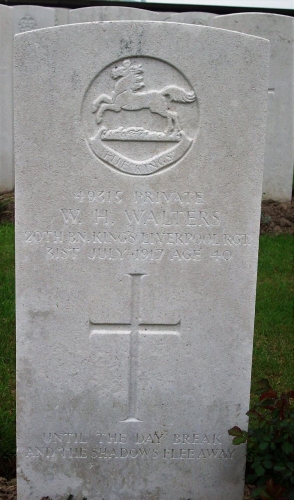
- Age: 40
- From: Bury
- Regiment: The King's (Liverpool Regiment) 20th Btn
- K.I.A Tuesday 31st July 1917
- Commemorated at: Bedford House Cem Encl 4
Panel Ref: XII.H.24
William Henry Walters was born in 1877 in Bury, resided in Chester and was the husband of C. V. E. Walters, of 19 Lime Grove, Hoole, Chester.
The 1901 Census shows William Henry is a boarder at 68, Handbridge, Overleigh Road, Chester and he is aged 23 and gives his occupation as a solicitor’s clerk.
He is boarding with the Thomas family and the head of the household is Elizabeth Thomas a widow aged 57, born 1844 in Broomfield Shropshire. She has three children living with her, Sarah aged 30, born 1871, Walter aged 25, born 1876 a booksellers assistant and Florence aged 22, born 1879 who were all born in Cheshire.
The 1911 Census shows Willaim and his wife living at 19 Lime Grove, Hoole, Chester. William Henry is aged 34, born 1877 occupation, law clerk who was born in Bury, Lancashire and his wife Violet is aged 29, born in St Asaph, Denbighshire in 1882 with no occupation listed. They have been married for less than a year.
He enlisted in Chester and was serving in the 20th Battalion, The King’s Liverpool Regiment as Private No 49315 when he was killed in action on the 31st July 1917 aged 40 during the Third Battle of Ypres,more commonly known as the Battle of Passchendaele..
20th Battalion
On that day, the 89th Brigade was to follow up the attacks of the 21st and 90th Brigades and once their objectives had been taken, to go through them and secure a line of strong points on the German third line. The 89th Brigade line of attack was from the South West corner of Polygon Wood, to the Menin Road. The 17th Battalion, The King’s Liverpool Regiment was on the left of the attack, and the 20th to the right, with the 19th Battalion and the 2nd Battalion The Bedfordshire Regiment, in Divisional Reserve.
On that day, the 89th Brigade was to follow up the attacks of the 21st and 90th Brigades and once their objectives had been taken, to go through them and secure a line of strong points on the German third line. The 89th Brigade line of attack was from the South West corner of Polygon Wood, to the Menin Road. The 17th Battalion, The King’s Liverpool Regiment was on the left of the attack, and the 20th to the right, with the 19th Battalion and the 2nd Battalion, The Bedfordshire Regiment, in Divisional Reserve.
The Battalion moved into assembly positions east of Maple Copse between 05.00 and 05.20am, they were heavily shelled and suffered many casualties. At 07.50 they began to advance with the 17th Battalion on the left, and the 20th on the right, the whole time under heavy shell fire. On reaching their position which was the Blue Line , troops of both the 21st and 90th Brigades were still pinned down and thus any attempt at further progress were futile.
At this point a message was sent to Brigade HQ advising that Companies were digging in on and consolidating a line running south from Stirling Castle.
The 20th Battalion was relieved on the night of 03rd – 04th August. During this time the Battalion lost one officer 2nd Lieutenant G.G. Nickel and 42 men killed or died of wounds with six officers and 149 men wounded.
Chester Chronicle dated 25th August 1917:
LANCE CORPORAL W.H. WALTERS (KILLED) “Lance-Corpl. Wm. Henry Walters, King’s Liverpool Regiment, has been killed in action. He was 40 years of age, lived at 19, Lime Grove, Hoole, and had been for over 20 years a clerk in the offices of Messrs. Potts, Potts and Gardener, solicitors, Chester. The news of his death has been received with great regret. He was highly esteemed by his employers and colleagues, and his manly qualities won him the warm regard of all who know him. He was eager to join the army soon after war broke out, but circumstances did not permit of his wish being gratified until June 1916, when he enlisted in the Liverpool Scottish. He went to the front in October of the same year and was attached, when out there, to another battalion. In the early part of January this year he was invalided home with trench feet, and was for a time at hospital in Oswestry. He was then sent down to Pembroke Dock and attached to another battalion. When again sent out to the front he was attached to still another battalion, this making four in all in which he had served. He fell on July 31st at a place not stated. A tall sturdy fellow, keen and smart in performing his duties, he made a first class soldier and would, had he been spared, undoubtedly have obtained further promotion, and probably the opportunity of taking a commission. Before enlisting he drilled with the Cheshire Volunteers for the purpose of obtaining a preliminary training. He was very well know in the city and was, when living in Handbridge before his marriage, a popular member of the Handbridge Institute. Deep sympathy is felt for his widow in her sad bereavement. There is no family. Messrs. Potts, Potts and Gardener have now lost three members of their staff in the war, the others being Second Lieut. Charles Potts (Cheshire Regiment) and Second Lieut. Burrell (Cheshire Regiment)
He now rests at Bedford House Cemetery Encl 4, Belgium, where his headstone bears the epitaph:
“UNTIL THE DAY BREAK AND THE SHADOWS FLEE AWAY”
Zillebeke village and most of the commune were in the hands of Commonwealth forces for the greater part of the First World War, but the number of cemeteries in the neighbourhood bears witness to the fierce fighting in the vicinity from 1914 to 1918.
Bedford House, sometimes known as Woodcote House, were the names given by the Army to the Chateau Rosendal, a country house in a small wooded park with moats. Although it never fell into German hands, the house and the trees were gradually destroyed by shell fire. It was used by field ambulances and as the headquarters of brigades and other fighting units, and charcoal pits were dug there from October 1917.
In time, the property became largely covered by small cemeteries; five enclosures existed at the date of the Armistice, but the graves from No.1 were then removed to White House Cemetery, St. Jean, and those from No.5 to Aeroplane Cemetery, Ypres.
ENCLOSURE No.2 was begun in December 1915, and used until October 1918. After the Armistice, 437 graves were added, all but four of which came from the Ecole de Bienfaisance and Asylum British Cemeteries, both at Ypres.
ENCLOSURE No.3, the smallest, was used from February 1915 to December 1916; the burials made in August-October 1915 were largely carried out by the 17th Division.
ENCLOSURE No.4, the largest, was used from June 1916 to February 1918, largely by the 47th (London) Division, and after the Armistice it was enlarged when 3,324 graves were brought in from other burial grounds and from the battlefields of the Ypres Salient. Almost two-thirds of the graves are unidentified.
ENCLOSURE No.6 was made in the 1930s from the graves that were continuing to be found on the battlefield of the Ypres Salient. This enclosure also contains Second World War burials, all of them soldiers of the British Expeditionary Force, who died in the defence of the Ypres-Comines canal and railway at the end of May 1940. The canal lies on high ground on the west side of the cemetery.
Commonwealth casualties buried in the following smaller cemeteries were either concentrated into Bedford House Cemetery after the war or if lost, are now commemorated in Bedford House Cemetery:-
ASYLUM BRITISH CEMETERY, YPRES, was established in the grounds of a psychiatric hospital (the Hospice du Sacre Coeur) a little West of the railway station, between the Poperinghe road and the railway. It was used by Field Ambulances and fighting units from February 1915, to November 1917, and it contained the graves of 265 soldiers from the United Kingdom, nine from Canada, seven from Australia and two of the British West Indies Regiment.
BOESINGHE FRENCH CEMETERY No.2, a little South of Bard Cottage, contained the grave of one soldier from Canada.
DROOGENBROODHOEK GERMAN CEMETERY, MOORSLEDE, contained the graves of two United Kingdom soldiers who fell in October 1914.
ECOLE DE BIENFAISANCE CEMETERY, YPRES, was on the North side of the Poperinghe road, immediately West of the railway, in the grounds of a school (later rebuilt). It was used by Field Ambulances in 1915-1917, and it contained the graves of 133 soldiers from the United Kingdom, three from Canada, three from Australia and one of the British West Indies Regiment.
KERKHOVE CHURCHYARD contained the graves of five United Kingdom soldiers, who fell in October and November 1918, and seven German.
POELCAPELLE GERMAN CEMETERY No.4, between Langemarck and the Poelcapelle-St. Julien road, contained the graves of 52 soldiers from the United Kingdom who fell in 1914 and 1916.
ZONNEBEKE BRITISH CEMETERIES No.1 and No.3 were on the South and North sides respectively of the Broodseinde-Zonnebeke road. Zonnebeke was occupied by the Germans on the 22 October 1914, retaken by the French on the following day, and evacuated at the beginning of May 1915; retaken by British troops on the 26 September 1917; evacuated again in April 1918; and retaken by Belgian troops on the 28th September, 1918. Four British Cemeteries were made by the Germans on the Broodseinde-Zonnebeke road; No.1 contained the graves of 31 United Kingdom soldiers (mainly 2nd East Surrey) who fell in April 1915, and No.3 those of 69 who fell in April, and May 1915.
In all, 5,139 Commonwealth servicemen of the First World War are buried or commemorated in the enclosures of Bedford House Cemetery. 3,011 of the burials are unidentified but special memorials commemorate a number of casualties known or believed to be buried among them. Other special memorials name casualties buried in other cemeteries whose graves could not be found on concentration. Second World War burials number 69 (3 of which are unidentified). There are 2 Germans buried here.
The cemetery was designed by W.C. Von Berg.
We currently have no further information on William Henry Walters, If you have or know someone who may be able to add to the history of this soldier, please contact us.
Killed On This Day.
(108 Years this day)Sunday 16th June 1918.
Pte 57615 Fred William Preddy
23 years old
(105 Years this day)
Thursday 16th June 1921.
Captain Leonard George Duncan
43 years old