
1885 - 1916

CPL David Wallace Crawford
1887 - 1916

Lce-Corpl John Joseph Nickle
1894 - 1916

Pte 17911 Morton Neill
1897 - 1916

Lieut Edward Stanley Ashcroft
1883 - 1918

Sgt 15627 George Ward (MM)
- Age: 28
- From: Pickering, Yorks
- Regiment: The King's (Liverpool Regiment) 17th Btn
- K.I.A Thursday 12th October 1916
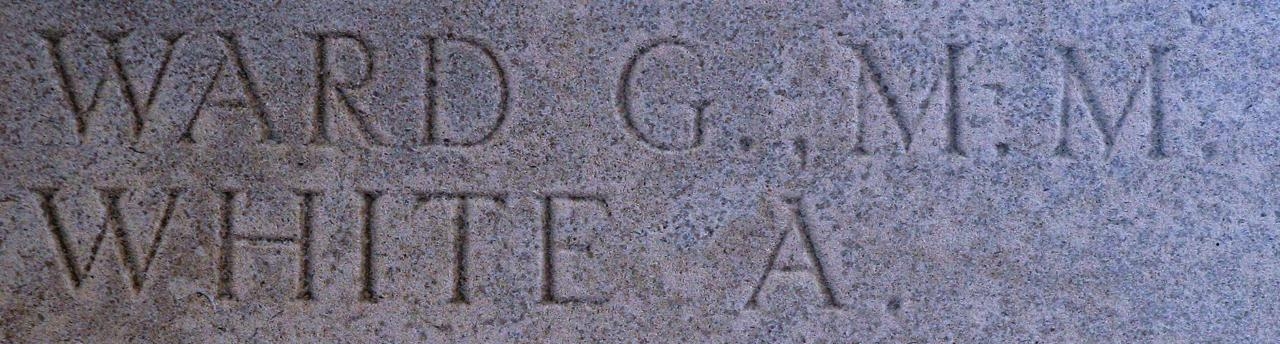
- Commemorated at: Thiepval Memorial
Panel Ref: P&F1D8B &8 C.
George Ward was born in 1888 in Pickering, (Ryedale District) Yorkshire and was the son of Richard Ward and his wife Anne Elizabeth(nee Cross). His father was born in Pickering, and his mother in Canada. (In 1871 Ann Elizabeth Cross, 17, born in Montreal, was living in Leeds, working as a draper’s assistant.) They married in about 1878 and had six children; birth records have been found for five; George had older siblings William, born in 1878, Alice 1880, and Mary 1883, and a younger sister Dorothy, born in 1893.
At the time of the 1891 census the family is living in Bridge Street, Pickering, with four children. His father, 48, is a relieving officer (a relieving officer handed out parish relief and/or arranged for admission to the workhouse). His mother is 38, and George is 3 years old.
The 1901 Census shows the family living at Bridge Street, Pickering. His father, Richard, is aged 56 born 1845 and his occupation is listed as a relieving officer, whilst his mother Annie E. is aged 47 born 1854 and is a dressmaker. They have three children living with them, all born in Pickering, daughter Alice, aged 20, born 1881 is a College Student, George aged 13 born 1888 and Dorothy aged 8 born 1893.
His father died in 1905, aged 61, having held the position of relieving officer with the Pickering Union for thirty-one years.
In 1911 George Ward, 23, born in Pickering, a corn merchant’s clerk, is boarding in Liverpool, with William Jones and family at 57 Mulgrave Street, Toxteth Park. His widowed mother is still in Pickering, at Bridge House, 8 Bridge Street, with two of his siblings and a domestic servant. His mother is 58, still working as a dressmaker, William, 32, like his father, is a relieving officer for the Board of Guardians, and Dorothy, 18, is a student teacher for the North Riding Council. (No.8 Bridge Street is now a Grade II listed building, described as “18th or early 19th century, two-storey in coursed stone in a picturesque location nestling on the banks of Pickering Beck”.)
He enlisted on 31st August 1914 at St George's Hall in Liverpool joining the 17th Battalion of The King’s Liverpool Regiment as Private 15627. He gave his age as 26 years and 210 days, and his occupation as clerk. He is described as being 5’ 9 and three-quarter inches tall, weighing 151 lbs, with a fresh complexion, hazel eyes, and brown hair. He gives his religion as Wesleyan, and as next of kin his mother, Elizabeth Ward, at Bridge House, Pickering.
He was billeted at Prescot Watch Factory from 14th September 1914, he trained there and also at Knowsley Hall. On 30th April 1915 the 17th Battalion alongside the other three Pals battalions left Liverpool via Prescot Station for further training at Belton Park, Grantham. They remained here until September 1915 when they reached Larkhill Camp on Salisbury Plain.
His service records show:
Promoted to the rank of Corporal on 26th October 1914
Appointed paid Lance Sergeant on 31st March 1915
Promoted to the rank of Sergeant 06th May 1915
George arrived in France on 07th November 1915 (his record appears to show embarking at Southampton).
His record shows qualification: machine gunner. From 31st December 1915 he attended a Vickers Gun course at St. Omer, and rejoined his unit on 18th January 1916.
He was granted leave to the U.K. from 21st to 30th May 1916.
On 12th June 1916 in the field he was reprimanded for not complying with an order.
He was awarded the Military Medal which is recorded in the Battalion War Diary on 17th July 1916, 15627 Sgt. Ward awarded M.M. for act of bravery in Trones Wood (the award was published in the London Gazette on 22/08/1916).
George was killed in action on the 12th October 1916, aged 28, during the Battle of the Transloy Ridges which was part of the ongoing Somme Offensive.
17th Bn War Diary: Battle of Transloy Ridge –
11-10-16 - Gird Trench/Gird Support – Battalion in front line and support trenches. British bombardment of enemy front line system commenced about midday. Hostile shelling was intermittent throughout the day.
12-10-16 - Our bombardment continued. Enemy reply weak. 2.5 p.m. Zero hour. Attack on German front line system commenced. Enemy wire was found to be uncut and attack was unsuccessful. Hostile machine gun fire was very heavy and caused many casualties. Battalion H.Q. and Support Trench were heavily shelled throughout afternoon and evening. […] During this action all communication had to be carried out by runners and carrier pigeons as all wires were being continually cut by enemy shelling.
Casualties: 5 officers killed, 5 officers wounded, 38 OR killed, about 225 OR wounded/missing etc.
Graham Maddocks, in “Liverpool Pals” p.140, adds:
“As the whistle blew, the 17th Battalion left its trenches to move forward. […] As soon as the attacking waves left their trenches the enemy artillery began to register on them, and at the same time, the defending infantry commenced a murderous rain of fire. […] Although their numbers had been depleted by the British bombardment, they were trained and experienced soldiers, well dug in on high ground, and for the most part, looking out on uncut wire. As such, it was virtually impossible for them to miss the City Battalion men struggling to advance in the mud towards them. The 17th Battalion, on the left, was particularly badly hit, as its portion of No Man’s Land contained a slight rise in the ground, and as the troops emerged onto it they were silhouetted against the sky and became easy targets. Those on the left of the attack, who managed to avoid the hail of bullets and make it to the German wire, then found that it was totally uncut, and thus trapped, they too became easy targets, to be picked off almost at the enemy’s will. It was hardly surprising that, seeing the first waves being wiped out, some of the following waves turned back and made for their start lines. These lines were now packed with other waves of troops, however, and the fleeing men added to the congestion already there, and became easy prey for the German gunners. There is some evidence also, to suggest that at this stage, the British trenches were also being hit by their own heavy artillery shells which were falling short.”
George has no known grave and is commemorated on the Thiepval Memorial, France.
The Thiepval Memorial, the Memorial to the Missing of the Somme, bears the names of more than 72,000 officers and men of the United Kingdom and South African forces who died in the Somme sector before 20 March 1918 and have no known grave. Over 90% of those commemorated died between July and November 1916.
On 01st August 1932 the Prince of Wales and the President of France inaugurated the Thiepval Memorial in Picardy. The inscription reads: “Here are recorded the names of officers and men of the British Armies who fell on the Somme battlefields between July 1915 and March 1918 but to whom the fortune of war denied the known and honoured burial given to their comrades in death.”
George earned his three campaign medals, which his mother signed for. (One medal roll shows middle initial W.)
From the pension card in the name of his mother it is not clear if a pension was awarded (George had been living away from home and likely had no dependents).
His mother received his Army pay and a War Gratuity of £12.
In May 1919 she provided information on George’s living relatives: His brother William, 41, was in France, Dorothy, 24, was living at home with her mother in Bridge Street, and his married sister Mary, 36, was in Johannesburg, South Africa. He also had relatives in Liverpool.
His mother died in 1922, aged 69.
George is also commemorated on the following Memorials:
St Peter & St Paul’s Church, Pickering, Yorkshire
Pickering War Memorial.
Liverpool Corn Trade Association Memorial
We currently have no further information on George Ward, If you have or know someone who may be able to add to the history of this soldier, please contact us.
Killed On This Day.
(108 Years this day)Sunday 16th June 1918.
Pte 57615 Fred William Preddy
23 years old
(105 Years this day)
Thursday 16th June 1921.
Captain Leonard George Duncan
43 years old