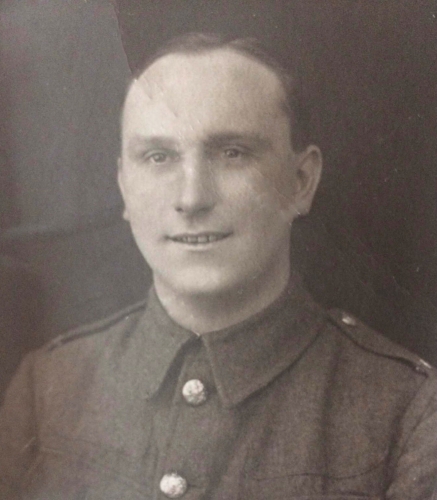
John Pearson Neal was born in Hugglescote, Leicestershire in the March quarter of 1883, the only child of John French Neal and his wife Clavender (née Pearson). His parents, both born in Leicestershire, married in 1882.
In 1891 the family is living at 61 Melbourne Road, Leicester, with a domestic servant. His father is a colliery agent, John is 8. His father started a brick manufacturing business at about this time and became very prosperous.
John enrolled at Leys School, Cambridge, at the age of 16 in 1898 and went into West House. He was a prefect, cadet colour sergeant, captain of both golf and rugby football, and won first colours in rugby and cricket and second colours in lacrosse. (Information from Leys School Roll of Honour.). John is one of 149 old boys who gave their lives in the war.
The 1901 census finds them at Bardon Hill House, Bardon Road, Bardon, Leicestershire, with a housekeeper and a domestic servant. (Bardon Hill House is a large property worth £1.3m today.) His father, 41, is a brick manufacturer, employer, his mother “Clavie” is 40, and John is 18, a secretary in his father’s business. Also in the household is a visitor, Lucy Watson, 20.
In 1902 John, as a former captain of the Leys School first XV, was encouraged to organise a rugby club in Coalville, a mining town in Leicestershire. The Coalville team flourished and won 18 of 24 matches in their first season. The club, like every other rugby club in the county, closed with the advent of the war and would not field a team again until 1926. (Coalvillerfc.com)
His father got into financial difficulties beginning in 1904 and bankruptcy proceedings were begun. By 1906 his parents are living in Arden Lodge, Harpenden, Hertfordshire, and his father is employed as a brick merchant’s traveller. The bankruptcy case made the newspapers in July and August 1906 and was adjourned until October. However, his father died in London in September 1906, aged 47 and is buried in Hampstead Cemetery.
John had married Mabel Amelia Bowles in 1904 in Leicester, and three sons were born in Bedford: Charles John, 12th September 1904; George Eric, 24th October 1905; and Hubert Roy, 22nd January 1908. John then moved the family to the Liverpool area, where Basil Edward was born on 23rd November 1910 in Waterloo. A fifth son, Allan Frank, was born on 30th March 1915.
By the time of the 1911 census the family was living at 8 Canning Street, Waterloo and had four sons; Charles John aged 6, George Eric aged 5, Hubert Roy aged 3 and a new baby Basil Edward. John is 28, employed as an accountant’s clerk.
In 1911 his widowed mother is a visitor at 101 Cricklewood Broadway, Willesden, London N.W. with relatives William and Agnes (née French) Williams. She is 51, living on her own means.
He enlisted, as part of the cotton contingent, at St George's Hall on 31st August 1914 joining the 17th Bn of the Kings Liverpool Regiment with the service number of 15251.
He was billeted at Prescot Watch Factory from 14th September 1914, he trained there and also at Knowsley Hall. On 30th April 1915 the 17th Battalion alongside the other three Pals battalions left Liverpool via Prescot Station for further training at Belton Park, Grantham. They remained here until September 1915 when they reached Larkhill Camp on Salisbury Plain. He arrived in France on 7th November 1915.
At some point he was transferred to the 13th Battalion of The Kings Liverpool Regiment.
John’s name, rank Acting Co. Sgt. Maj., appeared in the list of Liverpool’s Wounded published in the Liverpool Daily Post on 25th April 1918. He evidently recuperated from his wounds and returned to duty.
He was killed in action as Serjeant on 31st August 1918, aged 36. Details of the action in which John was killed was recorded in the Battalion Diary as follows:
August 30 – At night time the battalion moved up in preparation for an attack on Ecoust.
August 31 – the Battalion attacked and were successful in obtaining their objective as also did the 1st Gordon Highlanders on their Left. The Battalion on the Right flank, however, did not get their objective and this necessitated a withdrawal temporarily and subsequently the Battalion re-took the objective though suffering heavy casualties.
Estimated Casualties: 9 Officers, 200 Other Ranks.
John was one of those casualties. He now rests at Ecoust St Mein Cemetery and his headstone bears the epitaph:
"AND SO HE TROD THAT MORN TO GOD".
Ecoust-St. Mein was captured by the 8th and 9th Devons in a blizzard on the 02nd April 1917, lost on 21 March 1918, and retaken at the end of the following August by the 3rd Division. The British Cemetery was then made, in continuation of a German Extension (now removed) of the communal cemetery. The cemetery contains 151 burials of the First World War, eight of which are unidentified. The cemetery was designed by W H Cowlishaw.
Of the 143 identified casualties in this small cemetery 59 are K.L.R., all but 9 of whom are from the 13th battalion, lost in action on 31st August and 1st September in the successful attack on Ecoust.
John served over four years and earned his three medals (although his 1914-1915 Star medal roll has not been found).
His sons were 13, 12, 10, 7, and 3 years old when John was killed. His widow received John’s Army effects, including a War Gratuity of £22. Mabel, still at 8 Canning Street, Waterloo, was awarded a pension of £2-9s-5d a week from March 1919, increased in October to £3-6s-7d for herself and five children.
1939 his mother, 78, is living at 285 Belvoir Road, Coalville, with Agnes Pearson, 64 (relationship unknown), also widowed. Clavender died in 1941, aged 79.
His widow never remarried and in 1939 Mabel, 58, and son Allan are living at 5 Poplar Avenue, Norwich, where Allan, 24, is a pharmacist. Mabel appears to have returned to Liverpool and died in 1967, aged 86. Allan married, and died in Great Yarmouth in 1988, aged 73.
His son eldest son Charles emigrated to Canada in 1929 and died in Alberta in 1982, aged 78. George lived in Formby and died in 1994 aged 89. Basil married and lived in Blackburn, where he died in 1970, aged 59. Basil's son Hubert, a Second Officer in the Mercantile Marine, was captured by the Japanese in or near Java on 12th September 1942 and transported to Malaya. He survived three years as a POW, and was released on 2nd September 1945. He lived with his wife and family in Crosby, and died in 1973, aged 65.
John is commemorated on the following memorials -
Liverpool Cotton Association Memorial
Wyggeston & Queen Elizabeth College, Leicester
The Leys School, Cambridge.
We currently have no further information on John Pearson Neal, If you have or know someone who may be able to add to the history of this soldier, please contact us.