
1885 - 1916

CPL David Wallace Crawford
1887 - 1916

Lce-Corpl John Joseph Nickle
1894 - 1916

Pte 17911 Morton Neill
1897 - 1916

Lieut Edward Stanley Ashcroft
1883 - 1918

Lance Corporal 33351 Aubrey John Coldicott Upham
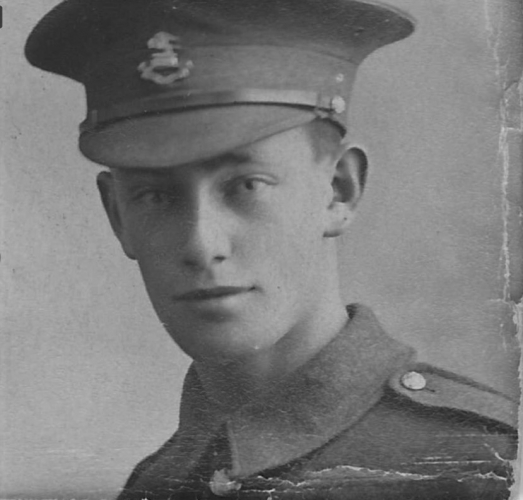
- Age: 22
- From: Toronto
- Regiment: 11 BORDER REGT
- Died on Tuesday 10th July 1917
- Commemorated at: Nieuport Memorial
Aubrey John Coldicott Upham was born in Toronto on 27th November 1894 to father John Upham, a provision dealer, and his wife Anna Maria (nee Coldicott) living at 131 Euclid Ave., Toronto.
His father Christopher John Upham, born in Torbay, Devon, and mother Anna Maria born in Worcestershire, married in St. George’s Church, Toronto in 1892. Annie had emigrated in 1891, and her father some time before that.
Aubrey was the second of four children, and the eldest son. His eldest sister Edith Gladys was born in Toronto; brother Alfred and youngest sister Doris were born in the Liverpool area. The family returned to England around 1895 and in 1901 they are living at 14 Quarry Road, West Derby. His father is a manager. His mother is not in the household. Edith Gladys is 7, Aubrey is 6, and Alfred is 5.
In 1911 they are at 1 Highfield Road, Stoneycroft. His mother, married, is head of household. His father, however, is not in the household. Aubrey is 16, an office boy for a metal merchant. His siblings Alfred, 15, and Doris, 12, are at school.
Given his service number, 22871, it is likely that he enlisted in November 1914. He was origianally posted to the 22nd Reserve Battalion of The King’s Liverpool Regiment as Private 22871, but he was then transferred to the 20th Battalion (KLR). Details from his medal roll indicate that he served with the 3rd K.L.R. before his transfer to the 11th Border Reg (the Lonsdales) with the service number 33351. It is entirely likely that Aubrey was wounded whilst serving with the 20th Battalion and had returned to the UK for treatment. It was usual for soldiers to be placed in the 3rd Battalion before returning to France. (The 3rd Bn was a training unit and remained in the UK throughout the war.)
In 1916 Aubrey sat for portrait photographs at Brown, Barnes, & Bell, Ltd., 31 Bold Street, Liverpool. He is still wearing his Pals Cap in the photograph. It is probable that he had the photograph taken following his recupperation.
He was with his new Battalion at the end of June 1917 when the Lonsdales were in dugouts in Nieuport, Belgium.
The battalion War Diary reads:
July 8th – Battalion moved into line to relieve 17th Highland Light Infantry. Night quiet.
July 9th – Day fairly quiet. The bombardment of our left commenced and lasted for about an hour. Our line signalled all O.K.
July 10th – A heavy bombardment of our sector commenced. The first and second lines were heavily strafed. Casualties last night 3 wounded. This morning 1 killed. Communication broken with both Companies in front line. Message from O.C. C Company holding first and second lines right half of Battalion front: “We have been continually strafed this morning with “Heavies”. […] The bombardment increased in intensity. All communications were broken. Message sent by 2 pigeons. Report by runner whether first and support lines are intact and whether supporting companies are all right. […] Casualties here. Heavy trench mortar bombardment of front line. Keep your visual open. The slightest sign of action on the part of enemy infantry send S.O.S. Enemy fire slackened and plane flew over very low apparently to examine extent of damage. This machine was engaged by our machine guns and Lewis guns. During this lull, a new kind of gas shell was used causing everyone to sneeze – it also affected the eyes and throat – and in some cases was followed by violent sickness. Bombardment increased to original intensity. Enemy barraging between third and second lines with heavies. The whole three lines are under a deadly barrage. Battle patrol must hold the front line whether demolished or not. Lull in bombardment. Enemy plane again flew over very low to reconnoitre. Gas shells used. Front line very badly smashed now. Right half completely wiped out. Second line very badly knocked about. Third line receiving particular attention and badly knocked about. Communication trenches – many blown in and always shelled. Casualties about 40. The shelling is very heavy throughout and continually on first, second and third lines and communication trenches. He has only about 15 men left out of the 2 platoons which went forward. There is very little shelter of any kind. The first and second lines are perfectly flattened. The other part very badly knocked about and untenable at present. Both Lewis Guns are out of action, useless. Impossible to reckon casualties yet. Lull in shelling. Gas shells being used again. Enemy plane flying low overhead. Shelling increased to original intensity. Your instructions are to hold on to the front line at all costs. Reinforcements are being sent up gradually. Shelling slackened considerably. Enemy reported as having gained a footing in the second line and part of third. Enemy patrols reported in left front line. Line must be established at once and every effort made to send patrols of fresh troops over to enemy line. Dig in and remain until further reinforcements. All lines to be held by small posts which must be dug in at once.”
It was during this action that Lance Corporal Aubrey Upham was killed, his body was not recovered and his name is recorded on the Nieuport Memorial in Belgium. He was 22 years of age.
The Nieuport Memorial commemorates 552 British officers and men who were killed in Allied operations on the Belgian coast during the First World War and have no known grave. Twenty of those commemorated served with the Royal Naval Division and were killed or mortally wounded during the siege of Antwerp in October 1914. Almost all of the remainder fell in heavy fighting in the region of Nieuport in the summer of 1917. The memorial is constructed of Euville limestone and stands eight metres high. It was designed by William Bryce Binnie, an Imperial War Graves Commission architect who served with The Black Watch during the war and was twice decorated for bravery. The lions standing at each point of the triangular platform were designed by Charles Sergeant Jagger, a celebrated British sculptor and decorated veteran of the Western Front. The memorial was officially unveiled by Sir George Macdonogh in July 1928.
British Operations on the Belgian Coast
The armies of the German Empire invaded Belgium on 4 August 1914. Within three weeks the fortified cities of Liege and Namur were in German hands and the Belgian forces had retreated to Antwerp, which was well defended and ringed by a series of forts. To begin with, the German First Army under General von Kluck bypassed the city and moved south-west toward the Franco-Belgian border. Yet on September 28, after weeks of heavy fighting in northern France, German artillery batteries began to shell the outer forts from the south-east. The accuracy of the German long-range guns had a devastating effect on the defences of the outer forts, and by the beginning of October the German infantry was slowly closing in on the city.
Fearing that the fall of Antwerp would expose the channel ports and leave Britain vulnerable to attack, the British deployed the newly formed Royal Naval Division to assist their Belgian allies in defending the city. The first British reinforcements, a brigade of Royal Marines, arrived at Antwerp on 4 October and relieved the 21st Belgian Regiment. On the following day the German forces crossed the river Nethe at Lier, 20 kilometres south of Antwerp. Two more British naval brigades arrived at Antwerp early on 6 October, yet while their arrival lifted the morale of the soldiers and civilians in the city, they could do little to alter the strategic position of the Belgian garrison, which was now critical. On the night of 6 October, the Belgian fortress troops under General Paris retired to the inner forts on the outskirts of the city, and over the course of the next day the German forces crossed the river Scheldt and began to shell the streets and houses of Antwerp. By 8 October, the Belgian Field Army had evacuated the city, which was now defended by mixed units of Belgian and British troops. The first German troops entered the city, following heavy shelling, on 9 October and the siege was at an end.
British units did not return to this sector of the Western Front until June 1917, when the 32nd Division relieved French troops stationed at Nieuport in preparation for planned Allied landings on German-held territory along the Belgian coast. German marines launched a pre-emptive attack against the British forces on the river Yser in July and the landings, codenamed ‘Operation Hush’, never took place. Over 260 men commemorated on the Nieuport Memorial were killed or mortally wounded during heavy fighting with units of the German Marine-Korps Flandern on July 10 1917.
His death was reported in the local Liverpool newspaper:
UPHAM - July 10 killed in action, Lance Corporal Aubrey Upham, Border Regiment, the dearly loved elder son of John and Annie Upham of 15 Cornice Road, Stoneycroft, Liverpool.
In Memorium notices were placed thereafter
UPHAM - In ever loving memory of our dear Aubrey, KLR., killed in action, Juy 10 1917. Lovingly remembered by all at 15 Cornice Road
UPHAM- In memory of AUBREY, killed in action July 10, 1917- Always remembered by Florence and Mr. and Mrs. Lynam.
Aubrey is commemorated on the following local Memorials:
Hall of Remembrance, Liverpool Town Hall, Panel 35 as 20th Battalion KLR
Lister Drive Primary school
St Pauls Church Stoneycroft.
His mother Annie, living at 15 Cornice Road, Stoneycroft, Liverpool, received a pension of 7 shillings a week for life. She and his two sisters emigrated from Liverpool to New York on 1st April 1920, giving their nearest relative as her brother Aubrey Coldicott, at 47 St. John’s Road, Bootle (it is not known when his father emigrated). His parents and sisters became American citizens. His brother Alfred remained in England. His parents celebrated their 50th wedding anniversary in 1942, by then living in West Virginia, USA. His father died there in 1949, and his mother in 1957.
We currently have no further information on Aubrey John Coldicott Upham, If you have or know someone who may be able to add to the history of this soldier, please contact us.
Killed On This Day.
(111 Years this day)Friday 6th August 1915.
2nd Lieutenant Thomas Leslie McGeorge
26 years old
(110 Years this day)
Sunday 6th August 1916.
Pte 34960 Joseph Furness
21 years old
(110 Years this day)
Sunday 6th August 1916.
Pte 36640 John Faultus Jones
29 years old
(110 Years this day)
Sunday 6th August 1916.
Pte 24664 Harry Lloyd
28 years old
(110 Years this day)
Sunday 6th August 1916.
Pte 26153 William Duncalf
41 years old